
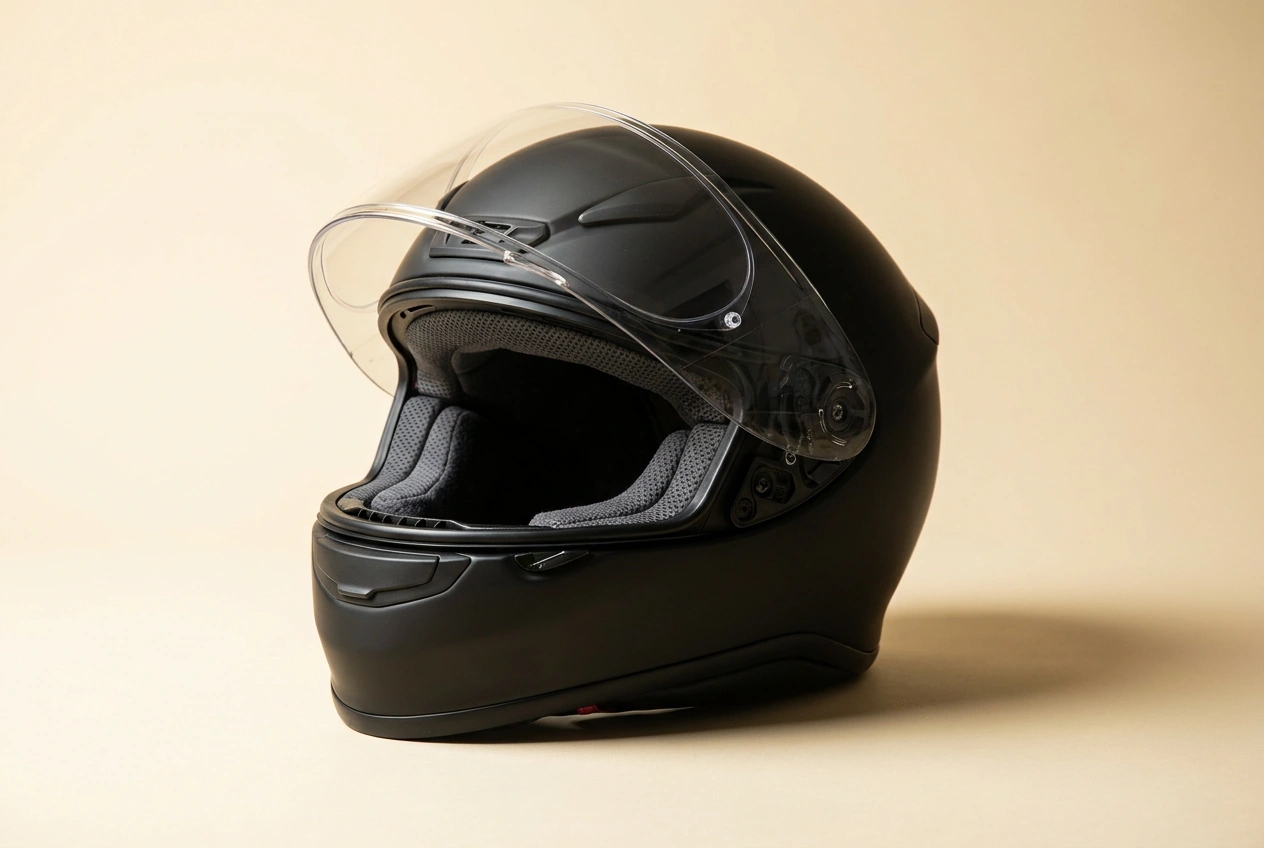
You cannot safely stretch a motorcycle helmet's EPS foam or shell, and attempting it risks ruining the protection. What you can do: allow a proper break-in period (15-20+ hours of wear compresses the liner roughly one size), swap to thinner cheek pads, or target specific hot spots with pad adjustments. A helmet that still hurts after break-in is the wrong fit, not a stretch project.
Here is the uncomfortable truth that most how-to guides skip: the word "stretch" is a bit of a misnomer. A new motorcycle helmet is supposed to feel snug. The comfort liner (the soft foam and fabric layer you actually feel) will compress over time and the helmet will settle around your head. That process is break-in, and it is real. What you cannot do is force-stretch the shell or the EPS safety liner, because both of those are structural components and wrecking them means the helmet fails when you actually need it.
Our research desk has mapped what is physically happening inside a snug helmet, where the safe adjustment margin actually lives, and which methods are myths (and genuinely dangerous ones at that). Read this before you reach for a bag of rice or a heat gun.
How the break-in process works (and why it is the real answer)
When a helmet is new, the comfort liner (the EPS-backed fabric padding pressed against your head) is at its thickest. Under the pressure of repeated wear, that foam compresses and conforms. Helmet manufacturers and long-term owners on forums like r/motorcycles consistently report that a new helmet can feel noticeably more comfortable after 15-20 hours of use, with some liners settling by the equivalent of roughly half a size over time.
That means a helmet that feels just-snug when you first put it on is working as intended. It should be evenly firm all around with no single painful point. If it is uniformly pressure on the crown, cheeks and sides with no sharp spots, wear it in short sessions and let it conform.
Swapping cheek pads: the most effective legitimate adjustment
Cheek pad thickness is the single most useful tuning lever inside a helmet. Most established brands (Shoei, Arai, Bell, AGV, Shark, HJC) sell optional cheek pads in multiple thicknesses: typically 3 mm, 5 mm or even 10 mm thinner than the stock pad. If your primary discomfort is cheek pressure, ordering one size thinner from the brand's accessory page is a clean, safe fix.
- Check the brand's official parts page or ask a dealer. Most brands list cheek pads as a service item.
- Go one step at a time. Drop 5 mm and ride with it for a session before deciding you need another 5 mm.
- Do not go so thin that the helmet begins to rotate on your head. Retention is the whole point.
- Crown and top-of-head pressure is usually not a cheek pad issue. See the pressure-spot table below.
Targeting a specific pressure hot spot
Even a helmet that fits well overall can create one uncomfortable contact point for riders with slightly irregular skull geometry. A few rider-level fixes exist before you consider returning the helmet.
- Wear in short sessions: 20-30 minutes at a time around the house or on easy rides, taking it off when pressure becomes uncomfortable, then back on. Repeated cycles accelerate the liner conforming to your head shape.
- Remove the liner and inspect: most modular and premium helmets have removable interior padding. Some allow you to swap individual crown sections. Check whether your helmet has a skull cap insert that can be removed for narrow-crown heads.
- Thin adhesive-backed foam: some helmet shops (and the vintage helmet community) carefully thin out a single pad section using craft foam, adding a thin relief layer over an aggressive pressure point. This is a minor pad adjustment, not a structural change. It only makes sense for a persistent single spot, not general tightness.
If the pain point is the forehead ridge or the temples, the more likely explanation is head shape mismatch rather than a sizing issue. Oval heads in round-oval helmets (and vice versa) create those specific pressure points. Our head shape fit finder maps which brands run round vs. intermediate oval vs. long oval so you can narrow down options before buying.
What not to do: methods that damage your helmet
Some methods circulate on forums and YouTube that we have to address plainly, because they are not just ineffective: they compromise the safety of the helmet.
- Heating the shell: motorcycle helmet shells are designed to be stable at ambient temperatures. Using a heat gun, oven, or leaving a helmet in a hot car to "soften" it for reshaping can partially delaminate the composite layers or relax the thermoplastic, reducing impact resistance in ways you cannot see.
- The bag-of-rice or ball method: stuffing a helmet with a bag of rice, an inflated ball, or any rigid object overnight to "stretch" it from the inside applies outward pressure against the EPS liner. The EPS is not designed to absorb slow outward pressure. It deforms permanently, and deformed EPS no longer crushes predictably in a crash.
- Forcing objects inside overnight: same problem as above. Any method that uses prolonged mechanical force against the interior foam is attacking the protective layer.
When tightness means the helmet is simply the wrong fit
A new helmet that causes real pain (not snugness, not pressure you can ride through, but actual pain on the forehead or temple bones after a 20-minute ride) is not a break-in issue. That is a sizing or head-shape mismatch, and the correct response is to return or exchange it.
Most retailers accept helmet returns within a window specifically because fit cannot be confirmed until you wear one. A few indicators that you are past the break-in scenario:
- Pain starts within 10-15 minutes on every ride, even after several sessions.
- The discomfort is specifically on the forehead ridge or temples. These are head-shape indicators, not liner-compression points.
- The liner shows no sign of beginning to conform after 10+ hours of wear.
For round heads, longer-oval or intermediate-oval helmets create exactly these temple pressure points. Our roundup of helmets for round heads covers the brands that run a genuinely round interior.
Pressure spot, likely cause, and safe fix
| Where it presses | Likely cause | Safe fix |
|---|---|---|
| Cheeks / jaw | Stock cheek pads are too thick for your face width | Order one size thinner cheek pads from the brand accessory range |
| Forehead ridge | Head shape mismatch: helmet is too round for a long-oval head | Try a brand that runs long-oval (Shoei, Schuberth) or intermediate-oval |
| Temples | Head shape mismatch: helmet is too oval for a round head | Try a rounder interior (Bell, HJC, Shark, many budget brands) |
| Crown / top of head | Helmet is a half-size too small; liner has not yet broken in | Allow 15-20 hours of wear; if still painful, size up |
| One specific spot | Slight irregular skull geometry or a seam in the liner | Short wear sessions to let liner conform; inspect liner for a ridge; thin pad relief as last resort |
| Everywhere simultaneously | Helmet is simply too small | Size up. Do not attempt to force fit |
DOT vs ECE vs Snell vs MIPS, how to pick the right lid in 60 seconds, and when to replace it. One page, no fluff.
Frequently Asked Questions
Can you stretch a motorcycle helmet to make it bigger?
You cannot safely stretch the EPS safety foam or the shell of a motorcycle helmet. What you can do is allow the comfort liner to break in over 15-20 hours of wear, and swap to thinner cheek pads if cheek pressure is the main issue. Attempts to force-stretch the interior with objects or heat damage the protective foam.
How long does a motorcycle helmet take to break in?
Most comfort liners begin to feel noticeably better after 10-15 hours of wear, and settle substantially by around 20-30 hours. Short sessions (20-30 minutes at a time rather than marathon rides) tend to speed the process by letting the foam compress and recover repeatedly.
Is it safe to use a bag of rice or a ball to stretch a helmet?
No. Placing a bag of rice, an inflated ball, or any rigid object inside a helmet overnight applies sustained outward pressure against the EPS foam, which can permanently deform it. Deformed EPS no longer crushes predictably in a crash. This method is widely discussed online and widely harmful.
Why does my helmet hurt my temples but not my cheeks?
Temple pressure is almost always a head shape mismatch rather than a fit issue you can solve by breaking the helmet in. A helmet that is too oval-shaped for a round head creates exactly that temple pressure pattern. The fix is a rounder interior shell from brands like Bell, HJC, or Shark, not breaking in the current helmet.
I put on my helmet and it fits fine, but it hurts after 20 minutes. What should I try?
Start by identifying where the pain is. Cheek pressure often responds to thinner replacement pads; crown pressure may resolve with break-in; forehead and temple pain usually indicates a head-shape mismatch. If the pain has not improved after 10-plus hours of wear and the location points to a structural pressure point, the helmet is likely the wrong shape for your head and should be exchanged.
