
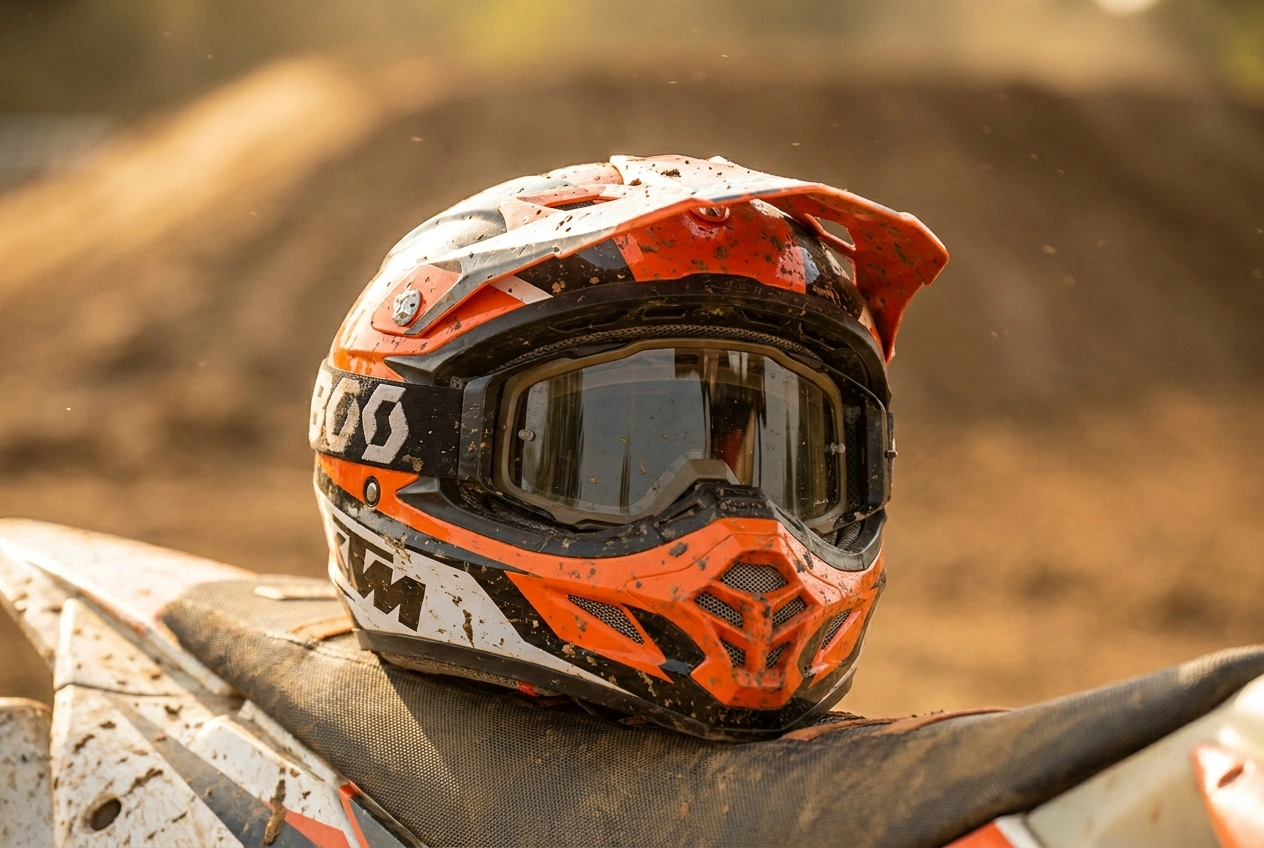
A goggle fits a helmet when its frame seats inside the eye port with even foam contact all the way around, the strap drops into the helmet's rear channel, and the top of the frame sits close to the brow with no large gap. There is no rule that brands must match. Test the exact goggle in the exact helmet and check gap, pressure points, peripheral vision, and strap seating before you ride.
You buy a sharp new lid, snap your goggles on, and there it is: a wedge of daylight between the top of the goggle frame and the helmet brow. The internet calls it the goggle gap, and it is the first thing every paddock critic notices. It also tends to be the first thing a rider blames on the wrong brand, which is usually not the real problem.
Goggles and helmets are designed by different companies that rarely coordinate, so the curve of a brow and the curve of a goggle's top edge do not always agree. When they fight each other, you get a gap, dust gets in, and tightening the strap only makes it worse. Here is what the gap actually tells you, how to fit a goggle to a specific eye port, and whether the brand badge on the frame matters at all.
The goggle gap, explained
The gap is the space between the top edge of the goggle frame and the lower edge of the helmet's brow or visor. A thin, even sliver is normal and harmless. A large or lopsided gap is a geometry mismatch: the helmet's eye-port shape and the goggle frame's size and curvature are not following the same line.
Two things drive it. First, frame curvature: some goggle frames run fairly flat across the top while others curve hard to wrap a face. If the helmet brow has a tight upward sweep and the goggle frame is flatter, they meet at an angle and the gap stays open no matter what you do. Second, the outriggers, the arms that hold the strap off the frame. Bigger outriggers push the goggle body away from the face and the brow, which can open a gap; lower-profile or strap-mounted designs let the frame tuck in closer.
The instinct is to crank the strap down to pull the frame up under the brow. That backfires. Most frames have flex built in so the foam compresses evenly against your face; over-tightening distorts that flex, squashes the foam vents shut, and trades a cosmetic gap for fogging and pressure points.
How to match goggles to your eye port
Eye-port size varies a lot between helmets. Larger ports swallow oversized or over-the-glasses (OTG) frames happily; smaller ports, more common on some MTB full-face shells, can leave a roomy frame perched too high or pinched at the edges. The only reliable test is the real pairing: put this goggle in this helmet, on your head, and look at it. A goggle that fits one rider's face in a given helmet can sit too high or low on another rider's face in the same lid, so fit is partly personal.
- Even frame contact. The foam should press lightly all the way around your face, with no gaps at the temples or bridge of the nose and no single hot spot.
- Top gap. Look from the side. A thin, even line under the brow is fine; a wide wedge or a one-sided gap means the curvature does not match.
- Strap in the channel. The strap should drop into the recessed channel on the back of the shell and lie flat, not bunch up or ride over the brim.
- Peripheral vision. With the helmet on, sweep your eyes left and right. The frame and eye-port edges should not crop your useful field of view.
- No pressure points. Wear the combo for a few minutes. Cheek pads should not shove the frame up, and outriggers should not dig into the port edges.
- Foam and vents. Triple-layer foam (wicking, cushion, structure) seals and manages sweat better than dual-layer; either way the foam should compress slightly against the face opening without choking the vents.
- Nose and tear-offs. If you run a nose guard, tear-offs, or a roll-off canister, check they clear the chin bar and port edges when fitted.
Do the brands have to match?
No. There is no strict rule that a goggle and helmet must wear the same badge, and plenty of riders mix brands with a clean fit. Most goggles are built to a fairly standard MX profile, so cross-brand pairings work more often than not.
That said, same-brand pairings sometimes seat better simply because the company tuned the eye port and the frame to the same shape, and a few makers (Fox and Alpinestars among them) publish guidance on which of their goggles align best with which helmet shells. Treat that as a shortcut, not a guarantee. Our reading of fitment notes and owner reports is consistent: the badge predicts fit far less reliably than the port-and-frame geometry does.
So skip brand loyalty as your filter and use the method instead. Test the goggle in the helmet, check the gap, the pressure points, the peripheral vision, and the strap channel, and judge that specific combination. We synthesize manufacturer fitment guidance and rider experience here rather than bench-testing every pairing, and the honest takeaway is that the only compatibility chart that counts is the one you confirm on your own head.
Goggle fit checklist
| Check | What good looks like | Red flag |
|---|---|---|
| Goggle gap | Thin, even line under the brow when viewed from the side | Wide wedge or one-sided gap that the strap cannot close |
| Strap channel | Strap drops into the rear shell channel and lies flat | Strap bunches, slides, or rides over the brim |
| Pressure points | Light, even foam contact all around the face | Hot spot at temple or nose, or cheek pads forcing the frame up |
| Peripheral vision | Frame and port edges stay outside your useful side view | Frame or eye-port edge crops your field of view |
| Nose / tear-offs | Nose guard, tear-offs, or roll-off clear the chin bar and port | Accessories foul the port edges or chin bar when fitted |
DOT vs ECE vs Snell vs MIPS, how to pick the right lid in 60 seconds, and when to replace it. One page, no fluff.
Frequently Asked Questions
Is a small gap between my goggles and helmet a problem?
A thin, even sliver under the brow is normal and harmless. A large or lopsided gap is the warning sign, because it means the goggle frame's curve and the helmet's eye port are not following the same line, which can let dust in and signals a poor shape match.
Do my goggles have to be the same brand as my helmet?
No. There is no rule that brands must match, and cross-brand pairings work for most riders. Same-brand combos sometimes seat better because the port and frame share a shape, but the geometry of the specific helmet and goggle predicts fit far more reliably than the badge does.
Why does tightening the strap not close the gap?
Most goggle frames have flex built in so the foam compresses evenly against your face. Cranking the strap distorts that flex and can squash the foam vents shut, which causes fogging and pressure points while leaving a geometry-based gap open.
Will over-the-glasses or oversized goggles fit any helmet?
Not always. Large OTG or oversized frames need a roomy eye port. Helmets with smaller ports, which are more common on some MTB full-face shells, can leave a big frame sitting too high or pinching at the edges, so test the exact pair before buying.
Is goggle fit different for an MTB full-face versus a motocross helmet?
The principles are the same: match frame size and curvature to the eye port, seat the strap in the channel, and check the gap. MTB ports are sometimes smaller, and some MTB goggles favor open or foamless vents for airflow, so a frame that fits a moto lid may sit differently in a trail full-face.
