
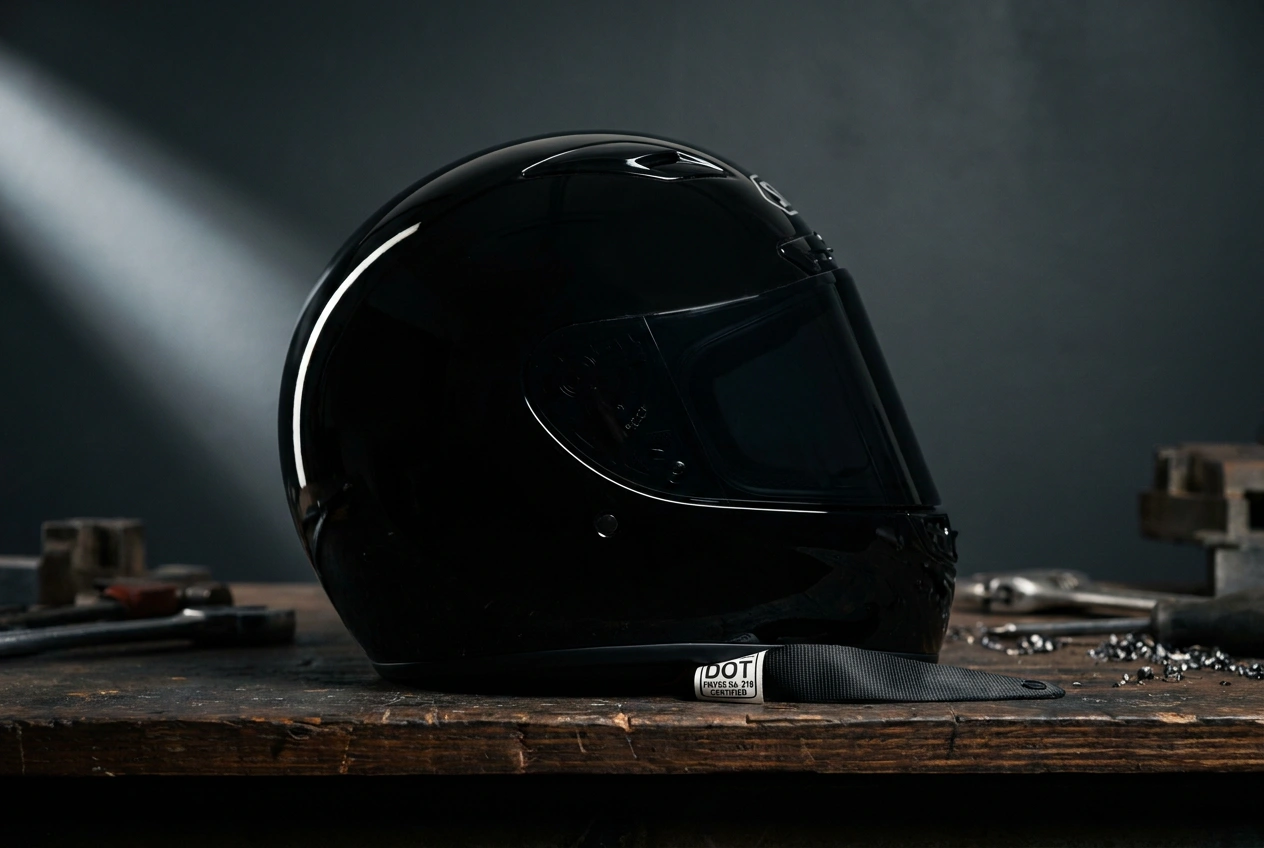
ECE 22.06 is the European motorcycle helmet standard that replaced ECE 22.05. Adopted in 2020 with production of new 22.05 helmets ending mid-2023, it is tougher in three big ways: it adds rotational (oblique) impact testing, hits far more points on the shell, and tests at multiple speeds. For a US rider it signals independent, lab-verified protection that goes beyond what DOT alone certifies.
Open a premium full-face sold in the US today and you will often find an ECE sticker alongside the DOT one, and increasingly that ECE label reads 22.06 rather than 22.05. The number jump looks minor. The testing behind it is not. ECE 22.06 is the first version of the standard to grade how a helmet handles the twisting forces that drive brain injury, and it raised the bar on almost every other test at the same time. We read the protocol so you can tell what that small sticker actually promises.
This matters even where the law never asks for it. A US rider can legally ride in a plain DOT helmet, and ECE is not required on American roads. But understanding what 22.06 added, and how it differs from the version it replaced, is the difference between treating a certification label as decoration and reading it as a test report.
What ECE 22.06 changed vs 22.05
ECE 22.05 was a respected standard for nearly two decades, but it tested a narrow slice of what a crash actually does to a helmet. It measured a handful of points on the shell at essentially one speed, and it never looked at rotational force at all. ECE 22.06 was adopted in 2020 and became the new baseline as production of fresh 22.05 helmets stopped around mid-2023, with remaining stock allowed to sell through the following year. It widened the test program substantially.
The headline addition is the rotational, or oblique, impact test. The helmet is dropped onto an anvil angled at roughly 45 degrees to generate the twisting motion that real crashes apply to the head and brain, a mechanism linked to serious brain injury. That test simply did not exist in 22.05. Sources broadly agree on the direction and scale of the other changes, though exact figures vary by helmet type and how the test program is counted.
- Rotational impact test added. An angled-anvil oblique test measures twisting forces on the brain, a first for the ECE standard. 22.05 had no equivalent.
- More impact points. Reports commonly cite a jump from around 6 tested points in 22.05 to up to roughly 18 in 22.06, including lower-edge zones the older test skipped.
- Multiple test speeds. Where 22.05 tested at essentially one speed, 22.06 tests across a low-energy and high-energy range to cover both light secondary knocks and harder hits.
- Visor and accessory testing. 22.06 brings visors, sun shields and fitted accessories into the test program rather than treating them as add-ons.
- Per-shell and per-size testing. The standard tightened how each shell and size combination must be verified, not just one representative sample.
ECE 22.06 vs DOT: the honest comparison
The cleanest way to understand ECE is to set it next to DOT, the US standard known formally as FMVSS 218. The two standards differ less in their numbers than in who does the testing and when. ECE certification is handled by an independent, government-appointed authority that batch-tests helmets before they can be sold in the ECE market. DOT runs on self-certification: the manufacturer tests its own helmet, declares it compliant, and applies the DOT sticker itself. No independent lab signs off before the helmet reaches the shelf.
NHTSA does buy random samples after the fact and send them to an outside lab, so DOT is not unchecked. But that is post-market enforcement, not pre-sale approval, and historically a meaningful share of sampled helmets have failed when independently tested. On top of that, FMVSS 218 contains no rotational impact test at all, the exact gap ECE 22.06 was written to close.
Should a US rider care?
For most street riders the practical answer is yes, with perspective. You are not legally required to wear an ECE helmet in the US, and a properly fitted DOT-certified helmet is legal everywhere you ride. ECE 22.06 is not a law you must obey; it is a quality signal you can choose to read.
Three things make it worth knowing. First, many premium helmets sold in the US now carry ECE 22.06 because manufacturers build to one tougher global spec rather than a softer regional one. Second, the FIM, motorsport's governing body, moved to a racing standard that mandates ECE 22.06 as the underlying homologation from 2026, which tells you where the top of the market considers the floor to be. Third, 22.06 is arguably the most rigorous mainstream street standard widely available, because it pairs independent batch testing with rotational energy measurement in a way no other common road standard does at scale.
The honest caveat: a certification is a floor, not a fit. A 22.06 helmet that does not fit your head shape protects you worse than a well-fitted helmet to an older standard. Read the sticker, then fit the helmet.
ECE 22.05 vs 22.06 vs DOT (FMVSS 218)
| Test / feature | ECE 22.05 | ECE 22.06 | DOT (FMVSS 218) |
|---|---|---|---|
| Rotational (oblique) test | No | Yes | No |
| Independent lab approval | Yes, before sale | Yes, before sale | No, self-certified (post-market spot checks) |
| Impact points tested | Around 6 | Up to about 18 (incl. lower edges) | One flat + one hemispherical site per sample |
| Test speeds | Essentially one speed | Multiple (low and high energy) | Single drop energy per site |
| Visor / accessory test | Limited | Yes, included in program | Not required |
DOT vs ECE vs Snell vs MIPS, how to pick the right lid in 60 seconds, and when to replace it. One page, no fluff.
Frequently Asked Questions
Is ECE 22.06 better than ECE 22.05?
By test program, yes. ECE 22.06 adds a rotational impact test that 22.05 never had, checks more points on the shell (commonly cited as up to about 18 versus around 6), tests at multiple speeds rather than one, and brings visors and accessories into the program. It is the same family of standard, made tougher. 22.05 helmets you already own remain legal to wear.
Can I still buy and ride an ECE 22.05 helmet in the US?
Yes. ECE is not required on US roads at all, and there is no US ban on wearing a 22.05 helmet. Production of new 22.05 helmets ended around mid-2023 and remaining European stock cleared over the following year, so most new helmets now carry 22.06. A well-fitted 22.05 helmet is still a legitimate helmet; 22.06 simply reflects a broader test.
Is ECE 22.06 legal for street riding in the United States?
Yes, and a helmet can carry both labels. US law requires DOT (FMVSS 218) compliance for street use, not ECE. Many ECE 22.06 helmets sold in the US are also DOT-certified, which makes them fully legal here. If a helmet is ECE-only, confirm it also meets DOT before treating it as street-legal in the US.
Does DOT test for rotational impact like ECE 22.06?
No. FMVSS 218, the DOT standard, has no rotational or oblique impact test. It measures direct linear impact at a flat and a hemispherical site, plus penetration and retention. Rotational energy, the twisting force tied to serious brain injury, is exactly the gap ECE 22.06 was written to address and DOT does not cover it.
Why do FIM racing rules matter to a street rider's helmet choice?
They signal where the top of the market sets the floor. From 2026 the FIM racing helmet standard requires ECE 22.06 as the underlying homologation before a helmet can even be considered for racing approval. You do not need a race helmet to commute, but seeing the industry treat 22.06 as the baseline for its most demanding use is a useful reference point when reading a street helmet's label.
