
Affiliate disclosure As an Amazon Associate we earn from qualifying purchases, at no extra cost to you.
An arc flash face shield is one component of a larger PPE system, not a standalone answer to an arc-flash hazard. NFPA 70E requires that PPE selection start with a site-specific incident-energy analysis (or, where permitted, the standard's PPE category tables) carried out by a qualified person, and the shield you end up wearing has to match or exceed the calculated incident energy in cal/cm² while paired with the rest of the required arc-rated clothing, balaclava or arc hood, gloves, and hard hat. This page does not make that determination for you.
What follows is listing-level data pulled directly from each product's Amazon page for eight face shields marketed to electricians, linemen, and industrial-electrical crews: the arc rating (ATPV) as the manufacturer prints it, the standard it's tested to where one is stated, the mount style, and construction details. Manufacturers cite different standards on different listings - some print an ATPV figure tied explicitly to ASTM F2178, others state conformity to ANSI/ISEA 125 without citing ASTM F2178 by name. Where a listing doesn't state a number or a standard, that gap is flagged rather than filled in. Cross-check the printed rating against the label on the physical shield and your own incident-energy analysis before it goes into service.
Key Takeaways
- Arc rating (ATPV) is a test result, not a safety guarantee - it states the incident energy in cal/cm² at which a fabric or shield has a 50% probability of transmitting enough heat to cause a second-degree burn under ASTM F2178 test conditions; it does not mean a wearer is protected above or below that number in a real event.
- Your incident-energy analysis picks the number, not this list - NFPA 70E requires a qualified person to determine the required arc rating (via calculation or the standard's PPE category tables) before any shield is selected for a task.
- Manufacturers cite different standards on different listings - some print an ATPV per ASTM F2178, others state ANSI/ISEA 125 Level 2 conformity without an ASTM F2178 citation; treat these as separately sourced numbers, not directly interchangeable ratings.
- A face shield is one layer of a PPE system - NFPA 70E PPE categories specify the shield in combination with arc-rated clothing and, at higher categories, a balaclava or arc-rated hood; a shield rated above your incident energy does not substitute for the rest of the required layers.
- Mount style has to match your existing hard hat or headgear - full-brim and cap-style hard-hat attachments, ratchet headgear, and shield-plus-hard-cap kits are not interchangeable hardware.
| Klein Tools 03600 Arc Flash Face Shield |  |
Highest Stated ATPV (Full-Brim Mount) | Arc Rating: Rated to 21 cal/cm2 (ATPV) per ASTM F2178 | Standard: ASTM F2178-23; NFPA 70E PPE Category 2 (per listing) | Origin: Made in USA (per listing) | VIEW LATEST PRICE | Read Our Analysis |
| Oberon Arc Flash Face Shield - 30 Cal - Hard Cap and Adapter Options - TCG Series |  |
Highest Cal Rating in This Roundup (Cap-Style Kit) | Arc Rating: Arc rating of 30 cal/cm2 (per listing) | Standard: ANSI/ISEA 125 Level 2 conformity; Arc Flash PPE Category 2 (per listing); ASTM F2178 not cited on this listing | Origin: Made in USA (per listing) | VIEW LATEST PRICE | Read Our Analysis |
| Klein Tools 03601 Arc Flash Face Shield | 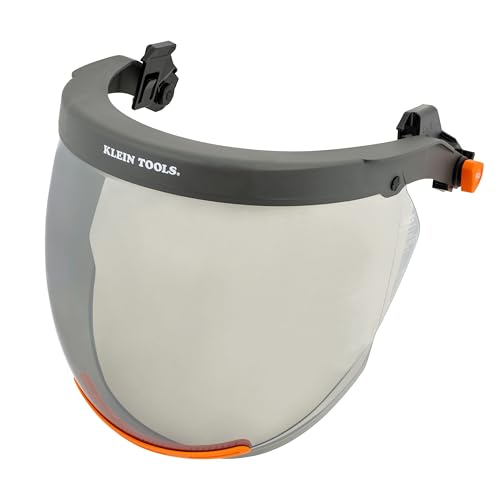 |
Best Cap-Style Hard Hat Attachment | Arc Rating: Rated to 22 cal/cm2 (ATPV) on cap-style hard hats / 15 cal/cm2 (ATPV) on safety helmets, per ASTM F2178 | Standard: ASTM F2178-23; NFPA 70E PPE Category 2 (per listing) | Origin: Made in USA (per listing) | VIEW LATEST PRICE | Read Our Analysis |
| Oberon Arc Flash Face Shield & Canadian Hard Cap - 12 Cal |  |
Standard 12-Cal Kit with Hard Cap | Arc Rating: Arc rating of 12 cal/cm2 (per listing) | Standard: ANSI/ISEA 125 Level 2 conformity; Arc Flash PPE Category 2 (per listing); ASTM F2178 not cited on this listing | Origin: Made in USA (per listing) | VIEW LATEST PRICE | Read Our Analysis |
| Oberon Arc Flash Face Shield Kit - Hard Cap, Face Shield, Balaclava |  |
Kit with Balaclava Included | Arc Rating: Arc rating of 12 cal/cm2 (per listing) | Standard: ANSI/ISEA 125 Level 2 conformity; Arc Flash PPE Category 2 (per listing); ASTM F2178 not cited on this listing | Origin: Made in USA (per listing) | VIEW LATEST PRICE | Read Our Analysis |
| Delta Plus/Elvex FS-20ARC10 Arc Flash Face Shield |  |
Universal-Fit Wraparound Shield | Arc Rating: Rated to 12 cal/cm2 (ATPV) per ASTM 2178-08 | Standard: ASTM 2178-08 (per listing); ANSI Z87.1-2003 | Color/Tint: Light green tint, clear | VIEW LATEST PRICE | Read Our Analysis |
| Sellstrom Full Face Shield Mask with Hard Hat |  |
Hard-Hat-Integrated Shield | Arc Rating: Listing text states 9.9 cal/cm2 (see note) | Standard: ANSI Z87.1 (per listing); ASTM F2178 and NFPA 70E category not cited on this listing | Weight: Not specified by manufacturer on this listing | VIEW LATEST PRICE | Read Our Analysis |
| Sellstrom Arc Flash Rated Dual Crown Safety Face Shield |  |
Ratchet-Headgear Mount | Arc Rating: Listing text states 9.9 cal/cm2, described as "Light" (see note) | Standard: Not stated on this listing; ASTM F2178 and NFPA 70E category not cited | Package Dimensions: 10.0 in L x 8.5 in W x 14.0 in H (per listing) | VIEW LATEST PRICE | Read Our Analysis |
More Details on Our Top Picks
Klein Tools 03600 Arc Flash Face Shield
Klein Tools states this shield's arc rating directly: 21 cal/cm2 (ATPV) per ASTM F2178-23, cited on the listing as corresponding to NFPA 70E PPE Category 2. That's the highest stated ATPV among the full-brim, hard-hat-integrated shields in this roundup, and the listing ties the number to a named test method rather than leaving it as a bare figure.
The shield mounts to a full-brim hard hat as a single integrated unit rather than clipping onto separate headgear, which simplifies the setup for crews standardizing on one hard-hat style across a site. Klein also lists ANSI Z87.1+S (2020) high-impact compliance for the lens itself, a separate rating from the arc rating that covers flying-debris impact resistance.
A toric (curved) lens profile with integrated venting and a chin guard are called out on the listing; the vented design is aimed at reducing fogging and heat buildup during extended wear, though the listing does not quantify airflow or provide a duty-cycle rating.
Whether 21 cal/cm2 is the right ATPV for a given task depends entirely on the incident-energy figure calculated for that task or equipment, not on this shield being the highest-rated option here. Confirm the printed rating against the label on the physical unit and against your site's arc-flash study before assigning it to a job.
- Arc Rating:Rated to 21 cal/cm2 (ATPV) per ASTM F2178
- Standard:ASTM F2178-23; NFPA 70E PPE Category 2 (per listing)
- Mount:Full-brim hard hat, integrated shield
- Impact Rating:ANSI Z87.1+S (2020) high-impact
- Lens Style:Low-profile toric lens with integrated venting
- Chin Protection:Integrated chin guard
- Weight:Not specified by manufacturer on this listing
- Origin:Made in USA (per listing)
Oberon Arc Flash Face Shield - 30 Cal - Hard Cap and Adapter Options - TCG Series
Oberon's listing states an arc rating of 30 cal/cm2 for this kit, the highest cal figure among the eight shields sourced for this roundup. The listing describes the coverage as suitable where a minimum of 30 calories of protection is specified, framed for utility, manufacturing, construction, and maintenance electrical work.
The listing cites ANSI/ISEA 125 Level 2 conformity and Arc Flash PPE Category 2, but it does not name ASTM F2178 as the test method behind the 30 cal/cm2 figure the way some of the Klein and Delta Plus listings in this roundup do. That's a gap in the listing text, not necessarily in the underlying product, but it's worth confirming against Oberon's own documentation or the label on the shield before relying on the number.
The shield and hard cap ship as a kit, and Oberon's True Color Grey polycarbonate window is built for minimal color distortion with anti-scratch and anti-fog coatings, which matters for reading meters, labels, and indicator lights through the lens during a task.
A 30 cal/cm2-rated shield is not automatically the right choice just because it's the highest number in this list. NFPA 70E ties the required arc rating to the incident energy calculated (or category-tabled) for the specific task, and over-rating a shield doesn't correct for gaps elsewhere in the PPE system, such as an unrated balaclava or mismatched clothing layer.
- Arc Rating:Arc rating of 30 cal/cm2 (per listing)
- Standard:ANSI/ISEA 125 Level 2 conformity; Arc Flash PPE Category 2 (per listing); ASTM F2178 not cited on this listing
- Mount:Hard cap included as part of the kit
- Shield Material:Polycarbonate, True Color Grey coating
- Coating:Anti-scratch and anti-fog coating
- Coverage:Minimum 30 calories where PPE is required (per listing)
- Weight:Not specified by manufacturer on this listing
- Origin:Made in USA (per listing)
Klein Tools 03601 Arc Flash Face Shield
Klein states two separate ATPV figures for this shield depending on what it's mounted to: 22 cal/cm2 on a cap-style hard hat and 15 cal/cm2 on a safety helmet, both per ASTM F2178-23 and both cited on the listing as corresponding to NFPA 70E PPE Category 2. That split rating is a detail worth reading carefully - the number that applies depends on the headgear you actually pair it with, not just the shield alone.
The cap-style attachment is a different mount than the full-brim version Klein also sells (the 03600, also in this roundup); cap-style hard hats sit closer to the head and are common where crews need to move through tighter clearances or wear the hard hat with other headgear underneath.
A counterbalancing frame is called out on the listing as designed to distribute weight evenly, which is relevant for shields worn for extended stretches during switching, testing, or troubleshooting tasks. The same toric lens, integrated venting, and chin protection shown on the 03600 carry over to this cap-style version.
Because the ATPV changes with the mounting hard hat, confirm which headgear combination applies to your task before treating either the 22 or the 15 cal/cm2 figure as the operative number, and verify that combination against your site's incident-energy analysis rather than assuming the higher figure always applies.
- Arc Rating:Rated to 22 cal/cm2 (ATPV) on cap-style hard hats / 15 cal/cm2 (ATPV) on safety helmets, per ASTM F2178
- Standard:ASTM F2178-23; NFPA 70E PPE Category 2 (per listing)
- Mount:Cap-style hard hat attachment
- Impact Rating:ANSI Z87.1+S (2020) high-impact
- Lens Style:Low-profile toric lens with integrated venting
- Frame:Counterbalancing frame for weight distribution (per manufacturer)
- Weight:Not specified by manufacturer on this listing
- Origin:Made in USA (per listing)
Oberon Arc Flash Face Shield & Canadian Hard Cap - 12 Cal
This Oberon kit pairs a 12 Cal TCG face shield with a Canadian-style hard cap, and the listing states an arc rating of 12 cal/cm2 tied to ANSI/ISEA 125 Level 2 conformity and Arc Flash PPE Category 2. Notably, the listing's coverage language states the kit covers a minimum of 17 calories where PPE is required, a figure that sits alongside, but isn't identical to, the stated 12 cal/cm2 arc rating - both numbers are printed as-is on the listing, and the discrepancy is worth clarifying with Oberon directly before relying on either one.
As with the other Oberon listings in this roundup, ASTM F2178 is not named as the test method behind the arc rating; the standard cited is ANSI/ISEA 125. That's a different citation path than the Klein and Delta Plus shields here, which state ASTM F2178 explicitly.
The Canadian hard cap style differs from the standard North American hard hat profile and is specified for markets and job sites where that cap style is standard issue; confirm compatibility with your site's headgear requirements before ordering.
The same True Color Grey polycarbonate window construction used across Oberon's line appears here, with anti-scratch and anti-fog coatings. Whether a 12 cal/cm2-rated kit is adequate for a given task is a determination for your site's incident-energy analysis or qualified person, not a default based on this being a mid-range figure in the lineup.
- Arc Rating:Arc rating of 12 cal/cm2 (per listing)
- Standard:ANSI/ISEA 125 Level 2 conformity; Arc Flash PPE Category 2 (per listing); ASTM F2178 not cited on this listing
- Mount:Canadian hard cap included as part of the kit
- Shield Material:Polycarbonate, True Color Grey coating
- Coating:Anti-scratch and anti-fog coating
- Coverage:Minimum 17 calories where PPE is required (per listing)
- Weight:Not specified by manufacturer on this listing
- Origin:Made in USA (per listing)
Oberon Arc Flash Face Shield Kit - Hard Cap, Face Shield, Balaclava
This Oberon kit bundles the 12 Cal TCG face shield and hard cap with a balaclava and a storage bag, which is the only shield in this roundup that ships with a balaclava included rather than sold separately. NFPA 70E PPE categories that call for a balaclava do so as a distinct requirement from the face shield itself, so a bundled kit like this removes one sourcing step rather than changing what the standard requires.
The stated arc rating is 12 cal/cm2, tied to ANSI/ISEA 125 Level 2 conformity and Arc Flash PPE Category 2 on the listing. As with Oberon's other kits here, the listing does not cite ASTM F2178 as the test method behind that figure.
Bundling the balaclava with the shield and hard cap can simplify kitting out a crew for tasks that fall into a PPE category requiring both pieces, provided the balaclava's own arc rating (stated separately from the shield's, where Oberon provides it) also meets or exceeds the task's incident energy - a detail to confirm on the balaclava's own specification rather than assuming it matches the shield.
As with every kit in this roundup, the 12 cal/cm2 rating and the ANSI/ISEA 125 conformity language are starting points for verification, not a substitute for the incident-energy analysis and PPE-category determination your site's qualified person or safety officer is responsible for.
- Arc Rating:Arc rating of 12 cal/cm2 (per listing)
- Standard:ANSI/ISEA 125 Level 2 conformity; Arc Flash PPE Category 2 (per listing); ASTM F2178 not cited on this listing
- Mount:Hard cap included as part of the kit
- Kit Contents:Face shield, hard cap, balaclava, storage bag (per listing)
- Shield Material:Polycarbonate, True Color Grey coating
- Coating:Anti-scratch and anti-fog coating
- Weight:Not specified by manufacturer on this listing
- Origin:Made in USA (per listing)
Delta Plus/Elvex FS-20ARC10 Arc Flash Face Shield
Delta Plus (sold under the Elvex FS-20ARC10 model designation on this listing) states an arc rating (ATPV) of 12 cal/cm2 tested per ASTM 2178-08, one of the two shields in this roundup, alongside the Klein pair, that ties its arc figure to a named ASTM test method rather than a general conformity statement.
The shield is a cylindrical, wraparound molded-polycarbonate design with an integrated chin protector, built for Risk Category 2 applications per the listing. The wraparound shape is intended to extend lateral coverage compared to a flat visor, though the listing does not provide side-impact test data beyond the ANSI Z87.1-2003 citation.
This listing describes the shield as "one size fits most" but does not specify what mounting hardware, headgear, or hard-hat adapter it pairs with, which is a gap worth resolving with the seller or manufacturer before ordering if you need it compatible with a specific hard hat already in use on site.
The listing's heat-tolerance figure (up to 265 degrees F) and anti-fog treatment are manufacturer specifications for the lens material rather than an arc-flash performance claim; the 12 cal/cm2 ATPV under ASTM 2178-08 remains the relevant number for arc-flash task selection, and that selection is still governed by your site's incident-energy analysis.
- Arc Rating:Rated to 12 cal/cm2 (ATPV) per ASTM 2178-08
- Standard:ASTM 2178-08 (per listing); ANSI Z87.1-2003
- Mount:One size fits most; specific attachment hardware not specified on this listing
- Shield Material:Anti-fog molded polycarbonate (Lexan), cylindrical wraparound
- Chin Protection:Integrated chin protector
- Thickness:0.078 in (per listing)
- Heat Tolerance:Up to 265 degrees F (per listing)
- Color/Tint:Light green tint, clear
Sellstrom Full Face Shield Mask with Hard Hat
Sellstrom's listing title describes this as an "Arc Flash Rated Protective Mask," and the feature text states a 9.9 cal/cm2 figure for the molded polycarbonate window. That said, this listing's feature bullets are worded identically to another Sellstrom listing in this roundup (the Dual Crown model), which suggests shared marketing copy across a product family rather than two independently written spec sheets - a reason to confirm the 9.9 cal/cm2 figure against this specific SKU's label before relying on it.
The shield ships bundled with a hard hat as a single kit, and the listing cites ANSI Z87.1 general eye/face protection compliance. It does not cite ASTM F2178 or state an NFPA 70E PPE category the way the Klein and Delta Plus listings in this roundup do.
Sellstrom positions the shield broadly for construction, manufacturing, oil & gas, and metal work rather than exclusively for electrical arc-flash tasks, which is consistent with the listing's general safety-mask framing alongside its arc-flash claim.
Given the shared copy with another listing and the absence of a cited ASTM F2178 test method, this is one to verify directly against Sellstrom's own product documentation or the label on the physical shield before assigning it to any arc-flash task, rather than relying on the 9.9 cal/cm2 figure as printed here alone.
- Arc Rating:Listing text states 9.9 cal/cm2 (see note)
- Standard:ANSI Z87.1 (per listing); ASTM F2178 and NFPA 70E category not cited on this listing
- Mount:Hard hat included as part of the kit
- Shield Material:Molded polycarbonate window
- Package Dimensions:22.86 cm L x 25.4 cm W x 35.56 cm H (per listing)
- Application:Marketed for construction, manufacturing, oil & gas, metal work
- Weight:Not specified by manufacturer on this listing
Sellstrom Arc Flash Rated Dual Crown Safety Face Shield
This Sellstrom model (SKU S31200) pairs a light green-tinted polycarbonate shield rated at 9.9 cal/cm2 on the listing with ratchet headgear and a universal slotted adapter, so it mounts to hard hats that already have a compatible slot rather than shipping with its own dedicated hard hat.
The listing describes the rating as "Light 9.9 Cal" without citing ASTM F2178 or an NFPA 70E PPE category, and, as noted on the companion Sellstrom listing in this roundup, the feature copy overlaps closely with that other SKU. Treat 9.9 cal/cm2 as a starting point to verify against Sellstrom's documentation, not a confirmed ATPV under a named test standard.
The large polycarbonate crown-and-chin-guard combination is built for extra head and neck coverage beyond a flat visor, and the 55% light transmittance figure indicates a moderate tint rather than a heavily darkened lens, relevant for tasks that also require reading meters or fine work through the shield.
Ratchet headgear allows the shield to be adjusted without tools and swapped between hard hats that share the slotted adapter standard, which can be a practical fit for crews rotating shields across shared headgear, provided the resulting combination is still verified against the task's required incident energy.
- Arc Rating:Listing text states 9.9 cal/cm2, described as "Light" (see note)
- Standard:Not stated on this listing; ASTM F2178 and NFPA 70E category not cited
- Mount:Ratchet headgear with universal slotted hard-hat adapter
- Shield Material:Molded polycarbonate, light green tint
- Light Transmittance:55% (per listing)
- Crown/Chin Coverage:High-impact polycarbonate crown and chin guard combo
- Package Weight:1.6 lb (per listing)
- Package Dimensions:10.0 in L x 8.5 in W x 14.0 in H (per listing)
How to Choose an Arc Flash Face Shield
This guide explains the framework electrical workers use to select arc-flash PPE. It does not tell you which shield to buy for a specific task - that determination belongs to a qualified person or your site's safety officer, working from your facility's incident-energy analysis and NFPA 70E. What follows is meant to help you read a listing, a label, and an arc-flash risk assessment with more precision, not to replace any of them. For a broader look at how impact-rated helmet certifications (DOT, ECE, ANSI Z87.1, and similar) differ from the arc-rating system used on electrical PPE like the shields below, see our helmet certifications overview.
Start with Your Site's Incident-Energy Analysis, Not a Shield
NFPA 70E requires that PPE selection be based on the incident energy a worker could be exposed to during a specific task at a specific piece of equipment, expressed in calories per square centimeter (cal/cm²). That figure comes from either an incident-energy analysis (a calculation specific to the equipment, its fault current, and clearing time) performed by a qualified person, or, where the standard's conditions are met, the PPE category tables in NFPA 70E Table 130.7(C)(15)(a) and (b). Neither of those determinations happens by browsing a product listing. The shield you select has to have an arc rating that meets or exceeds the incident energy calculated or tabled for that specific task - working backward from a shield you already own, or from whichever product has the highest number on the page, is not how the standard's selection process works.
What Arc Rating (ATPV) Actually Measures
Arc Thermal Performance Value (ATPV), tested under ASTM F2178 for face shields and hoods (ASTM F1959 covers arc-rated clothing fabric separately), is the incident energy at which a material has a 50% probability of transmitting enough thermal energy to cause the onset of a second-degree burn, under the specific test arc conditions defined by the standard. A higher ATPV number means the material withstood more incident energy in that controlled test before reaching that threshold - it is a laboratory test result, not a field guarantee, and it says nothing about performance in a real arc event that differs from the test's arc gap, working distance, or fault current. Some listings in this roundup print an ATPV figure explicitly tied to ASTM F2178 (for example, the Klein Tools and Delta Plus shields); others state a cal/cm² number tied to ANSI/ISEA 125 conformity levels without citing ASTM F2178 by name. Those are not automatically the same measurement, and a shield's printed number should be checked against the standard actually cited on that listing, and ideally against the label on the physical unit, before being treated as directly comparable to a shield rated under a different test method.
NFPA 70E PPE Categories
NFPA 70E organizes required PPE into categories tied to incident-energy ranges, with each category specifying not just a minimum arc rating but a combination of garments and accessories - arc-rated shirt and pants or coverall, face and eye protection, hand protection, and, at the higher categories, a balaclava or arc-rated hood in addition to a face shield. A face shield rated well above the calculated incident energy does not substitute for a missing or under-rated layer elsewhere in that combination; the categories are specified as a system, not a menu where one high-rated item offsets a gap somewhere else. If your task's PPE category calls for a balaclava alongside the shield, that balaclava needs its own arc rating verified separately, whether it's sold with the shield as a kit or sourced independently.
Face Shield vs. Balaclava/Hood: One Layer of Several
A face shield alone protects a portion of the face and eyes from an arc-flash event under its own tested rating; it is not equivalent to a full arc-rated hood, which typically wraps the head, neck, and often connects into the rest of the arc-flash suit. Where NFPA 70E's category tables or your incident-energy analysis call for a hood rather than a shield-plus-balaclava combination, a face shield by itself does not meet that requirement, regardless of its ATPV. Several of the kits in this roundup bundle a balaclava with the shield specifically to address that requirement in one purchase; shields sold without one need a separately verified balaclava or hood sourced to match.
Hard-Cap Mount, Cap-Style, Full-Brim, and Ratchet-Headgear Attachments
The shields in this roundup use several different mounting approaches: a full-brim hard hat with the shield integrated as one unit, a cap-style hard-hat attachment that sits closer to the head, a shield-and-hard-cap kit sold together, and ratchet headgear with a universal slotted adapter meant to fit hard hats a crew already owns. These are not interchangeable hardware, and in at least one case in this roundup (the Klein 03601), the manufacturer states two different ATPV figures depending on which hard-hat style the shield is mounted to - meaning the mount you actually use can change which rating applies. Confirm the mounting hardware matches your existing hard hat or headgear standard before ordering, and if a listing states a rating that varies by mount, use the figure that matches your actual configuration.
Reading and Cross-Checking a Listing's Arc Rating
Treat every arc rating on this page, and on any Amazon listing, as a starting point for verification rather than a final answer. Confirm the printed cal/cm² figure and cited standard against the physical label on the shield when it arrives, against the manufacturer's own technical documentation, and against your site's incident-energy analysis or the applicable NFPA 70E PPE category. Where a listing's copy is duplicated across multiple SKUs, as flagged on two of the Sellstrom listings above, or where a coverage figure and a stated arc rating don't obviously match, as flagged on one of the Oberon listings above, that's a reason to confirm directly with the manufacturer, not a reason to assume either number is wrong. Final PPE selection - the specific arc rating required, the category of PPE, and whether a given shield is appropriate for a given task - is a determination for a qualified person or your safety officer under NFPA 70E, not a conclusion this page can make for you.
Arc Flash Face Shields for Electrical Work (2026) Comparison
| Helmet | Arc Rating | Standard | Mount | Best For |
|---|---|---|---|---|
| Klein Tools 03600 Arc Flash Face Shield | Rated to 21 cal/cm2 (ATPV) per ASTM F2178 | ASTM F2178-23; NFPA 70E PPE Category 2 (per listing) | Full-brim hard hat, integrated shield | Highest Stated ATPV (Full-Brim Mount) |
| Oberon Arc Flash Face Shield - 30 Cal - Hard Cap and Adapter Options - TCG Series | Arc rating of 30 cal/cm2 (per listing) | ANSI/ISEA 125 Level 2 conformity; Arc Flash PPE Category 2 (per listing); ASTM F2178 not cited on this listing | Hard cap included as part of the kit | Highest Cal Rating in This Roundup (Cap-Style Kit) |
| Klein Tools 03601 Arc Flash Face Shield | Rated to 22 cal/cm2 (ATPV) on cap-style hard hats / 15 cal/cm2 (ATPV) on safety helmets, per ASTM F2178 | ASTM F2178-23; NFPA 70E PPE Category 2 (per listing) | Cap-style hard hat attachment | Best Cap-Style Hard Hat Attachment |
| Oberon Arc Flash Face Shield & Canadian Hard Cap - 12 Cal | Arc rating of 12 cal/cm2 (per listing) | ANSI/ISEA 125 Level 2 conformity; Arc Flash PPE Category 2 (per listing); ASTM F2178 not cited on this listing | Canadian hard cap included as part of the kit | Standard 12-Cal Kit with Hard Cap |
| Oberon Arc Flash Face Shield Kit - Hard Cap, Face Shield, Balaclava | Arc rating of 12 cal/cm2 (per listing) | ANSI/ISEA 125 Level 2 conformity; Arc Flash PPE Category 2 (per listing); ASTM F2178 not cited on this listing | Hard cap included as part of the kit | Kit with Balaclava Included |
| Delta Plus/Elvex FS-20ARC10 Arc Flash Face Shield | Rated to 12 cal/cm2 (ATPV) per ASTM 2178-08 | ASTM 2178-08 (per listing); ANSI Z87.1-2003 | One size fits most; specific attachment hardware not specified on this listing | Universal-Fit Wraparound Shield |
| Sellstrom Full Face Shield Mask with Hard Hat | Listing text states 9.9 cal/cm2 (see note) | ANSI Z87.1 (per listing); ASTM F2178 and NFPA 70E category not cited on this listing | Hard hat included as part of the kit | Hard-Hat-Integrated Shield |
| Sellstrom Arc Flash Rated Dual Crown Safety Face Shield | Listing text states 9.9 cal/cm2, described as "Light" (see note) | Not stated on this listing; ASTM F2178 and NFPA 70E category not cited | Ratchet headgear with universal slotted hard-hat adapter | Ratchet-Headgear Mount |
Frequently Asked Questions
How many cal/cm2 does my arc flash face shield need?
It depends on your incident-energy analysis. NFPA 70E requires that the required arc rating for a task be determined either by a site-specific incident-energy calculation or, where applicable conditions are met, the PPE category tables in NFPA 70E Table 130.7(C)(15)(a) and (b), carried out by a qualified person. No product page, including this one, can tell you the correct number for your equipment, fault current, and clearing time - that determination has to come from your facility's arc-flash study or your safety officer.
What is the difference between an ATPV rating and a general arc-flash-rated claim?
ATPV (Arc Thermal Performance Value) is a specific test result under ASTM F2178, expressing the incident energy at which a shield has a 50% probability of transmitting enough heat to cause a second-degree burn under the standard's defined test conditions. Some listings in this roundup cite an ATPV figure tied directly to ASTM F2178; others state a cal/cm2 number tied to ANSI/ISEA 125 conformity levels without naming ASTM F2178. Both are labeled arc-flash-rated, but they are not necessarily measured the same way, so check which standard a given listing actually cites.
Does a face shield alone meet NFPA 70E's PPE requirements?
Not by itself in most cases. NFPA 70E's PPE categories specify a combination of garments and accessories for a given incident-energy range, and at higher categories that combination includes a balaclava or arc-rated hood in addition to a face shield, along with arc-rated clothing and hand protection. A face shield with a high ATPV does not substitute for a missing balaclava, hood, or clothing layer that the applicable category requires.
What's the difference between a cap-style and a full-brim hard hat mount for an arc flash shield?
A full-brim mount integrates the shield with a hard hat that has a brim extending around the full circumference, while a cap-style mount attaches to a hard hat that sits closer to the head with a shorter or no rear brim. Some manufacturers, including Klein Tools on the shields in this roundup, state different ATPV figures depending on which hard-hat style the shield is paired with, so confirm which mount and figure applies to the specific hard hat you're using.
Who decides which PPE category or arc rating applies to a specific electrical task?
A qualified person, as defined by NFPA 70E, working from your facility's incident-energy analysis or the standard's PPE category tables, makes that determination - not a shopping guide or a product listing. If your workplace doesn't have a current arc-flash risk assessment for the equipment you're working on, that's a question for your safety officer or employer before any specific PPE, including a face shield, is selected.
DOT vs ECE vs Snell vs MIPS, how to pick the right lid in 60 seconds, and when to replace it. One page, no fluff.
