
Affiliate disclosure As an Amazon Associate we earn from qualifying purchases, at no extra cost to you.
If your head is shaped like a russet potato and your last two motorcycle helmets left hotspot bruises on your temples, congratulations: you have a round oval head, and the helmet market has been quietly ignoring you in favor of the intermediate oval majority. Most helmets are built for heads that are a bit wider front-to-back than side-to-side. Round oval heads are the opposite, and stuffing one into the wrong shell is how you end up with a headache before the first stoplight.
Our research desk mapped brand fit data, owner reports from r/motorcycles and the Harley-Davidson Forums, and published shell geometry notes to find eight helmets that fit rounder skulls better than the intermediate-oval norm. The short version: none of these is a true round oval shell (no mainstream full-face is) - they are all intermediate oval, but HJC, Bell and the Scorpion Covert run rounder or wider than average, while LS2 and the touring Scorpion T520 run longer, so treat those as neutral rather than round. Arai and Shoei run narrow and are the shells round oval riders should avoid. If your hot spot shows up on your forehead instead of your temples, you likely have the opposite problem, and our long oval head helmet guide covers the Arai, Shoei, and HJC models built for that narrower, more elongated fit. We also cover how to figure out your own head shape before you spend money, and what the pressure points actually tell you.
Certification note: DOT (FMVSS 218) is the US minimum and is self-certified by the manufacturer. ECE 22.06 is the European standard, requires third-party lab testing, and includes rotational impact assessment that DOT does not mandate. Where a helmet carries both, we say so. All eight picks below are at minimum DOT-certified; six carry ECE 22.06 as well.
Key Takeaways
- Round oval heads are wider side-to-side and shorter front-to-back compared to intermediate oval, the most common shape helmets are built around. If temples ache but forehead and back feel fine, you likely have a round oval head.
- These are all intermediate-oval shells, not true round ovals - but HJC, Bell and the Scorpion Covert run rounder or wider than average, while LS2 and the Scorpion T520 run longer. Cross-referenced against retailer spec listings and owner reports; only Arai publishes head-shape by name. Arai and Shoei run narrowest.
- The AirFit inflation system on the ScorpionEXO T520 lets you custom-fit the cheek pads after purchase, which is especially useful for round oval heads who find standard pads too tight at the temples.
- ECE 22.06 is independently lab-tested; DOT is self-certified - six of the eight picks here carry both. Where only DOT appears, we say so.
- Head shape fit is more important than any other spec for daily comfort - a correctly shaped helmet that fits eliminates temple pressure, reduces wind noise, and keeps the helmet from rocking side to side.
| HJC RPHA 91 Modular Motorcycle Helmet | 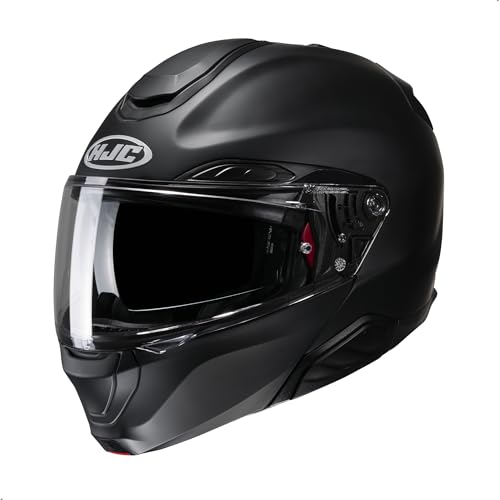 |
Best Overall for Round Heads | Type: Modular (flip-up) | Head shape fit: Intermediate oval (HJC runs rounder) | Best for: Round oval riders who want a lightweight premium modular | VIEW LATEST PRICE | Read Our Analysis |
| HJC RPHA 71 Full-Face Motorcycle Helmet |  |
Best Full-Face for Round Heads | Type: Full-face | Head shape fit: Intermediate oval (HJC runs rounder) | Best for: Round oval riders who want a dedicated full-face with premium construction | VIEW LATEST PRICE | Read Our Analysis |
| Bell Qualifier Full-Face Motorcycle Helmet |  |
Best Value for Round Heads | Type: Full-face | Head shape fit: Intermediate oval (Bell runs round-friendly) | Best for: Round oval riders who want dual certification at a mid-range price | VIEW LATEST PRICE | Read Our Analysis |
| ScorpionEXO Covert FX Full-Face Motorcycle Helmet |  |
Best Dual-Certified for Round Heads | Type: Full-face | Head shape fit: Intermediate oval (Covert runs rounder) | Best for: Round oval riders who want independent ECE certification and a street-fighter aesthetic | VIEW LATEST PRICE | Read Our Analysis |
| ScorpionEXO T520 Full-Face Touring Motorcycle Helmet |  |
Best Touring Helmet for Round Heads | Type: Full-face (touring) | Head shape fit: Intermediate oval (T520 runs long) | Best for: Round oval riders doing long-distance touring who want an adjustable fit | VIEW LATEST PRICE | Read Our Analysis |
| LS2 Rapid III Full-Face Motorcycle Helmet |  |
Best Budget Dual-Certified for Round Heads | Type: Full-face | Head shape fit: Intermediate oval (LS2 runs long) | Best for: Round oval riders who want dual certification without the premium price | VIEW LATEST PRICE | Read Our Analysis |
| Bell SRT Modular Full-Face Helmet |  |
Best Modular for Round Heads | Type: Modular (flip-up) | Head shape fit: Intermediate oval (Bell runs round-friendly) | Best for: Round oval riders who want Bell's fiberglass construction in a modular | VIEW LATEST PRICE | Read Our Analysis |
| LS2 Stream II Full-Face Motorcycle Helmet |  |
Best Touring Value for Round Heads | Type: Full-face (sport-touring) | Head shape fit: Intermediate oval (LS2 runs long) | Best for: Round oval riders who want LS2's sport-touring geometry with an integrated sun shield | VIEW LATEST PRICE | Read Our Analysis |
More Details on Our Top Picks
HJC RPHA 91 Modular Motorcycle Helmet
HJC does not publish a formal head-shape category the way Arai does, but its shells run rounder and wider than Arai or Shoei, which is what puts the brand on this list; the RPHA 91's own shell is intermediate oval. The carbon and carbon-glass hybrid fiber shell is a genuine upgrade over polycarbonate at a similar weight, and the RPHA line is where HJC puts its best aerodynamic engineering, which shows up as reduced buffeting and wind noise at highway speeds.
The 5-intake, 7-exhaust ventilation system moves a notable amount of air, and the flip-up chin bar opens for the glasses-on sequence without any of the fumbling a full-face requires. The SMART HJC 21B and 50B Bluetooth systems snap into speaker pockets sized correctly for them, rather than the afterthought slots found on cheaper helmets.
The HJ-37 Pinlock-ready shield comes standard with a Dark Smoke sun visor already installed, so you are not buying an additional piece on day one. The 3-step adjustable sun shield stays locked where you put it, which is a small detail that cheap modular helmets get wrong constantly.
The honest limitation is certification: the US listing is DOT-only. If ECE 22.06 independent testing matters to your buying decision, the ScorpionEXO picks lower on this list carry that stamp. For round oval riders who prioritize the shell geometry and modular convenience, the RPHA 91 is the top of the HJC range without the full-carbon price.
- Type:Modular (flip-up)
- Head shape fit:Intermediate oval (HJC runs rounder)
- Certification:DOT FMVSS 218
- Shell:Carbon and carbon-glass hybrid fiber
- Weight:Approx. 3.5 lbs
- Best for:Round oval riders who want a lightweight premium modular
HJC RPHA 71 Full-Face Motorcycle Helmet
The RPHA 71 is HJC's flagship full-face. Its shell is intermediate oval, but like most HJC helmets it runs rounder and wider than Arai or Shoei, which is why round oval riders who feel temple pressure in premium-brand shells tend to fit it well. The P.I.M. EVO shell uses Carbon-Aramid hybrid and Natural Fibers, which gives it a competitive weight advantage over polycarbonate competitors and a tighter shell-to-liner fit. Wide-oval heads often find mid-range full-face helmets shift side-to-side; the RPHA 71 sits still.
The 2-intake, 2-exhaust ventilation is simpler than some helmets in this segment, but the front-to-back channeling is effective enough for most riding conditions. The Pinlock-ready HJ-40 shield delivers the same fog resistance as the RPHA 91's visor, and the push-release shield lock handles quick visor swaps without tools.
Removable and washable cheek and crown pads are standard. The emergency release cheek pads are a real-world safety feature that gets overlooked in marketing but matters if you are ever in a crash and EMTs need access. SMART HJC 21B and 50B Bluetooth compatibility is here as well for riders who want audio without a handlebar-mounted system.
Same DOT-only caveat as the RPHA 91 in its US listing. Riders doing a lot of highway miles and who want independent lab certification should look at the ScorpionEXO Covert FX or LS2 picks below. For round oval riders who want HJC's best full-face construction in a rounder-running shell, this is the pick.
- Type:Full-face
- Head shape fit:Intermediate oval (HJC runs rounder)
- Certification:DOT FMVSS 218
- Shell:P.I.M. EVO Carbon-Aramid hybrid
- Weight:Approx. 3.0 lbs
- Best for:Round oval riders who want a dedicated full-face with premium construction
Bell Qualifier Full-Face Motorcycle Helmet
Bell has built neutral, round-friendly intermediate shells for decades, and the Qualifier is the accessible entry into that tradition. Its intermediate-oval shell runs wider and more neutral than Arai or Shoei - echoed in owner reports from riders who tried Shoei and Arai first and returned both. The Qualifier is built around 3 shell sizes rather than padding a single shell down, which means the geometry is actually proportional to your head size rather than approximate.
The dual DOT plus ECE 22.06 certification is notable at this price point. ECE 22.06 requires independent lab testing and rotational impact assessment, not manufacturer self-certification. For riders shopping between a DOT-only helmet and a DOT-plus-ECE option at a similar price, the independent verification is worth having.
Ionic+ padding is Bell's antimicrobial liner treatment, and it works well enough in practice. The NutraFog II shield uses a ClickRelease system for tool-free swaps. Velocity Flow Ventilation is the ventilation story here, with inlet and exhaust positioning that the engineers clearly thought about rather than just placed for visual symmetry.
The Qualifier is not a premium helmet and it does not pretend to be. The shell is polycarbonate and the construction reflects the price. But for a round oval rider who wants a proven brand, real dual certification, and a helmet that will not fight their skull shape, the Qualifier is the smartest spend on this list.
- Type:Full-face
- Head shape fit:Intermediate oval (Bell runs round-friendly)
- Certification:DOT FMVSS 218 + ECE 22.06
- Shell:3 shell sizes (polycarbonate)
- Weight:Approx. 3.3 lbs
- Best for:Round oval riders who want dual certification at a mid-range price
ScorpionEXO Covert FX Full-Face Motorcycle Helmet
ScorpionEXO states its CAD-refined aerodynamics minimize lift and turbulence on the Covert FX for a smoother, more stable ride - relevant to the round-head conversation because a shell that holds its aerodynamic position well also tends to sit more consistently on a rounder head shape. The TCT-Ultra Composite shell is lighter than polycarbonate, and the dual DOT plus ECE 22.06 certification means a third-party lab signed off on the impact performance rather than just the manufacturer self-certifying. ECE 22.06 also covers rotational-impact testing, which DOT alone does not require.
Scorpion does not list an inflatable or adjustable-volume cheek pad system on this model's current spec sheet, but the KwikFit 3D sculpted cheek pads are shaped to accommodate most eyeglasses - useful given the real overlap between round oval heads and glasses wearers - and Scorpion sells optional thinner and thicker cheek pad sets separately if the stock fit needs adjusting in either direction.
The Everclear shield is fog-free with 95% UV-A/UV-B protection per Scorpion's spec sheet, and a free additional dark-smoke Everclear shield ships in the box at no extra cost. The aero-tuned ventilation system uses one large top intake with rear exhaust vents, plus a dual-position mouth vent that works as a defroster alone or defroster-plus-ventilation when opened further.
The 5-year warranty is longer than most competitors offer, and the listed weight of about 1,348 g (size medium) is on the heavier side for a sport-styled helmet - a function of the 2-shell/3-EPS construction and included hardware rather than a manufacturing shortfall.
- Type:Full-face
- Head shape fit:Intermediate oval (Covert runs rounder)
- Certification:DOT FMVSS 218 + ECE 22.06
- Shell:TCT-Ultra Composite (2 shells)
- Weight:1,348 g / 2.9 lbs (size medium)
- Best for:Round oval riders who want independent ECE certification and a street-fighter aesthetic
ScorpionEXO T520 Full-Face Touring Motorcycle Helmet
The T520 is ScorpionEXO's touring full-face, built with three shell sizes and the AirFit inflation cheek pad system. Its intermediate shell runs a touch longer than the Covert, so the AirFit pads earn their keep dialing in a round-head fit. For touring riders covering 400-mile days, the ability to fine-tune cheek pad pressure after three hours in the saddle is the difference between a comfortable end to the day and a headache at the fuel stop.
Dual DOT plus ECE 22.06 certification at the touring price point is consistent with ScorpionEXO's approach: no compromise on certification depth in exchange for the lower shell material cost. The dual-position mouth vent operates as both a defroster and a ventilation source, which handles the cold-morning condensation problem touring riders face more than weekend riders.
The KwikFit 3D contoured cheek pads fit the glasses-wearers use case in addition to round oval fit. The EXO-COM Bluetooth integration is the cleanest communication system in this segment if you are in the Scorpion ecosystem; third-party systems fit the speaker pockets as well. A breath deflector and aero skirt are included, which reduce wind noise on extended highway runs.
The Everclear SpeedView drop-down sun visor is retractable and interchangeable. The 3-shell construction means the helmet proportions scale with the size rather than being padded down from a single large shell, which benefits round oval heads in the extremes of the size range. Five-year warranty.
- Type:Full-face (touring)
- Head shape fit:Intermediate oval (T520 runs long)
- Certification:DOT FMVSS 218 + ECE 22.06
- Shell:Advanced polycarbonate (3 shell sizes)
- Weight:Not specified by manufacturer
- Best for:Round oval riders doing long-distance touring who want an adjustable fit
LS2 Rapid III Full-Face Motorcycle Helmet
LS2 as a brand actually leans long and narrow, but the Rapid III is one of its more neutral, intermediate-fitting models, and it brings that fit to a price point that puts the Bell Qualifier in direct competition. The HPTT shell construction is LS2's own thermoplastic process, with 3 shells and 5 EPS densities across the size range, meaning the fit geometry is dialed per size rather than padded from a single mold. Round oval heads in the smaller and larger size brackets specifically benefit from this.
Dual DOT plus ECE 22.06 certification is the same story as the Bell and Scorpion picks: a third party tested the helmet rather than just the manufacturer. The 3D laser-cut cheek pads use a contouring process that maps to face geometry more precisely than flat-cut foam. For round oval heads, this tends to mean less temporal pressure from the cheek pad edges.
The micrometric buckle closes securely with one hand without the threading complexity of a Double D-ring, and the Emergency Release Cheek Pads are the same crash-rescue feature as on the HJC RPHA 71. The A-Class polycarbonate shield has double-injected rubber edging that seals against wind and debris better than typical pinch-fit shields at this price.
Seven liner and three cheek pad options across the size range gives this more fit adjustment than most helmets in the segment. If the standard setup does not fit a round oval head correctly, there are documented replacement options available from LS2. For the price relative to dual certification and 3-shell construction, this is the clearest value argument on the list.
- Type:Full-face
- Head shape fit:Intermediate oval (LS2 runs long)
- Certification:DOT FMVSS 218 + ECE 22.06
- Shell:High Pressure Thermoplastic Technology (HPTT), 3 shells
- Weight:1,350 g (plus or minus 50 g)
- Best for:Round oval riders who want dual certification without the premium price
Bell SRT Modular Full-Face Helmet
The Bell SRT Modular brings fiberglass composite construction to a modular flip-up at a price that undercuts most carbon alternatives. Bell's neutral, round-friendly intermediate fit carries through the line, and the SRT is the modular version of that tradition. The fiberglass shell is lighter and more impact-energy-dispersing than polycarbonate, which matters in a modular where the flip mechanism adds some structural complexity.
The Panovision shield delivers an exceptionally wide visual field, with Class 1 optics (the same rating used in prescription eyeglasses) rather than the Class 2 optics found on budget shields. At highway speeds, optical distortion from a lower-quality shield adds fatigue that round oval riders already fighting a marginal fit do not need.
The removable interior is straightforward and washable. Bell does not include the same eyeglass groove cutouts as HJC, but the wider, more neutral shell means the temporal pressure issue is reduced at the source rather than managed through foam channels. The flip-up chin bar handles glasses donning the same way as all modular helmets.
DOT-only certification is the honest limitation here. Bell's DOT certification record is solid and the brand has a long track record, but riders who specifically want independent ECE 22.06 testing will find it with the ScorpionEXO or LS2 options. For round oval riders who want Bell's fiberglass quality in a modular without the full-carbon premium, the SRT is the pick.
- Type:Modular (flip-up)
- Head shape fit:Intermediate oval (Bell runs round-friendly)
- Certification:DOT FMVSS 218
- Shell:Lightweight fiberglass composite
- Weight:Approx. 3.8 lbs
- Best for:Round oval riders who want Bell's fiberglass construction in a modular
LS2 Stream II Full-Face Motorcycle Helmet
The Stream II is LS2's sport-touring full-face, and it shares the same neutral, intermediate-oval fit as the Rapid III covered elsewhere on this list, in a slightly more touring-oriented package. The Kinetic Polymer Alloy shell uses LS2's proprietary KPA process, aimed at getting composite-like energy management out of a polycarbonate-price shell. The AREM (Advanced Rotational Energy Management) liner addresses the rotational-impact vector that ECE 22.06 testing specifically covers.
The integrated sun shield means round oval riders who also wear glasses can flip down the built-in visor instead of juggling two pairs of lenses or squinting through midday glare on a west-facing road. LS2's spec sheet does not explicitly list Pinlock compatibility for the Stream II, so if anti-fog performance matters for your riding, verify current specs before buying rather than assuming it. The shield uses a tool-free Quick-Release swap system.
Ventilation is dynamic, flow-through. LS2 does not publish a specific vent count for the Stream II, but the intake and exhaust placement is built to move air across the crown and through the chin area continuously, which suits a touring-oriented helmet better than adjustable ports do on long stints. The interior liner is removable and washable.
The Stream II sits a step above the Rapid III in LS2's lineup mainly because of the integrated sun shield - if that is not a priority for you, the Rapid III saves money for essentially the same neutral, intermediate-oval fit. If you will actually use the drop-down visor on your typical routes, the Stream II earns its spot. Both carry the same DOT FMVSS 218 + ECE 22.06 dual certification and the same LS2 fit.
- Type:Full-face (sport-touring)
- Head shape fit:Intermediate oval (LS2 runs long)
- Certification:DOT FMVSS 218 + ECE 22.06
- Shell:Kinetic Polymer Alloy (KPA)
- Weight:Not specified by manufacturer
- Best for:Round oval riders who want LS2's sport-touring geometry with an integrated sun shield
How to Choose a Helmet for a Round Head
Most motorcycle helmet reviews skip head shape entirely and go straight to ventilation counts and visor swaps. That is backwards. A helmet that is the wrong shape for your skull will be uncomfortable regardless of how many vents it has, and no amount of padding adjustment fixes the wrong shell geometry. Here is what actually matters.
The Three Head Shapes
Helmet brands design around three basic skull profiles measured from the top down (imagine looking straight down at the top of your head). Round oval heads are roughly as wide side-to-side as they are front-to-back. Intermediate oval heads are slightly longer front-to-back than side-to-side, and this is the shape most helmets are designed around. Long oval heads are noticeably elongated front-to-back relative to their width. If you have been wearing helmets that fit fine front-to-back but squeeze your temples, you are almost certainly round oval. If helmets feel fine at the temples but tight on your forehead and back of head, you are likely long oval.
Finding Your Head Shape
The mirror method works well: stand over a bathroom sink, look straight down into the mirror, and note the rough outline of your skull. A roughly circular outline is round oval. An egg shape is intermediate oval. A noticeably elongated shape is long oval. A second approach is to measure your head circumference (needed for sizing anyway) and then measure the front-to-back and side-to-side dimensions separately. If front-to-back minus side-to-side is less than 5 mm, you are round oval. If it is 5-15 mm, intermediate oval. Over 15 mm, long oval. These thresholds are approximate and used differently across brands, but they give you a starting point before you spend money. For more on how head size and shape interact with fit, see our guide on motorcycle helmets for big heads.
Which Brands Fit Round Heads
Brand shell orientation is the most reliable pre-purchase fit signal. HJC does not label its shells by head shape, but they run rounder and wider than Arai or Shoei, so they suit round oval riders well. Bell builds neutral, round-friendly intermediate shells and is the most commonly recommended alternative when riders return an Arai or Shoei. ScorpionEXO is intermediate too - its Covert models run rounder, while touring models like the T520 run a touch longer, and the AirFit inflation system adds post-purchase adjustment latitude. LS2 actually leans long and narrow as a brand; the Rapid and Stream are its more neutral-fitting exceptions, and their 3D laser-cut cheek pads and multiple pad options give additional fine-tuning. Arai and Shoei build for intermediate oval and their premium models especially tend to leave round oval riders with temporal pressure. This is not a quality verdict on either brand; it is shell geometry, and it is not fixable with different pads. For a broader look at how to fit a helmet across body types, see our big heads guide.
Pressure Points: What They Tell You
Temple pressure (sides of the head, just above and forward of the ears) on an otherwise correctly sized helmet is the clearest signal of an intermediate-oval shell on a round oval head. The shell is simply not wide enough where you need it to be. Forehead hotspots in an otherwise fine-feeling helmet can indicate a correctly-shaped shell that is slightly small, which sizing up resolves. If a helmet rocks side-to-side during a head shake, it is too wide and too short front-to-back, which is the round oval head in an oversized intermediate oval shell. None of these are padding problems. They are shell geometry problems. See also our guide on when to replace a motorcycle helmet for how fit degradation over time affects both comfort and protection. For riders who wear glasses, the interaction between head shape and eyeglass channel geometry is covered in our best motorcycle helmet for glasses guide.
Motorcycle Helmet for Round Heads Comparison
| Helmet | Type | Head shape fit | Certification | Best For |
|---|---|---|---|---|
| HJC RPHA 91 Modular Motorcycle Helmet | Modular (flip-up) | Intermediate oval (HJC runs rounder) | DOT FMVSS 218 | Round oval riders who want a lightweight premium modular |
| HJC RPHA 71 Full-Face Motorcycle Helmet | Full-face | Intermediate oval (HJC runs rounder) | DOT FMVSS 218 | Round oval riders who want a dedicated full-face with premium construction |
| Bell Qualifier Full-Face Motorcycle Helmet | Full-face | Intermediate oval (Bell runs round-friendly) | DOT FMVSS 218 + ECE 22.06 | Round oval riders who want dual certification at a mid-range price |
| ScorpionEXO Covert FX Full-Face Motorcycle Helmet | Full-face | Intermediate oval (Covert runs rounder) | DOT FMVSS 218 + ECE 22.06 | Round oval riders who want independent ECE certification and a street-fighter aesthetic |
| ScorpionEXO T520 Full-Face Touring Motorcycle Helmet | Full-face (touring) | Intermediate oval (T520 runs long) | DOT FMVSS 218 + ECE 22.06 | Round oval riders doing long-distance touring who want an adjustable fit |
| LS2 Rapid III Full-Face Motorcycle Helmet | Full-face | Intermediate oval (LS2 runs long) | DOT FMVSS 218 + ECE 22.06 | Round oval riders who want dual certification without the premium price |
| Bell SRT Modular Full-Face Helmet | Modular (flip-up) | Intermediate oval (Bell runs round-friendly) | DOT FMVSS 218 | Round oval riders who want Bell's fiberglass construction in a modular |
| LS2 Stream II Full-Face Motorcycle Helmet | Full-face (sport-touring) | Intermediate oval (LS2 runs long) | DOT FMVSS 218 + ECE 22.06 | Round oval riders who want LS2's sport-touring geometry with an integrated sun shield |
DOT vs ECE vs Snell vs MIPS, how to pick the right lid in 60 seconds, and when to replace it. One page, no fluff.
Frequently Asked Questions
How do I know if I have a round oval head?
Look straight down into a mirror from above your head and check the rough outline of your skull. A roughly circular outline means round oval; a slight egg shape is intermediate oval; noticeably elongated is long oval. You can also measure: if your front-to-back head measurement is within 5 mm of your side-to-side measurement, you are round oval. The practical test is if every helmet you try squeezes your temples but feels fine front-to-back.
Which motorcycle helmet brands are best for round heads?
HJC does not publish a head-shape category, but its shells run rounder and wider than Arai or Shoei, so round oval riders fit them well. Bell builds neutral, round-friendly intermediate shells and is the most common recommendation when riders return an Arai or Shoei. ScorpionEXO's Covert models run rounder, while LS2 actually leans long - its Rapid and Stream are the more neutral-fitting exceptions. Arai and Shoei run narrow and are not a good fit for round oval regardless of size.
Can I fix a wrong head shape fit with extra padding?
No. Padding adjusts the volume inside a shell, not the geometry of the shell itself. If a helmet squeezes your temples because the shell is too narrow for your width, thinner cheek pads will make the overall fit looser but will not widen the temporal area of the shell. You need a helmet built with a rounder shell profile, not a different padding configuration inside an intermediate oval shell.
What is the difference between DOT and ECE 22.06 certification?
DOT (FMVSS 218) is the US legal minimum. The manufacturer self-certifies compliance, meaning no independent lab tests the helmet before it ships. ECE 22.06 is the European standard and requires third-party lab testing, including rotational impact assessment that DOT does not mandate. Six of the eight helmets on this list carry both certifications. Where a helmet is DOT-only, we note it explicitly. For daily riders and touring, dual certification is worth seeking out.
I wear glasses and have a round oval head. What should I prioritize?
Head shape fit is the first filter, then glasses compatibility. From this list, the ScorpionEXO Covert FX and T520 pair intermediate shells (the Covert runs rounder; the T520 a touch longer) with KwikFit 3D sculpted cheek pads that explicitly accommodate most eyeglasses. HJC modular helmets combine a rounder-running shell with the flip-up donning convenience that glasses wearers need. The Bell Qualifier has eyeglass-channel documentation in its cheek pads as well. See our dedicated best motorcycle helmet for glasses guide for the full eyewear-first analysis.
