
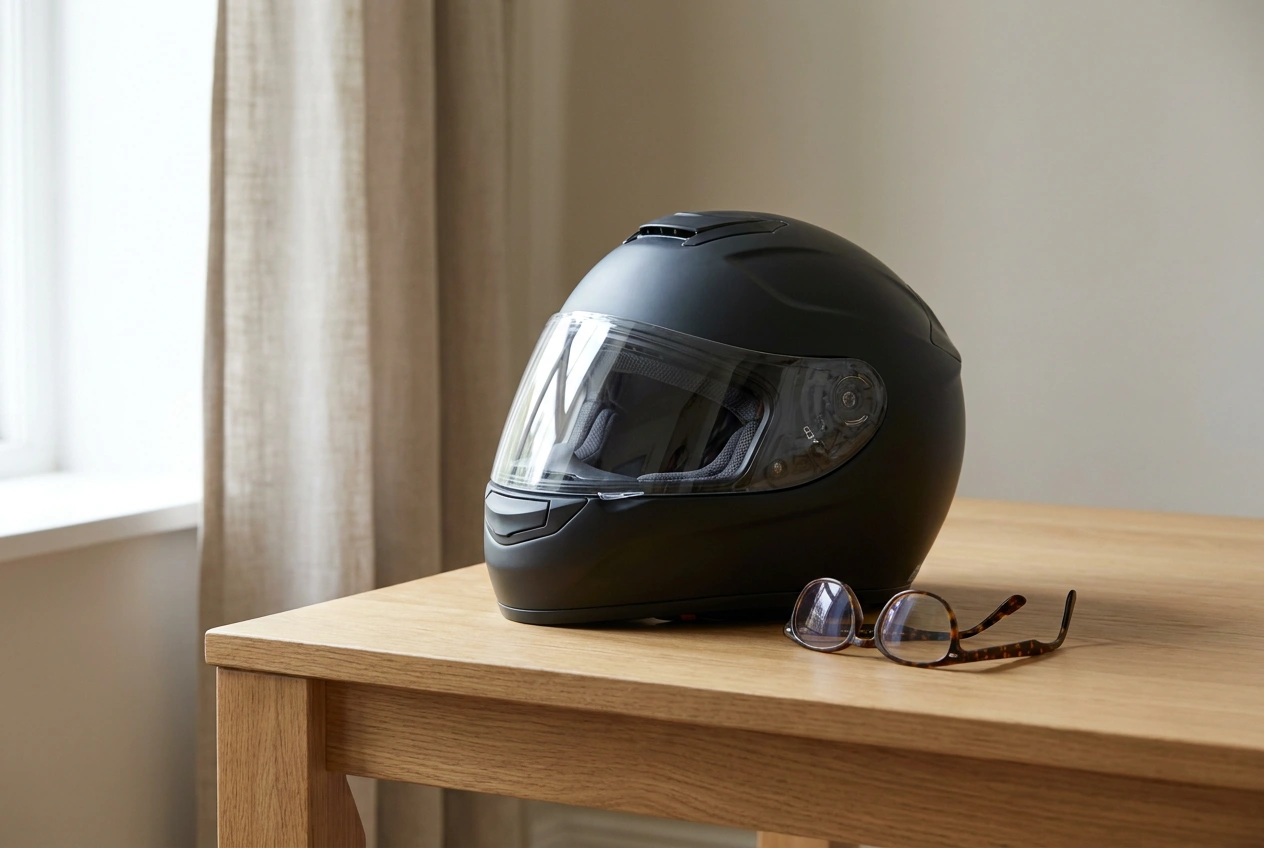
Put the helmet on first, then slide your glasses in afterward, threading the temple arms back through the gap between the cheek pads and the shell. Choose a helmet with glasses-friendly eyeglass channels, pick frames with thin, flexible temple arms, and treat the visor with anti-fog or fit a Pinlock insert. Modular helmets make this easiest because the chin bar flips up.
Glasses and a full-face helmet are not natural friends. The cheek pads that hold the helmet snug are exactly where a temple arm wants to sit, so most riders who wear prescription lenses know the familiar pinch behind the ear, the lens that fogs at every red light, and the frame that gets dragged off their face when the helmet comes on. None of that is inevitable. It is almost always a sequencing problem, a frame problem, or a fog problem, and all three have practical fixes.
Our research desk pulled together the methods that actually work, from the order you put things on, to the helmet features worth looking for, to the anti-fog options that keep the lens clear. The goal here is a setup you can repeat at every stop without thinking about it, whether you ride a budget full-face or a premium modular. We also cover where contact lenses make more sense than fighting the helmet at all.
Put the helmet on first, glasses second
The single biggest fix costs nothing. Most riders instinctively put their glasses on, then pull the helmet down over them. That forces the temple arms to fold or scrape against the cheek pads, bends the frames, and often shoves the glasses crooked or off entirely. Reverse the order. Fit the helmet first, get it seated, then slide the glasses in from the front and thread each temple arm back along the gap between your temple and the cheek pad until the arm rests behind your ear.
On most full-face helmets there is a usable channel between the comfort liner and the shell at temple height. The arms tuck into it. With a little practice the whole motion takes a couple of seconds at a stop, and the frames stay where they belong. Taking the glasses off works the same way in reverse: pull them forward and out before you remove the helmet, never the other way around.
- Helmet on first. Seat it fully before the glasses go anywhere near your face.
- Insert from the front. Slide the lenses down and back, not over the top.
- Thread the arms last. Guide each temple arm along the cheek-pad gap to behind the ear.
- Remove in reverse. Glasses out first, then the helmet, to avoid yanking the frames.
Helmet features that make glasses easy
Some helmets are simply built with riders who wear glasses in mind, and the difference is noticeable the first time you try one. The feature to look for is what manufacturers call eyeglass channels or glasses-friendly cutouts: small recesses moulded into the cheek pads at temple height that give the arms a dedicated path so they never press into your skull.
Internal shape matters too. A helmet's head shape (round, intermediate oval, long oval) decides how tightly the pads clamp at the temples, and a helmet that matches your head shape leaves the temple zone snug but not crushing. If you already know glasses are part of your ride, see our picks in the best motorcycle helmets for glasses guide, where eyeglass channels and pad design were the main filter.
Pick the right frames: thin and flexible temple arms
The glasses you already own may be the problem. Thick, rigid temple arms (the kind on heavy acetate or sport-wrap frames) have nowhere to hide inside a snug helmet and turn into pressure points within minutes. Frames designed for, or simply suited to, helmet use share a few traits worth matching.
- Thin temple arms. Wire or slim metal arms slide into the cheek-pad gap far more easily than chunky plastic.
- Flexible, springy hinges. Arms that flex with pad pressure distribute the load instead of digging a single hard line behind your ear.
- Straight or shallow-curve arms. Aggressive hook-around ear pieces catch on the liner; gentler arms thread cleanly.
- A snug nose fit. Glasses that already slip down your nose will slip worse with airflow inside the helmet.
Riding-specific glasses exist and several optical brands sell frames marketed for motorcycle and powersports use with exactly these features. If you wear prescription lenses every day, a dedicated thin-arm pair kept with your gear is often the cleanest answer. For riders who do not need prescription lenses, our best motorcycle glasses roundup covers tinted, mirrored, and photochromic options suited to daytime riding.
Beat the fog: anti-fog, Pinlock, and airflow
Fog is the other half of the glasses problem, and it lands on two surfaces: the visor and the lenses themselves. Inside a sealed helmet your breath has nowhere to go, so warm moist air condenses the moment it hits cooler glass. The fogging risk is highest on cool evening and night rides, where the temperature differential between your face and the outside air is at its greatest - see our motorcycle safety tips for riding at night for the broader picture. There are layered fixes, and using more than one together works best.
- Pinlock insert. A second lens that clips inside the visor and creates a sealed air gap, the most reliable fix for visor fog. Look for a helmet that is Pinlock-ready (it has the visor pins) and fit the matching insert.
- Anti-fog treatment. Sprays and wipes applied to both the visor interior and your lens surfaces buy real time, though they need reapplying.
- Crack the visor. Most visors have a first detent that lets a thread of air through at low speed, clearing fog at stops.
- Use the chin vent and breath guard. Open the chin vent and seat the breath deflector to push exhaled air down and away from the glass.
Modular helmets and OTG options
If wrestling glasses past the cheek pads sounds like more than you want to deal with, two routes make life easier.
A modular helmet (the flip-up kind) is the most glasses-friendly full-coverage design, because raising the chin bar opens the front of the helmet completely. You lift the chin bar, settle the glasses on your face normally, then close it, with no threading required. That convenience is a large part of why touring riders who wear glasses gravitate toward modulars, on top of the comfort of flipping up at fuel stops.
The other route is OTG, short for over-the-glasses, a design borrowed from ski goggles and seen on some adventure and off-road helmets that pair with goggles rather than a visor. OTG goggles carry deeper foam channels cut specifically to clear temple arms. If you ride an adventure or dirt-style helmet with goggles, an OTG-rated pair removes the pressure-point problem outright.
- Modular: flip the chin bar up, fit glasses normally, close. Easiest for full-coverage riding.
- OTG goggles: foam channels sized for temple arms, ideal for adventure and off-road setups.
- Fit still counts: a helmet that matches your head shape keeps temple pressure low whichever route you take.
When contact lenses are the simpler answer
Sometimes the cleanest fix is to take the glasses out of the equation. For riders who tolerate contact lenses, they remove the temple-arm pressure point, the fogging lens, and the threading routine all at once, and they let you use any helmet and any visor or sunglasses-style sun protection without compromise.
The honest trade-offs are real. Wind through vents and an open visor dries the eyes, so daily disposables and lubricating drops help on long rides. Dust and grit are a genuine concern on adventure and off-road riding, where a sealed full-face visor or goggles matters more. And contacts are not an option for every prescription or every rider. But for many riders who wear a single-vision prescription and ride regularly, a pair of dailies kept with their kit sidesteps the whole glasses-in-a-helmet problem. Keeping a backup pair of glasses in the tail bag covers the day a lens tears.
Glasses-with-helmet methods compared
| Approach | How it works | Best for |
|---|---|---|
| Glasses on after helmet | Thread temple arms through the cheek-pad gap once the helmet is seated | Any full-face; costs nothing and works for most riders |
| Eyeglass-channel helmet | Moulded cheek-pad cutouts give the arms a dedicated path | Daily glasses wearers who want comfort built in |
| Thin-arm frames | Slim, flexible temple arms slide in without pinching | Riders whose current frames cause pressure pain |
| Pinlock plus anti-fog wipe | Sealed visor insert clears the visor; wipe clears the lenses | Cold or humid conditions and stop-start riding |
| Modular helmet | Flip the chin bar up, fit glasses normally, close | Touring and commuting riders who stop often |
| Contact lenses | Removes glasses from the helmet entirely | Riders who tolerate contacts and want zero hassle |
DOT vs ECE vs Snell vs MIPS, how to pick the right lid in 60 seconds, and when to replace it. One page, no fluff.
Frequently Asked Questions
What is the right way to wear glasses with a full-face helmet?
Put the helmet on first, then slide your glasses in from the front and thread each temple arm back through the gap between the cheek pad and your temple until it rests behind your ear. Putting glasses on before the helmet forces the arms against the pads and bends or dislodges the frames.
Why do my glasses hurt behind the ears in a helmet?
The cheek pads press the rigid temple arm into your skull because the arm has nowhere to go. Fixes include choosing a helmet with eyeglass channels cut into the pads, switching to frames with thin flexible temple arms, and confirming the helmet matches your head shape so the temple zone is snug rather than crushing.
How do I stop my glasses fogging up inside a helmet?
Use layered fixes. Fit a Pinlock insert to handle visor fog, apply an anti-fog wipe to your actual lenses, crack the visor to its first detent at low speed, and open the chin vent with the breath guard seated to push exhaled air away from the glass. Treating only the visor leaves the glasses themselves fogging.
Are modular helmets better for glasses?
Yes, for most riders. Flipping the chin bar up opens the front of the helmet so you can fit glasses normally and then close it, with no threading past the cheek pads. That convenience, plus the ability to flip up at stops, is why many touring riders who wear glasses prefer modulars.
Should I just wear contact lenses instead?
For riders who tolerate contacts, they remove the temple-arm pressure, the fogging lens, and the threading routine in one step and work with any helmet. The trade-offs are wind-dried eyes on long rides and a dust concern on open or off-road riding, so daily disposables, lubricating drops, and a backup pair of glasses help.
