
Affiliate disclosure As an Amazon Associate we earn from qualifying purchases, at no extra cost to you.
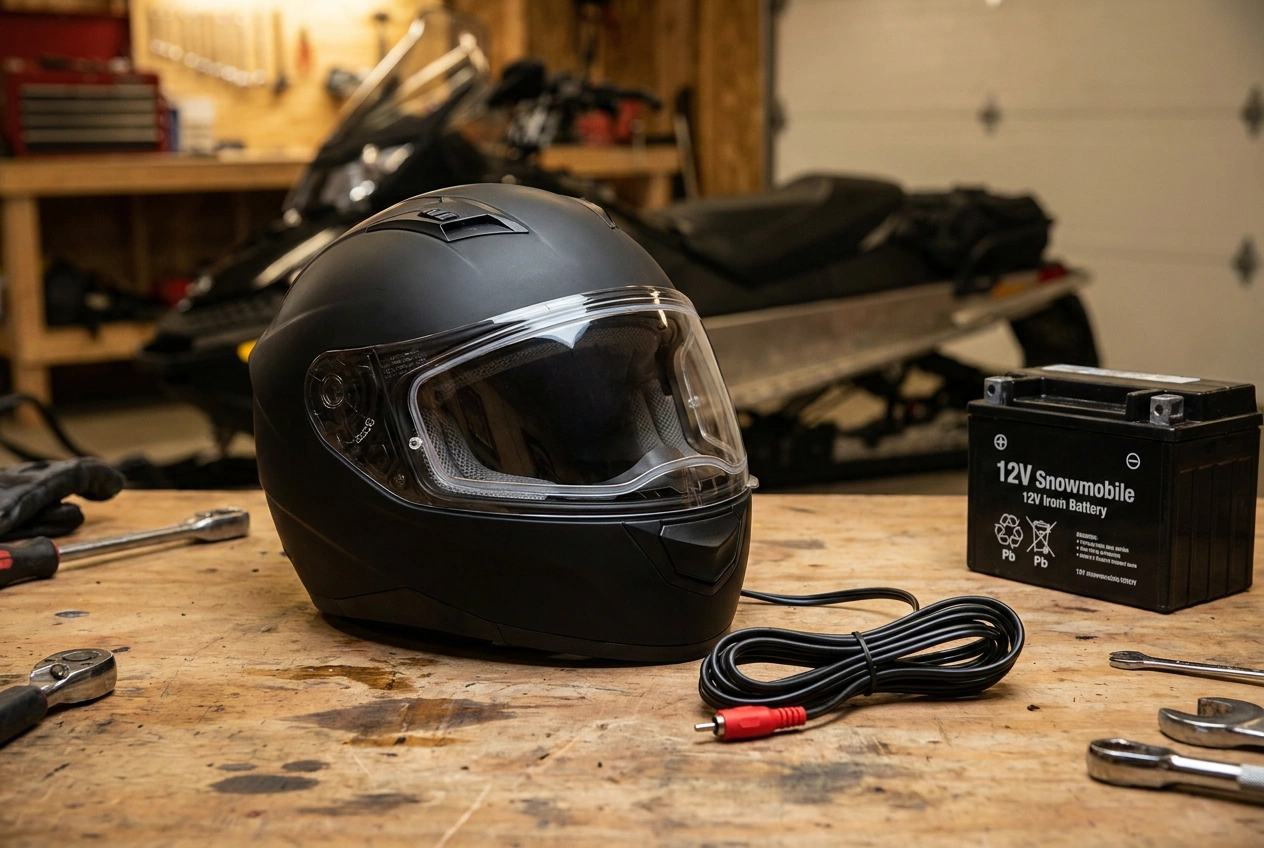
Most heated snowmobile shields run on 12V DC and connect through an RCA or coax quick-disconnect cord. The cord plugs into the shield on one end and into either the sled's accessory outlet or a fused lead wired to the battery on the other. Add an inline fuse at the kit's rating, mount the disconnect within reach, route the cord so it cannot snag, and test before you ride.
A heated shield only earns its keep if it has clean 12V power and a connection you can drop the moment you step off the sled. Get the wiring right and the dual-pane visor stays clear in falling snow and brutal cold. Get it wrong and you are riding with a fogged shield, a blown fuse, or a cord snagged on the handlebars.
Here at the Research Desk we pulled together what the manufacturer kits actually ship with and what experienced sledders do in the field, then boiled it down to a safe, repeatable wiring routine. We are not your electrician, and every kit differs, so treat this as the map and your kit's manual as the final word.
How a heated shield is powered
A heated snowmobile shield is a dual-pane (double-lens) visor with a thin electric heating element sealed between the panes. Feed it 12V DC and the element warms the inner pane just enough to drive off the moisture from your breath before it fogs or ices. Power comes from the sled's 12V electrical system, so the shield only heats while the machine is running or the battery is connected. (For a broader look at how the machine itself works, see our guide to how a snowmobile works.)
Almost every modern kit uses a two-part cord. A short pigtail runs from the shield down to a quick-disconnect; a longer power lead carries 12V up from the sled. The two halves meet at a connector you can pull apart by hand. The common plug types you will run into:
- RCA-style plug: the most common on snowmobile kits (Polaris, Typhoon and many aftermarket cords use this). Easy to find, cheap to replace.
- Coax-style barrel plug: a round push-on connector on some helmet brands, same idea as RCA.
- SAE two-pin: the flat trailer-style connector seen on some battery harnesses, often shared with heated gear.
- Magnetic quick-disconnect: an aftermarket upgrade that snaps apart cleanly if the cord is yanked.
Many shields draw only around 1.5 amps in steady use, so the wiring is light. That low draw is exactly why an undersized fuse and a clean ground matter more than heavy cable.
Wiring it up, step by step
The sequence below is generic and conservative. It assumes a sled with a 12V battery and an RCA-style shield cord, which covers most setups. Always cross-check it against the diagram in your kit, because fuse ratings and connector ends vary by brand.
- Identify the plug. Confirm whether your shield cord ends in RCA, coax, or SAE, and whether your sled already has a matching accessory lead. Many newer machines ship with a capped RCA accessory plug near the right side of the dash.
- Run a fused lead. If there is no factory accessory plug, run the kit's power lead from a 12V source. Wiring straight to the battery keeps the shield live whenever it is plugged in; tapping a switched accessory circuit means it only heats with the key on.
- Add an inline fuse. Place the fuse close to the power source, before any other connection. Use the rating printed in your kit's instructions. Snowmobile heated-shield circuits commonly sit in the 5A range (some OEM circuits are smaller), so follow the kit and do not guess high.
- Mount the quick-disconnect. Position the RCA or coax disconnect where you can reach it with a gloved hand, so you can unplug as you dismount instead of fighting the shield port itself.
- Route and test. Secure the cord so it cannot snag on the bars, your arm, or moving parts, leaving slack for head movement. Connect the shield, run the sled (or connect the battery), and confirm the element warms and any LED indicator lights before your first ride.
Battery harness vs accessory outlet vs battery pack
There are three honest ways to feed the shield, and the right one depends on your sled and how you ride.
Sled accessory outlet. The simplest path. If your machine has a 12V accessory lead or RCA port near the handlebars, you plug the power cord straight in. No cutting, no soldering, and the circuit is already fused at the factory. The trade-off is that not every sled has one, and some only power it with the key on.
Hardwired battery harness. The most reliable for cold starts and high demand. You run the kit's lead from the battery through your own inline fuse and quick-disconnect. It keeps power solid and lets you size the fuse to the kit, but it is a permanent install that asks for tidy routing and weatherproof terminals.
Portable rechargeable battery pack. Some helmets support a small clip-on battery so you are not tethered to the sled at all. Handy for ice fishing, working away from the machine, or sleds with no spare 12V. Expect limited runtime and a pack you have to remember to charge.
Whichever route you pick, the shield itself does not care; it just wants a clean, fused 12V supply and a connector you can drop fast.
Heated helmet power options
| Option | How it connects | Best for |
|---|---|---|
| Sled accessory outlet | Power cord plugs into the sled's factory 12V accessory or RCA port, usually near the handlebars; already fused at the factory. | Riders whose sled has an accessory plug and who want a plug-and-go setup with no wiring. |
| Hardwired battery harness | Kit lead runs from the battery through your own inline fuse to a quick-disconnect within reach. | Cold-weather reliability and sleds with no accessory port, when you accept a permanent, tidy install. |
| Portable battery pack | Helmet plugs into a small rechargeable pack carried on you instead of the sled. | Untethered use such as ice fishing or sleds with no spare 12V, accepting shorter runtime. |
DOT vs ECE vs Snell vs MIPS, how to pick the right lid in 60 seconds, and when to replace it. One page, no fluff.
Frequently Asked Questions
What fuse size does a heated snowmobile shield need?
Follow the rating in your kit's instructions. Snowmobile heated-shield circuits commonly sit around 5A, and some OEM circuits are smaller, but ratings vary by brand and machine. The shield itself draws little, so size the fuse to the kit rather than guessing high, and never run it without a fuse.
Can I plug a heated shield into the sled's accessory outlet?
Yes, if your sled has a 12V accessory or RCA-style port, usually near the handlebars. That circuit is already fused at the factory, so it is the easiest connection. If your machine has no accessory outlet, you wire the kit's lead to the battery through your own inline fuse instead.
Do I have to disconnect the shield when I get off the sled?
Yes. The quick-disconnect exists so you can pull the cord apart as you dismount and walk away without dragging or straining it. Leaving it plugged also keeps a battery-wired shield drawing power. Mount the disconnect where a gloved hand can reach it.
Why isn't my heated shield warming up?
Work the chain from the source out: check the fuse, then the connection at the accessory port or battery, then the quick-disconnect, then the plug on the shield. A loose RCA connector or a blown fuse is the usual culprit. Many kits have an LED indicator that confirms power is reaching the shield.
Can I wire the shield directly to the battery?
You can, and many riders do so the shield is live whenever it is plugged in. Run the kit's lead from the battery through an inline fuse at the kit's rating, keep the terminals weatherproof, and route the cord so it cannot chafe or snag. Do not splice into ignition, lights, or other critical circuits.
