
Affiliate disclosure As an Amazon Associate we earn from qualifying purchases, at no extra cost to you.
Motorcycle helmets substantially reduce - but cannot fully prevent - concussion risk. The EPS foam liner crushes to absorb linear (straight-line) impact energy, but concussions are also caused by rotational acceleration, which standard shells manage less completely. MIPS and similar slip-plane technologies specifically target that rotational component.
Every helmet sold in the US, EU, or UK carries a certification sticker - but no certification promises a concussion-free crash. Understanding how the foam, shell, and retention system work - and where the physics still wins - is the difference between smart gear selection and false confidence. This 2026 guide covers the biomechanics from first principles.
The Research Desk at Helmets Advisor has reviewed the peer-reviewed literature on head injury biomechanics and spoken with riders who have first-hand experience of both protected and unprotected impacts. Here is what the science actually says.
What Actually Causes a Concussion?
A concussion is a traumatic brain injury caused by the brain moving inside the skull. That movement is driven by two distinct forces:
- Linear acceleration - the head snapping straight forward, backward, or sideways. The brain sloshes in the direction of travel.
- Rotational (angular) acceleration - the head spinning or twisting. Rotational loading stretches and shears brain tissue in ways that are particularly damaging and closely linked to concussion, diffuse axonal injury, and chronic traumatic encephalopathy (CTE) research.
Most real-world crashes involve both. A glancing blow to the side of a helmet creates more rotational loading than a direct straight-on impact. That distinction is central to understanding both what helmets do well and where they fall short.
How the EPS Liner Absorbs Linear Impact
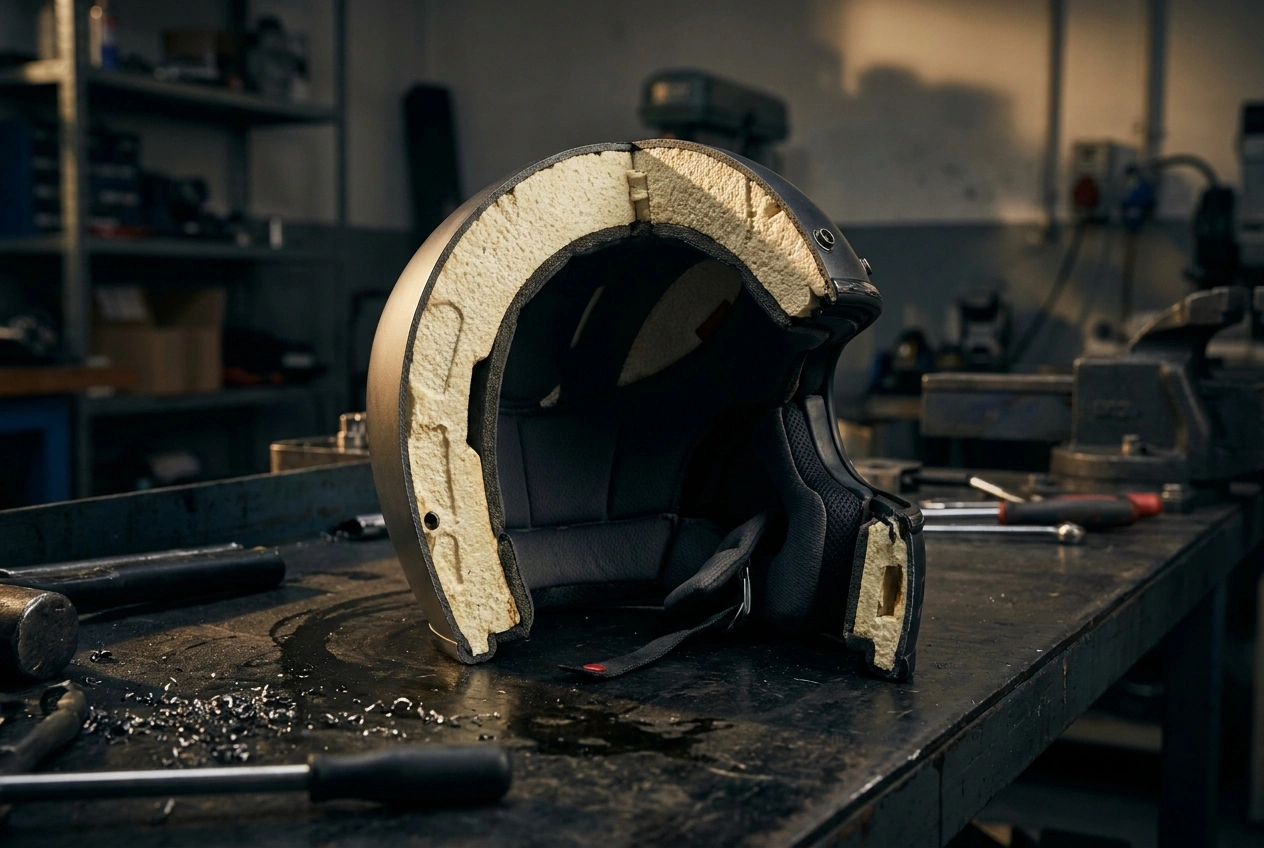
Expanded polystyrene (EPS) foam is the primary energy-absorbing layer in virtually every motorcycle helmet. Its job is to extend the stopping distance of your head - slowing it over a longer time interval rather than stopping it abruptly against hard pavement.
When the outer shell contacts a surface, it spreads the impact load across a wider area. The EPS liner then crushes - permanently, not elastically - and that crushing converts kinetic energy into heat and deformation. The result is a lower peak force delivered to your skull and brain.
- The outer shell (polycarbonate or fiberglass composite) disperses and spreads impact load
- EPS foam crushes irreversibly, converting kinetic energy into deformation
- A thicker EPS liner provides more crushing distance and absorbs more energy
- The retention system keeps the helmet on your head so all of the above actually happens
This is why a helmet that has taken a significant impact must be replaced: the EPS has already crushed and cannot absorb a second hit at the same location. The shell may look fine from outside.
Any helmet that has absorbed a significant impact should be replaced promptly - even when there is no visible damage to the outer shell.
The Rotational Injury Problem Helmets Historically Missed
For decades, helmet standards required manufacturers to drop a helmeted headform onto a flat steel anvil and measure the peak g-force. That test is excellent at validating linear protection. It does not measure what happens when a helmet scrapes along tarmac at an angle - which is a large fraction of real motorcycle crashes.
When a helmet slides obliquely across a surface, friction grips the outer shell while the rider's head (and brain) continues to rotate inside it. The angular acceleration generated can reach hundreds or thousands of radians per second squared. Researchers, most prominently at the KTH Royal Institute of Technology and the Strasbourg University group, found strong correlations between rotational head kinematics and concussion severity in reconstructed crashes. The rotational injury problem is not unique to motorcycle helmets - football helmets face exactly the same challenge, and the sport has driven significant independent research into rotational protection standards.
Standard EPS does very little to interrupt that rotational energy transfer. The helmet stays in place (which is important), but the coupling between shell and head means the brain still experiences significant angular loading.
MIPS and Other Rotational-Energy Technologies
MIPS - Multi-directional Impact Protection System - was developed directly from the KTH biomechanics research. It adds a low-friction slip liner between the EPS foam and the comfort padding that sits against your head. In an oblique impact, the MIPS layer allows the helmet shell and EPS to rotate slightly relative to the head, reducing the angular acceleration transferred to the brain.
Independent lab testing (Virginia Tech Helmet Ratings, among others) has consistently found that helmets with MIPS or equivalent technologies score better on rotational metrics than those without, across both cycling and motorcycle helmet categories. The magnitude of improvement varies by helmet design and impact angle.
MIPS is not the only approach. Competing technologies include:
- WaveCel (Bontrager) - a collapsible cellular structure that handles both linear and rotational energy
- SPIN (POC) - silicone pads that deform in shear during an oblique impact
- Omni-Directional Suspension (ODS) (Bell) - dual-density foam with shear-management properties
- Koroyd - co-polymer tubes that crush in a controlled manner across multiple axes
Each manufacturer measures performance differently, which makes direct comparison difficult. Virginia Tech's STAR rating system uses a common methodology and is the most useful independent benchmark available to consumers. Our detailed breakdown of what MIPS is and how it works covers the slip-plane mechanism in full.
Why No Helmet Can Fully Prevent Concussions
This is the section most helmet marketing glosses over. Here are the honest physical and biological limits:
- Threshold physics: At sufficiently high impact velocities, no wearable helmet is thick enough to absorb all the energy within the space constraints of a head-worn device. Certification tests use controlled drop heights; real crashes can exceed those energy levels.
- The rotational gap: Even with MIPS, rotational energy management is partial, not complete. The slip layer reduces - it does not eliminate - angular acceleration transmission.
- Fit dependency: A helmet that moves on impact - because it is too large, poorly retained, or improperly fastened - fails before the EPS can do its job. Fit and chin-strap fastening are as important as the certification rating.
- Brain anatomy: The brain floats in cerebrospinal fluid and is connected to the skull via bridging veins. Even moderate accelerations can cause microstructural damage. The threshold for concussion varies by individual, by impact history, and by direction.
- Multiple impacts: EPS is single-use at any given location. A rider who has already had one significant impact in a helmet may have reduced protection at that spot without any external evidence of damage.
Certification standards like DOT, ECE 22.06, and SHARP each test for different things, and understanding what they actually measure is part of making a well-informed gear choice.
How to Maximize the Protection a Helmet Actually Provides
Given those limits, the practical question is: what choices give you the best protection the physics allows?
- Fit correctly: The helmet should sit level, contact your head evenly all the way around, and not shift more than about one inch under firm front-to-back pressure. Our fit guide walks through the full sizing and check process.
- Always fasten the chin strap: An unfastened helmet can come off in a crash, rendering all other protection irrelevant. The D-ring system and micrometric buckles both work - the important thing is that the strap is snug against your chin.
- Choose full-face for maximum coverage: The chin bar protects a face impact that would otherwise reach your jaw and transfer force directly to the skull. Full-face helmets are measurably safer than open-face or half helmets, particularly in frontal impacts.
- Look for rotational-tech ratings: Virginia Tech's STAR ratings and the upcoming ECE 22.06 chin-strap tensile requirements both address real-world performance gaps. Prioritize helmets that score well on independent oblique-impact tests.
- Replace after significant impact: If your helmet contacts the ground hard enough to matter, replace it - even if it looks fine. EPS damage is not visible from outside.
- Replace on schedule: Manufacturers typically recommend replacement every 3-5 years due to EPS degradation, adhesive aging, and liner compression from sweat and UV exposure.
Helmet Technology at a Glance: Linear vs. Rotational Protection
| Technology | Linear (straight-line) protection | Rotational protection | Notes |
|---|---|---|---|
| EPS foam liner | Primary mechanism - crushes to absorb energy | Minimal | All certified helmets include EPS |
| Hard outer shell (polycarbonate) | Spreads impact load across wider area | Minor - high friction on oblique contact | Shape and thickness vary by helmet tier |
| MIPS slip liner | None (EPS still does this) | Reduces angular acceleration in oblique impacts | Effectiveness varies by helmet design |
| SPIN / WaveCel / ODS / Koroyd | Some additional linear absorption | Reduces shear and rotational transfer | Proprietary - compare via Virginia Tech STAR |
| Chin bar (full-face only) | Protects chin and jaw from direct impact | Reduces forward rotation from frontal impacts | Significant real-world safety advantage |
DOT vs ECE vs Snell vs MIPS, how to pick the right lid in 60 seconds, and when to replace it. One page, no fluff.
Frequently Asked Questions
Do motorcycle helmets prevent concussions?
Motorcycle helmets substantially reduce the risk and severity of concussion by absorbing linear impact energy through an EPS foam liner. They do not fully prevent concussions because rotational acceleration - a major driver of brain injury - is only partially managed by standard helmets. Technologies like MIPS address the rotational gap but do not eliminate it.
What is the difference between linear and rotational head injury?
Linear injury occurs when the head accelerates in a straight line, causing the brain to slosh in the direction of travel. Rotational injury occurs when the head spins or twists, shearing brain tissue - and this mechanism is closely linked to concussion severity. Most real crashes involve both types of force.
Does MIPS actually reduce concussion risk?
Independent lab testing, including Virginia Tech STAR ratings, shows that helmets with MIPS or equivalent slip-plane systems deliver lower rotational acceleration in oblique impacts compared to comparable helmets without rotational tech. Whether that translates directly to fewer or less severe concussions in real crashes is harder to prove statistically, but the biomechanical basis is sound.
Why does a helmet need replacing after a crash even if it looks fine?
EPS foam crushes permanently when it absorbs a significant impact. That crushed foam has already done its job and cannot absorb energy at the same location a second time. The outer shell may look undamaged while the EPS inside is compromised. Replace any helmet that has taken a hard impact.
Is a full-face helmet better for preventing concussions?
Yes, in most impact scenarios. Full-face helmets add a chin bar that protects against frontal and chin impacts that would otherwise bypass the helmet entirely. Studies of real-world crashes consistently show lower rates of facial and jaw injury, and the chin bar also helps manage forward-rotation loading in direct frontal impacts.
