
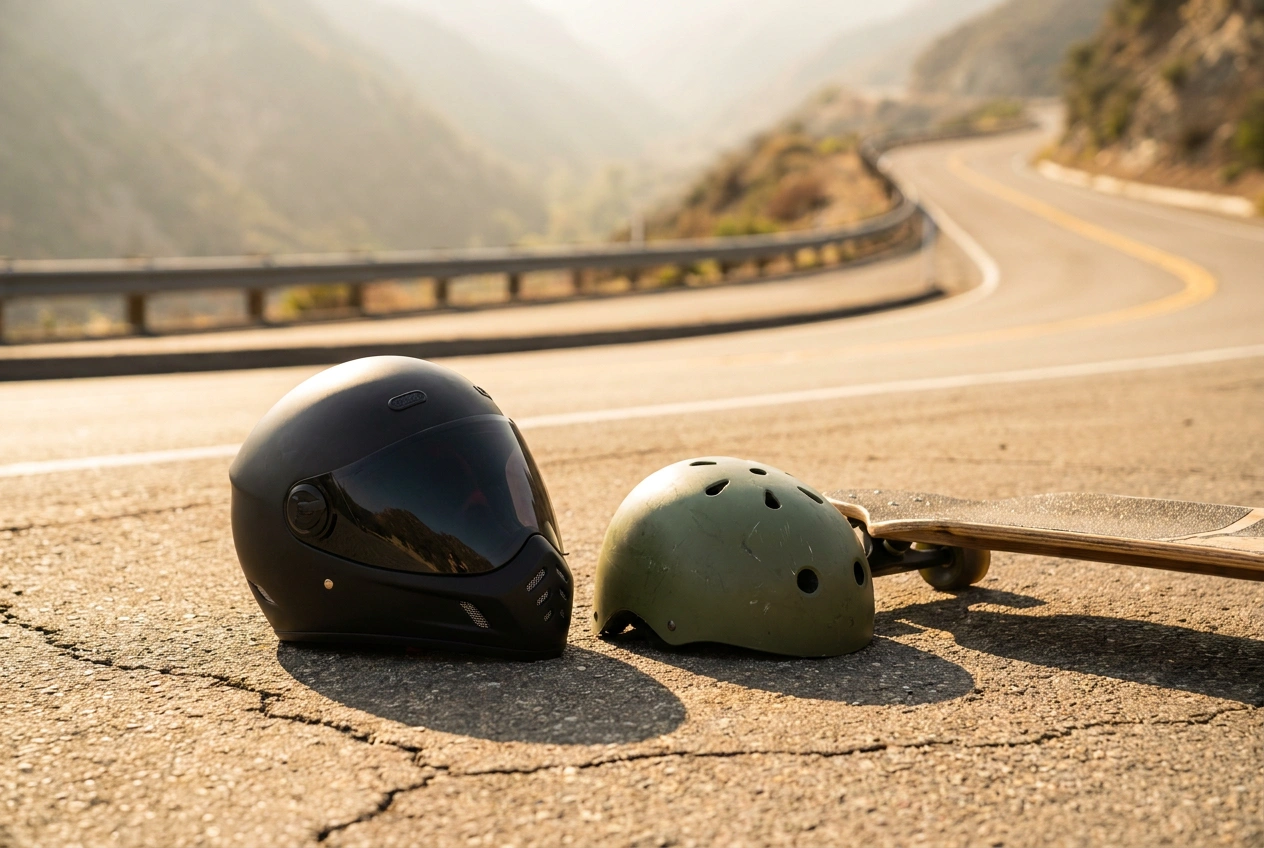
ASTM F1492 is the skateboard helmet standard. It is the right baseline for cruising, commuting and freestyle, usually as a half-shell that also meets CPSC 1203 for bicycle use. ASTM F1952 is the downhill mountain bicycle racing standard, and it is what serious downhill and freeride longboarders look for in a full-face helmet because it certifies higher-speed impact protection plus chin-bar testing. Slow and flat points to F1492. Steep and fast points to F1952.
Two ASTM numbers cover almost every longboard helmet worth buying, and they are built for opposite ends of the sport. F1492 was written for skateboarding, where the threat is falling off a board moving at walking-to-jogging speed onto pavement. F1952 was written for downhill mountain bike racing, where the threat is hitting the ground at speeds that turn a half-shell into the wrong tool. We read both protocols against how people actually ride longboards so you can match the certification to the hill, not to the marketing copy on the box.
This is the question hiding under every forum thread that starts "is my skate helmet OK for bombing hills." The honest answer depends entirely on which standard the shell was tested to and how fast you plan to go.
ASTM F1492: the skateboard standard
ASTM F1492 is the standard specification for helmets used in skateboarding and trick roller skating. It is the baseline for street, park and cruising use, and it is the standard most longboard half-shells are built to. Compared with a plain bicycle helmet, an F1492 helmet covers a larger area of the head, particularly lower at the back, because a skater can go down backward and hit the rear of the skull. That rear coverage is the reason skate-style helmets look rounder and sit lower than vented road-bike helmets.
One detail that surprises people: the skate standard requires a multi-impact helmet, meaning the protective material is meant to survive more than one knock. That suits skateboarding, where minor falls are frequent. Because F1492 is voluntary in the US and not federally mandated, the only reliable proof is the certification sticker printed inside the shell, not a claim on the packaging.
- The standard written specifically for skateboarding and trick roller skating
- Lower rear coverage than a typical bicycle helmet, for backward falls
- Built around multi-impact protection for repeated minor knocks
- Voluntary in the US, so look for the F1492 sticker inside the shell
ASTM F1952: the downhill full-face standard
ASTM F1952 is the standard specification for helmets used for downhill mountain bicycle racing. It was not written for longboarding, but it is the certification serious downhill and freeride longboarders look for, because the threat model lines up: high speed, hard pavement, and the need for protection the moment things go wrong. F1952 demands more impact energy than a recreational bike standard. A certified helmet must keep transmitted force under the limit when dropped onto a curbstone-shaped anvil from 1.6 meters, compared with about 1.2 meters for CPSC and 1.1 meters for EN 1078. It also uses a lower test line on the sides and rear than most bike standards.
A full-face chin bar is not strictly required for F1952 certification, but where a chin bar is fitted, the standard tests it for impact. That chin-bar test is exactly what a downhill longboarder is buying. The trade-off is that a helmet tuned for high-speed hits uses denser energy-absorbing foam, which can absorb low-speed impacts slightly less effectively. That is a fair exchange when the realistic crash is a fast one.
- The downhill mountain bike racing standard, used for downhill longboard full-face lids
- Higher anvil drop (1.6 m) than CPSC or EN 1078, so more high-speed protection
- Lower side and rear test line than most bicycle standards
- Tests the chin bar for impact when one is fitted, which full-face riders want
Which one do you need?
Match the standard to how fast you fall. Cruising, commuting and freestyle longboarding stay at speeds where a half-shell is the sensible choice, and the strongest version of that is a half-shell dual-certified to CPSC 1203 and ASTM F1492. CPSC 1203 is the US-mandated bicycle helmet standard, so a dual-certified shell is legal and tested for both bike commuting and skate-style falls. That combination is the do-it-all cruiser and commuter helmet. EN 1078 is the European equivalent for bicycle and skateboard use, and you will see it on shells sold both sides of the Atlantic.
Downhill, freeride and any session that involves sliding at speed are a different sport. There you want a full-face certified to ASTM F1952. The reason chin protection matters at downhill speed is simple physics: a slide that washes out at 40-plus mph sends your face into the road, and a skate half-shell leaves your jaw, chin and teeth completely exposed. The half-shell also was never tested for impacts at that energy.
ASTM F1492 vs ASTM F1952 for longboard helmets
| Standard | Built for | Best longboard use |
|---|---|---|
| ASTM F1492 | Skateboarding and trick roller skating | Cruising, commuting, freestyle (usually a half-shell) |
| ASTM F1952 | Downhill mountain bicycle racing | Downhill, freeride and high-speed sliding (full-face) |
| CPSC 1203 | US-mandated bicycle helmet standard | Bike commuting; pairs with F1492 in dual-certified half-shells |
| EN 1078 | European bicycle and skateboard standard | European equivalent baseline for cruising and commuting |
DOT vs ECE vs Snell vs MIPS, how to pick the right lid in 60 seconds, and when to replace it. One page, no fluff.
Frequently Asked Questions
Is ASTM F1492 or F1952 better for longboarding?
Neither is better in the abstract; they cover different riding. F1492 is the skateboard standard, ideal for cruising and commuting on a half-shell. F1952 is the downhill mountain bike racing standard, used for full-face helmets built for high-speed downhill and freeride. Match the standard to your speed.
Can I use a skate helmet for downhill longboarding?
For real downhill speed, no. A skate half-shell certified to F1492 has no chin bar and was not tested to the higher impact energy of ASTM F1952. At 40-plus mph a slide that washes out puts your face on the pavement, which a half-shell cannot protect. Use a full-face certified to F1952 for fast downhill runs.
What does CPSC 1203 have to do with longboard helmets?
CPSC 1203 is the US-mandated bicycle helmet standard. Many longboard half-shells are dual-certified to CPSC 1203 plus ASTM F1492, which makes them legal and tested for both bicycle commuting and skate-style falls. That dual-certified half-shell is the common do-it-all cruiser and commuter choice.
Does ASTM F1952 require a full-face helmet?
No. F1952 is the downhill mountain bike racing standard and does not mandate a chin bar. However, when a chin bar is fitted, the standard tests it for impact. That chin-bar test is exactly why downhill longboarders look for F1952 on a full-face helmet.
Is EN 1078 the same as ASTM F1492?
Not the same, but similar in role. EN 1078 is the European standard for bicycle and skateboard helmets, the rough equivalent baseline to CPSC and F1492 for cruising and commuting. Its anvil drop heights are lower than ASTM F1952, so EN 1078 alone is not a downhill racing certification.
