
Affiliate disclosure As an Amazon Associate we earn from qualifying purchases, at no extra cost to you.
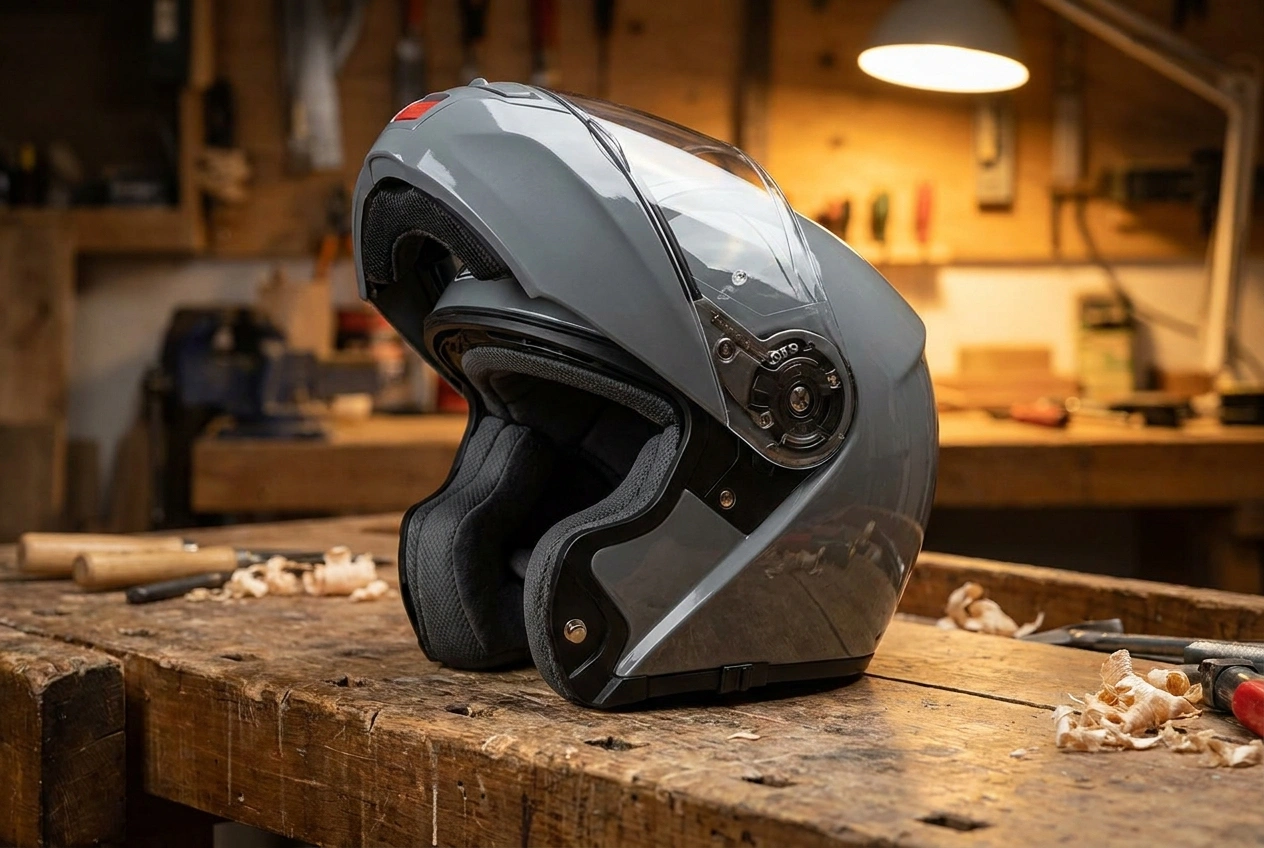
A modular motorcycle helmet (also called a flip-up helmet) combines a full-face shell with a hinged chin bar that swings up to open the face. Riders get the ventilation and communication convenience of an open-face lid while retaining full-face protection when the chin bar is locked down - making it the most versatile helmet style on the road.
If you have ever stopped at a red light, flipped your chin bar up to take a sip of coffee or swap a word with a passenger, you already understand the core appeal of the modular helmet. It sits in a category all its own: more protective than a half or open-face lid, more practical than a sealed full-face on long touring days.
At the Research Desk we field questions about modular helmets every week, so this guide covers everything you need: how the mechanism works, how modular safety compares to full-face, the honest pros and cons, who the style suits best, and what the 2026 ECE 22.06 P/J dual-homologation rating actually means for buyers.
How the Chin Bar Mechanism Works
The defining feature of a modular helmet is the hinged chin bar. A pivot assembly on each side of the shell lets the lower face section rotate upward, typically by 180 degrees, and lock in the raised position. Most designs use a single release button at the front or a lever on the left side.
Inside the chin bar you will find a polycarbonate or fibreglass structural shell lined with EPS (expanded polystyrene) foam - the same impact-absorbing material used in the main shell. The chin bar is not cosmetic; in a certified modular it must survive the same impact and penetration tests as a full-face chin section, at least in the closed position.
The hinge joint is the main engineering challenge: it must be stiff enough to resist chin impact forces yet light enough not to make the helmet front-heavy. Heavier modulars (1,600-1,900 g) are a direct result of this hardware overhead versus a comparable full-face at 1,200-1,500 g.
Modular vs Full-Face Safety: What the Research Shows
The short answer: a well-made, properly certified modular is safe - but not quite as safe as an equivalent full-face at the chin bar area, because a mechanical joint will always be a weaker point than a one-piece shell.
Studies of real-world crash data (including the COST 327 project and later UK STATS19 analysis) consistently show the chin bar as the most frequently impacted helmet zone. A hinge that pops open on impact, or a poorly constructed pivot, can expose the face at exactly the wrong moment.
For the best safety outcome in a modular, look for:
- ECE 22.06 P/J dual-homologation (not just J)
- SHARP 4- or 5-star rating, which includes chin-bar impact scoring
- A positive chin-bar latch - meaning the bar locks automatically when you push it closed and requires a deliberate button press to open
- Fibreglass or carbon construction rather than polycarbonate if budget allows
See our full-face vs modular safety breakdown for a deeper look at the crash data and test methodology.
Pros of a Modular Helmet
Modulars dominate the touring and adventure-riding segment for good reason. Here are the genuine advantages that owner reports and manufacturer specifications consistently confirm:
- Glasses and comms friendly - flip up the chin bar, slide on eyewear or a comms headset, close back down. No contortion required.
- Ventilation on demand - cracking the chin bar open at lower speeds gives dramatically more airflow than any internal vent system can match on a hot day.
- Eating and drinking at stops - no need to remove the helmet entirely at rest stops; just flip up and refuel.
- Easier conversations - passengers, tolls, and fuel station attendants can hear you without you shouting through a full-face shell.
- Built-in sun visor - most mid-range and premium modulars include an internal drop-down sun lens, eliminating the need for a tinted swap visor.
- One helmet for multiple contexts - commuting closed, touring semi-open, town running fully flipped. Three riding styles, one lid.
Cons of a Modular Helmet
No helmet style is a universal winner. Here is where modulars fall short, honestly assessed:
- Heavier than full-face - the hinge hardware adds 200-400 g on average. On a long day at motorway speeds this translates to genuine neck fatigue.
- Noisier - the chin-bar seal is rarely as acoustically tight as a single-piece full-face shell. Expect 3-6 dB more wind noise at 100 km/h and above.
- Not for track use - most circuit regulations prohibit modulars regardless of rating. If you ride track days, you need a separate full-face.
- Latch maintenance - the pivot pins and locking mechanism need periodic inspection. Wear or corrosion can degrade the positive lock over time.
- Reduced chin protection vs full-face - even with P/J rating, the joint is a weak point. If chin protection is your top priority, a full-face wins.
- Premium pricing for safe examples - a well-built P/J-rated modular costs more than an equivalent-quality full-face due to the extra engineering. Budget modulars with J-only ratings should be avoided.
Who Should Buy a Modular Helmet
Modulars consistently outsell every other helmet style in the touring and adventure-touring segment globally, and for most riders they are the rational choice. Here is a practical breakdown:
Ideal riders for a modular:
- Touring riders covering 300+ km days who need to eat, refuel, and communicate without removing the helmet
- Commuters who wear glasses or hearing aids and struggle with full-face entry
- Adventure riders who alternate between motorway and town riding on the same trip
- Older or less flexible riders for whom pulling a tight full-face over the head is genuinely difficult
- Pillion passengers on long trips where rest-stop convenience matters
Full-face is the better choice if:
- You track ride or participate in any competitive motor sport
- Maximum chin protection is non-negotiable
- You ride aggressively at high speed and want the lightest, quietest shell possible
- You are on a tight budget - a good full-face costs less than a comparable safe modular
Not sure how a modular fits? Our guide to every motorcycle helmet type walks through all five styles side by side. Once you have narrowed your choice, the helmet fit guide explains how to size any lid correctly.
ECE 22.06 P/J Homologation: What It Means in 2026
ECE 22.06 is the current European helmet safety standard, mandatory for new helmets sold in the EU since 2023. For modular helmets it introduced the P/J (Protection/Journey) combined rating, which is the most important certification change in two decades.
Here is what the rating means in practice:
- P (Protection) - chin bar closed, full-face impact tests applied including frontal chin strike. Same test protocol as a full-face helmet.
- J (Journey) - chin bar open, tested as if it were an open-face helmet. Protects the top and sides of the skull, not the chin.
- P/J combined - the helmet passed both test sequences. You can ride with the bar down and rely on full-face-equivalent chin protection.
The label to look for is a sticker or moulded mark reading ECE 22.06 P/J. If you see only ECE 22.06 J - or any ECE 22.05 marking - the chin bar has not been tested to the full-face standard.
Want to compare all the certification marks on a helmet sticker? See our are full-face helmets safer article which covers ECE, DOT, SNELL and SHARP in detail.
Modular vs Full-Face vs Open-Face: At a Glance (2026)
| Feature | Modular (P/J rated) | Full-Face | Open-Face (3/4) |
|---|---|---|---|
| Chin bar protection | Good (tested closed) | Best (one-piece shell) | None |
| Typical weight | 1,600-1,900 g | 1,200-1,500 g | 1,000-1,300 g |
| Noise level (motorway) | Moderate-high | Low-moderate | High |
| Convenience at stops | Excellent (flip up) | Poor (full removal) | Good |
| Glasses/aids friendly | Yes | Difficult | Yes |
| Track approved | No | Yes | No |
| Best for | Touring, commuting | Sport, track, max safety | Town, low speed |
| ECE 22.06 test | P/J (dual) | P only | J only |
DOT vs ECE vs Snell vs MIPS, how to pick the right lid in 60 seconds, and when to replace it. One page, no fluff.
Frequently Asked Questions
Can you ride with a modular helmet chin bar up?
Legally in most countries, yes - but only if the helmet carries a J or P/J rating for the open position. Safety-wise, riding with the chin bar up removes all lower-face protection. Reserve it for slow car-park or rest-stop use, not open-road riding.
Are modular helmets ECE approved for full-face use?
Only if the helmet is marked ECE 22.06 P/J (or the older P rating under earlier standards). A J-only modular is homologated as an open-face lid, meaning the chin bar impact performance has not been officially tested. Always check the label inside the chin strap area.
Why are modular helmets heavier than full-face helmets?
The pivot pins, locking latch mechanism, and reinforced hinge points add structural hardware that a one-piece full-face shell does not need. Premium modulars in carbon fibre can reduce the penalty significantly, but entry-level polycarbonate modulars typically run 200-400 g heavier than comparable full-face lids.
Is a modular helmet good for long-distance touring?
Yes - touring is the use case modulars were designed for. The ability to flip up at fuel stops, take phone calls, eat without removing the helmet, and ventilate on hot roads all reduce fatigue on multi-day journeys. Choose a P/J-rated model with an integrated sun visor and Pinlock-ready face shield for best results.
What is the difference between ECE 22.05 and ECE 22.06 for modular helmets?
ECE 22.05 (the previous standard) had no separate chin-bar-closed test requirement for modulars. ECE 22.06 (mandatory for new EU sales from 2023) introduced the P/J protocol that tests the chin bar under full-face conditions. A 22.05 modular may still be a quality helmet, but it has not been tested to the same rigour as a 22.06 P/J model.
