
Affiliate disclosure As an Amazon Associate we earn from qualifying purchases, at no extra cost to you.
To make a motorcycle helmet fit better: swap to thicker cheek pads, add a thinner top liner, or try a smaller size during the break-in window. If the shell presses unevenly on your skull, the helmet shell shape is mismatched to your head shape and padding alone will not fix it safely.
A too-loose motorcycle helmet is a safety failure, not just a comfort annoyance. At highway speed, a helmet that moves independently of your head can shift in a crash, exposing the parts of your skull it was sized to protect. The good news is that most fit problems fall into one of four solvable categories, and only one of them actually requires buying a new helmet.
Below, we walk through how to diagnose your specific fit problem, which fixes are safe to make yourself, and the one scenario where no amount of padding will help.
Step One: Diagnose the Type of Fit Problem
Before buying anything, put the helmet on and hold it still at the front. Try to rotate the helmet left and right and rock it front-to-back. A correctly sized helmet should move your skin with it, not slide over it.
- Loose all around: the shell is too large; padding upgrades are the first fix.
- Loose only front-to-back, tight side-to-side: the shell oval does not match your head oval. This is a head shape mismatch.
- Hot spots on the forehead or crown only: specific pressure points, often fixable with a different liner thickness.
- Cheeks slip up when you look down: cheek pads are undersized; thicker pads are the fix.
- Chin-bar gap with face shield closed: the helmet is too tall front-to-back; usually a wrong-shape problem.
Write down which description fits before moving to the next section. A wrong diagnosis leads to wasted money on pads that do not help.
Cheek Pad and Liner Swaps
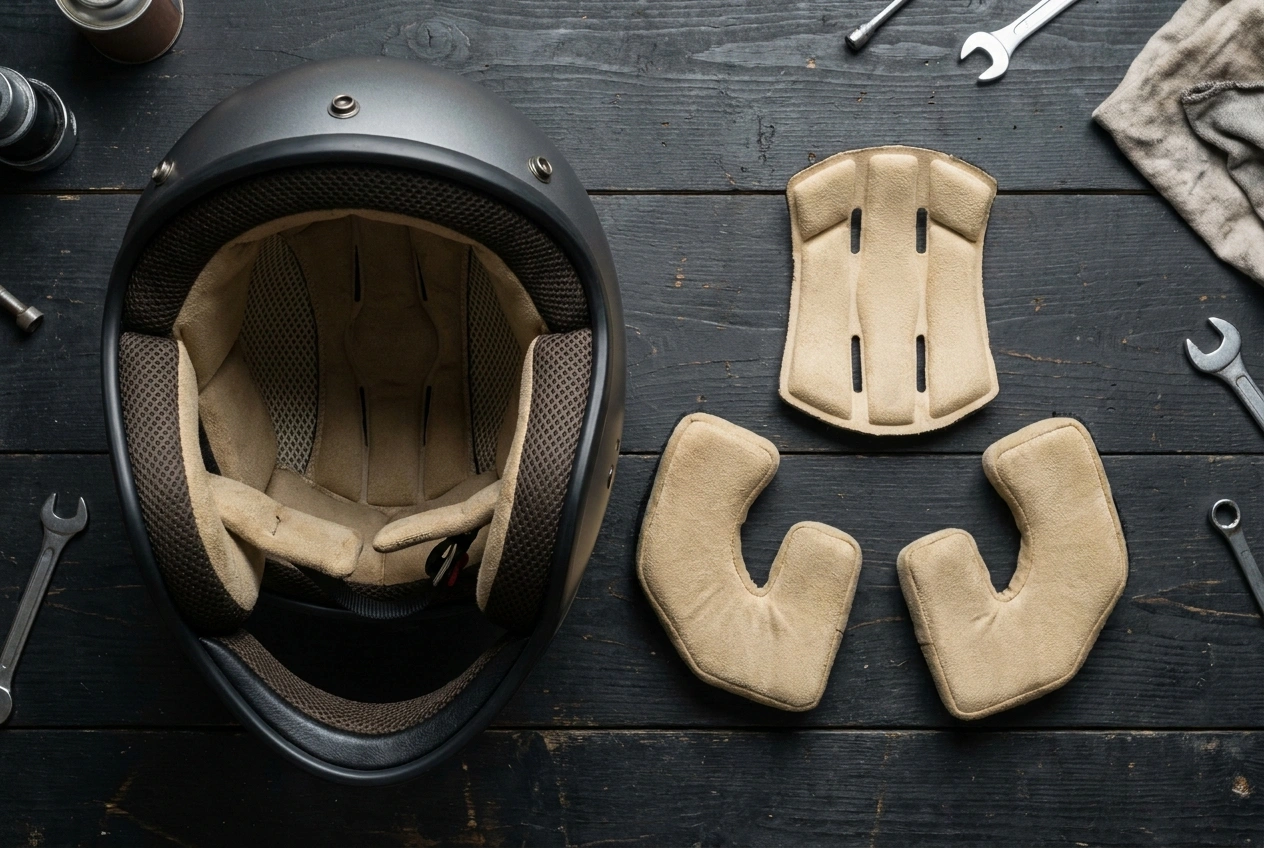
Cheek pads are the most accessible fit adjustment on almost every helmet made in the last decade. Most mid-range and premium helmets ship with at least two pad thicknesses in the box, and manufacturers sell additional sizes separately. Going up one pad size (typically 5 mm thicker) adds meaningful snug pressure against your cheeks and temples without changing the shell fit at the crown.
What to expect:
- Cheek pads are usually held by press-fit tabs or Velcro strips and swap out in under two minutes.
- A new set should feel uncomfortably tight for the first few rides, then soften to a firm hold.
- If thicker pads push the eye port away from your face or make the visor seal unreliable, you have gone too thick.
- Top crown liners can also be swapped for thinner versions to reduce pressure-point pain at the top of the head.
Not all helmet brands sell replacement pads with thickness options. Bell, Shoei, Arai, HJC, Scorpion, and Biltwell do. If your helmet brand does not, a universal foam insert kit (for rough fit adjustment only) can reduce movement while you save for a better-fitting helmet.
Sizing Down: When a Smaller Shell Is the Right Answer
Many riders size up one size when a helmet feels tight in the shop, reasoning that it will stretch. This often backfires. A helmet that is one size too large cannot be safely padded down to a correct fit because the EPS liner relationship to the shell is now wrong for your head volume. You have extra room everywhere.
If your current helmet passes the rotation test only with maxed-out padding, the correct move is to try the next smaller shell size with minimal padding:
- The helmet should feel slightly too tight for the first 15 to 20 seconds.
- After 30 minutes of wear, tight should become snug but not painful.
- A correctly sized helmet leaves no gap between the top liner and your crown.
- New helmets are typically sold with a 14-day fit exchange policy at reputable dealers.
If you are between sizes, go smaller rather than larger. You can always swap to thinner cheek pads; you cannot add a missing 10 mm of shell volume.
The Break-In Period: What Changes and What Does Not
Helmet EPS liners and cheek pad foam both compress with use. A brand-new helmet that feels uncomfortably snug but has zero pressure hot spots will typically break in over three to five hours of wear to a firm, uniform hold. This is normal and desirable.
What break-in does NOT fix:
- Hot spots (concentrated pressure on one point of the skull) get worse, not better, as padding flattens around the high point.
- Loose helmets do not tighten with break-in; pad foam compresses further, making them looser.
- Shell-to-head-shape mismatches are structural and no amount of riding changes the shell geometry.
A useful rule: if a new helmet produces a headache within 45 minutes, it is either the wrong size, the wrong shape, or the wrong brand for your head. Return it during the exchange window rather than hoping it breaks in.
Head Shape Mismatch: Round, Intermediate, and Long Oval
Motorcycle helmets are designed around one of three head oval templates: round oval (nearly circular when viewed from above), intermediate oval (the widest option and the industry default), and long oval (noticeably front-to-back elongated). If the helmet shell oval does not match yours, you will feel pressure on two opposing points regardless of what padding you use.
How to identify a mismatch:
- Pressure on temples only, loose front-to-back: your head is longer than the shell. You need a long-oval helmet.
- Pressure on forehead and back of head, loose at sides: your head is rounder than the shell. You need a round-oval helmet.
- Uniform pressure all around: the shell size is close but may need one size up or better cheek pads.
Head shape is why two riders with the same head circumference can have completely different helmet brand preferences. Shoei tends toward round oval; Arai and Bell Qualifier trend toward intermediate to long oval; HJC and Scorpion are commonly cited as intermediate fits. For a full brand-by-shape breakdown, see our guide to determining your head shape for a motorcycle helmet.
Fixing Pressure Points Without Replacing the Helmet
Pressure points differ from overall tightness. A pressure point is a specific, localized discomfort that increases over a long ride and may produce a headache behind the eyes, on the crown, or at the temples. (For a deeper look at what drives each pressure-point type, see our dedicated guide on why your helmet hurts your head.) Common causes and fixes:
- Crown pressure: swap to a thinner top liner (check your helmet manufacturer's liner options) or try a balaclava that distributes pressure more evenly.
- Temple pressure: try thinner cheek pads rather than thicker, as thick pads push the temples outward against the shell wall.
- Forehead bar contact: try adjusting the helmet further back on your head; if the bar still contacts the same point it is a shell-shape issue.
- Ear pressure from cheek pads: check that the pads are correctly seated; misaligned pads fold against the ear canal and cause pain that mimics a size problem.
A simple diagnostic: after a one-hour ride, mark with a pen the exact points where your scalp is tender. Match those points against the helmet interior padding. If the tender spot corresponds to a pad seam rather than foam center, a re-seat or pad replacement usually solves it.
When a Helmet Simply Cannot Be Fixed
There is an honest limit to what padding can do. If the EPS shell contacts your skull directly at any point (you can usually feel the hard inner surface through the padding), the helmet is structurally wrong for your head and no foam swap will make it safe in a crash. The EPS foam's job is to decelerate your skull over a controlled distance; if it is already bottomed out against your head at rest, it cannot do that job on impact.
Signs a helmet needs to be replaced or exchanged rather than adjusted:
- Any hard contact point you can feel through the liner when pressing on the outside of the shell.
- The helmet sits visibly higher on one side than the other due to an uneven skull contact.
- Rotation and rock tests still show free movement after adding the thickest available pads.
- The helmet has been in any impact, however minor.
See our full guide on when to replace a motorcycle helmet for the post-impact and age criteria that apply regardless of how the helmet fits.
Helmet Fit Symptom Guide: Problem, Fix, and When to Buy New
| Symptom | Most Likely Cause | Fix | Buy New? |
|---|---|---|---|
| Loose all around, rotates easily | Shell too large | Thicker cheek pads + thinner crown liner, or size down | Only if padding maxes out |
| Tight on two opposite points, loose on the others | Head-shape mismatch (oval mismatch) | Try a different brand shaped for your oval | Yes, padding will not fix this |
| General tightness, no hot spots | New helmet, needs break-in | Wear 3-5 hours across several sessions | No |
| Single painful pressure point after 30+ min | Pad misalignment or wrong liner thickness | Re-seat pads, swap to thinner crown liner | Only if EPS makes contact |
| Cheeks feel secure but crown is loose | Top liner too thin | Try a thicker crown liner | No |
| Chin bar sits away from face | Wrong head shape or too large | Size down or try different brand | Usually yes |
| Has been dropped or impacted | EPS may be compromised | N/A | Yes, always |
DOT vs ECE vs Snell vs MIPS, how to pick the right lid in 60 seconds, and when to replace it. One page, no fluff.
Frequently Asked Questions
Can I make a motorcycle helmet fit better with padding alone?
Yes, if the problem is overall looseness due to a slightly oversized shell. Thicker cheek pads and a thicker crown liner can take up meaningful slack. If the problem is a head-shape mismatch (pressure on two opposite points only), padding cannot fix it safely because the shell geometry is wrong for your skull.
How tight should motorcycle helmet cheek pads feel?
New cheek pads should feel snug to the point of mild discomfort for the first few rides. They should press evenly on your cheeks without causing pain. After three to five hours of wear they will conform and settle to a firm hold. If they produce sharp pain or affect vision, they are too thick.
Do motorcycle helmets loosen up over time?
Yes. Cheek pad foam and the EPS inner liner both compress slightly with use over the first 15 to 20 hours of wear. A helmet that starts at snug will break in to a firm but comfortable fit. A helmet that starts loose will only get looser as the foam compresses further.
What is the difference between a round oval and intermediate oval motorcycle helmet?
Round oval helmets are nearly circular when viewed from above and suit heads with similar front-to-back and side-to-side measurements. Intermediate oval helmets are slightly longer front-to-back and are the most common shell shape. Long oval helmets are noticeably elongated front-to-back. Wearing the wrong oval causes pressure on two opposing points that no padding will fix.
When should I replace a motorcycle helmet instead of adjusting the fit?
Replace a helmet if it has been in any impact (including a drop from bench height), if you can feel hard EPS contact through the liner when pressing gently on the outside, if it is more than five years old, or if maximum padding still leaves it rotating freely on your head. See our full replacement guide for the complete criteria.
