
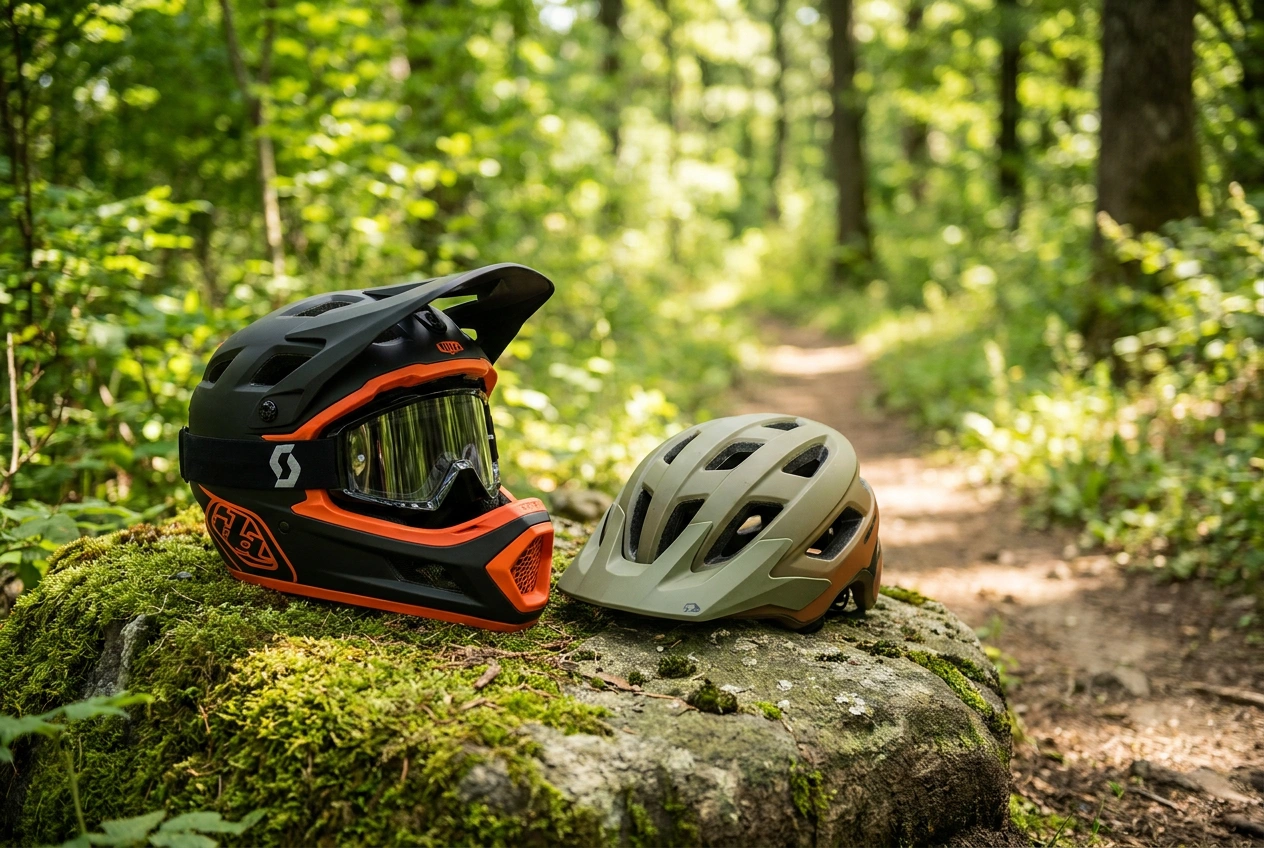
Wear a half-shell (open) trail helmet for cross-country, climbing, and most trail riding, where ventilation and low weight matter. Switch to a full-face for downhill, bike-park, and fast enduro, where a chin-bar guards your jaw and face. A convertible helmet with a removable chin-bar covers both jobs in one lid.
The question behind most helmet buys is simple: does the riding you actually do need a chin-bar? On our test bench we keep coming back to the same split. The faster and steeper the terrain, the more a face hits the ground, and the more a full-face earns its weight. The flatter and longer the day, the more a half-shell pays you back in airflow and a cooler head.
Below we lay out where each style fits, what certifications to look for, how convertible helmets bridge the gap, and how to read the rotational-impact features that now sit on most good lids.
Half-shell: the default for XC, trail, and climbing
A half-shell, also called an open-face trail helmet, covers the top, back, and sides of your head but leaves your face open. For the bulk of mountain biking, that is the right trade. You get more vents, less weight on your neck over a long climb, and far better heat management when the pace is steady rather than violent.
This is the helmet for cross-country racing, all-day trail loops, gravel crossover, and the climb-heavy rides where you are working hard but not regularly going over the bars at speed. Modern trail half-shells extend coverage lower at the back of the head than older road-style lids, which is what you want when a fall can send you backward off the saddle.
- Lighter on the neck across long climbs and multi-hour days
- More vents and better airflow when you are working hard
- Extended rear coverage on trail-specific models
- Easy to pair with sunglasses and a peak for sun and spray
Full-face: chin-bar protection for downhill, park, and enduro
A full-face wraps the jaw and chin in a fixed bar. That bar is the entire point. When you are riding downhill tracks, lapping a bike-park, or sending the steep, fast sections of an enduro stage, the ground comes up quickly and your face is exposed in a way a half-shell cannot cover. Jaw and chin injuries are common in crashes at these speeds, and the chin-bar is what stands between your teeth and a rock.
The trade is real: a full-face is heavier, hotter, and muffles hearing and breathing more than an open lid. For shuttle laps and lift-served park days that is a non-issue, because you are not grinding up a 40-minute climb in it. For pedal-up enduro, riders often climb with the helmet vented or loosened and commit to the descent with it fully on.
If you ride a bike-park, race downhill, or hit jump-lines and steep chutes regularly, a full-face is not optional. The protection a chin-bar adds in a face-first impact is the one thing a half-shell structurally cannot give you.
Convertible helmets: a removable chin-bar as the middle ground
A convertible helmet ships with a chin-bar you can attach or remove. Climb with the bar off and the helmet behaving like an open trail lid, then clip the bar on at the top for the descent. For enduro riders who pedal to the top of their own laps, this is the format that solves the airflow-versus-protection conflict in one purchase.
Two cautions keep this honest. First, a removable bar is generally not as strong in a hard face-first impact as a one-piece downhill full-face, so dedicated park and downhill riders should still favor a fixed-bar helmet. Second, check exactly which certifications the helmet carries with the bar attached, because that is the configuration where the chin protection is being claimed. A convertible is a smart compromise for mixed riding, not a replacement for a true gravity lid.
Certifications: CPSC, ASTM F1952, and what they cover
Every bike helmet sold in the United States must meet the CPSC bicycle-helmet standard. That is the baseline floor, and it applies to half-shells and full-faces alike. It is necessary, but on its own it does not tell you a helmet is built for gravity riding.
For downhill and bike-park use, look for ASTM F1952, the downhill mountain-bike standard. It tests the helmet, including the chin-bar, against the harder, faster impacts these disciplines produce. A full-face that carries ASTM F1952 has had its chin-bar validated for downhill duty. A convertible should state which standards it meets with the bar attached. A few full-faces also carry motorcycle standards, which adds further chin-bar testing, though those lids are usually heavier than purpose-built MTB models.
- CPSC: required baseline for any bike helmet sold in the US
- ASTM F1952: downhill MTB standard, validates the chin-bar for gravity impacts
- Convertibles: confirm the standard is met with the chin-bar attached
MIPS and rotational protection
Most crashes hit the head at an angle, not dead-on, and that angle twists the brain inside the skull. MIPS and similar systems add a low-friction layer that lets the shell rotate slightly against the head on impact, shedding some of that rotational energy. It is now common on both half-shells and full-faces across price tiers.
We treat rotational protection as a feature worth having rather than a substitute for the right helmet style. A half-shell with MIPS is still a half-shell with no chin-bar. Pick the correct format for your riding first, then prefer a model that includes a rotational-management system. To see how independent lab testing compares helmets on exactly this kind of impact, our guide on Virginia Tech ratings explained walks through how the scores are built.
Which one is the right call for you
Match the helmet to the riding you do most, then size up the protection for your hardest days. If you climb to descend, own both styles or run a convertible. If you only ever ride one way, the choice is usually obvious from the terrain.
- XC, trail, gravel, climbing-heavy days: half-shell trail helmet
- Bike-park, downhill, jump-lines, lift-served laps: full-face with ASTM F1952
- Pedal-up enduro with steep descents: convertible, or both styles in the kit
- New to the discipline and unsure: start with the helmet your local terrain demands, not the lightest one on the shelf
Half-shell vs full-face vs convertible
| Factor | Half-shell (open) | Full-face | Convertible |
|---|---|---|---|
| Chin-bar | None | Fixed, strongest | Removable, good with bar on |
| Best for | XC, trail, climbing | Downhill, park, fast enduro | Pedal-up enduro, mixed riding |
| Ventilation | Best, many vents | Most restricted | Open with bar off, warmer with bar on |
| Weight on neck | Lightest | Heaviest | Light climbing, heavier descending |
| Key certification | CPSC | CPSC plus ASTM F1952 | Confirm ASTM F1952 with bar attached |
| Rotational option | MIPS common | MIPS common | MIPS common |
DOT vs ECE vs Snell vs MIPS, how to pick the right lid in 60 seconds, and when to replace it. One page, no fluff.
Frequently Asked Questions
Do I really need a full-face for trail riding?
For most cross-country and trail riding, no. A half-shell trail helmet covers that riding well and keeps your head cooler. You need a full-face when you ride downhill, bike-park, jump-lines, or the fast steep parts of enduro, where a chin-bar protects your jaw and face in a head-first impact.
Is a convertible helmet as safe as a dedicated full-face?
With the chin-bar attached a good convertible adds real face protection, but a removable bar is generally not as strong in a hard face-first crash as a one-piece downhill full-face. For regular park and downhill use we still favor a fixed-bar helmet. A convertible is best for pedal-up enduro and mixed riding.
What is ASTM F1952 and why does it matter?
ASTM F1952 is the downhill mountain-bike helmet standard. It tests the helmet and its chin-bar against the harder, faster impacts typical of gravity riding. A full-face that carries ASTM F1952 has had its chin-bar validated for downhill duty, which CPSC alone does not cover.
Does MIPS replace the need for a chin-bar?
No. MIPS and similar systems reduce rotational energy from angled impacts, and they help on any helmet. They do nothing to protect your face, because a half-shell with MIPS still has no chin-bar. Choose the right helmet style first, then prefer a model that includes rotational protection.
Can I climb in a full-face without overheating?
Many enduro riders manage it by climbing with the helmet vented or slightly loosened, then committing to the descent with it fully on. If most of your day is climbing, a convertible with the bar off, or a separate half-shell for the way up, is more comfortable than grinding up in a fixed full-face.
