
Affiliate disclosure As an Amazon Associate we earn from qualifying purchases, at no extra cost to you.
Helmet intercoms let riders communicate in real time without taking their hands off the bars - whether calling turns in a group, talking to a passenger, hearing GPS directions, or streaming music. They mount inside any full-face or modular lid and connect via Bluetooth or mesh radio, giving on-road and off-road riders a safer, less distracted way to stay in touch.
There are moments on every ride where a hand signal is not enough. Your passenger wants to flag a fuel stop. Your riding buddy spots a pothole before you do. Your GPS recalculates mid-corner. Before intercoms, the only options were a tap on the shoulder or shouting through a full-face - neither worked well above 40 mph.
Today, helmet communication systems have become standard kit for group tours, adventure riders, snowmobilers, and even commuters. In this 2026 guide, the Research Desk breaks down exactly why riders install them, what each use case actually demands, and how to match the right technology to how you ride.
Group Riding: Coordination Without Hand Signals
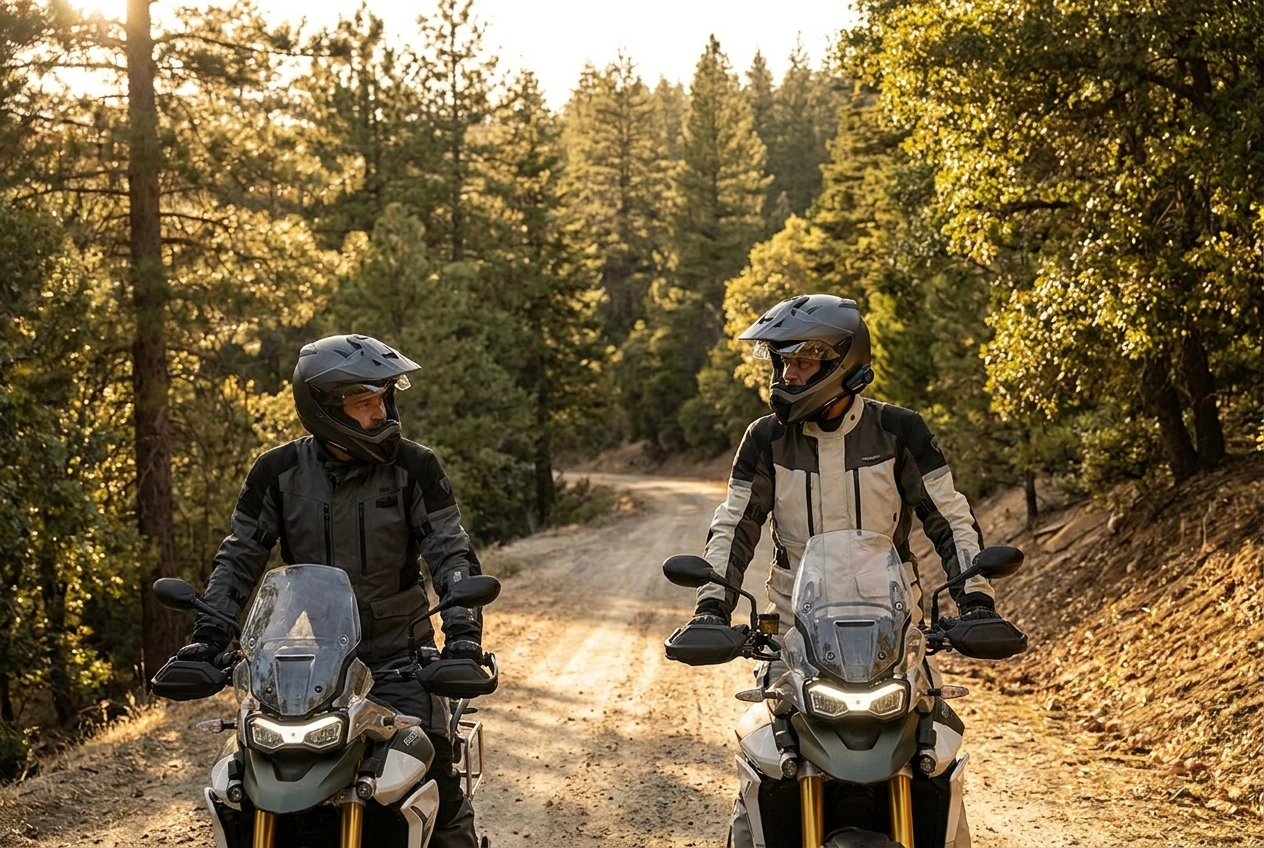
Hand signals work fine for a small group in clear conditions. They break down the moment a rider looks away, misses the signal, or the group stretches past three bikes. Intercoms solve this by keeping an open audio channel between riders - no looking away required.
Common group-riding benefits:
- Call out road hazards, loose gravel, or wildlife ahead
- Confirm the group is pulling in for fuel before the lead bike turns off
- Keep newer riders oriented on unfamiliar routes without stopping
- Maintain morale on long stretches - conversation fights fatigue
Mesh systems (Cardo DMC, Sena Mesh Intercom) are the current standard for groups of four or more because every node relays the signal. Lose visual contact with one rider and the audio chain stays intact, as long as units are within roughly 1 km of each other. Bluetooth-chained systems are cheaper but create a single point of failure if the middle rider drops out.
Honest caveat: open-mic group chat creates distraction if riders talk constantly. Most experienced groups agree on short tactical comms only - the intercom is not a podcast co-host.
Rider-Passenger Communication: The Most Underrated Use Case
Passenger riders have almost no way to communicate urgently from a pillion seat. Tapping the rider on the shoulder is vague; shouting through helmets is unintelligible at any speed. A paired intercom solves this completely.
- Passenger can say they need to stop - clearly, immediately
- Rider can warn the pillion before accelerating hard or braking
- Music or navigation audio is shared, so both enjoy the same experience
- New pillions report significantly less anxiety when they can speak
For rider-passenger use, even a basic two-channel Bluetooth headset is sufficient. Mesh is overkill unless the pair also ride separately in a larger group. Battery life matters here: a full day trip easily runs eight to ten hours, and most budget units advertise twelve hours but deliver closer to seven under real-world load (music plus occasional intercom bursts).
Even solo riders find intercoms valuable for one simple reason: without one, checking navigation means glancing down at a mounted phone or tank-bag screen. With one, GPS turn prompts play directly into the helmet speakers - eyes stay up.
Most modern intercoms connect to a smartphone via Bluetooth and support audio mixing, so GPS instructions cut through music automatically rather than requiring riders to manually pause and check. This is the same functionality built into high-end helmet audio systems, available here for $50-150 in an add-on unit.
Music quality varies significantly. Budget units use 30-32mm speakers; mid-range and premium units use 40mm drivers (some co-engineered by JBL or Harman Kardon). At 70 mph, wind noise through a modular or open-face helmet drowns out anything less than a well-sealed full-face plus decent speakers - a factor worth understanding before buying on price alone.
- GPS audio mix cuts navigation prompts over music automatically
- Voice assistant access (Siri, Google) for calls without stopping
- FM radio included on many units for long highway miles
- Two-phone pairing lets you keep a personal and work phone active
Mesh vs Bluetooth: Which Technology Do You Actually Need?
The intercom market splits into two core technologies. Understanding the difference prevents buyers from over-spending or buying the wrong system entirely.
Bluetooth intercom pairs units in a daisy-chain. Rider A connects to B, B to C, C to D. Range is typically 800m to 1.6km in open terrain. Chain breaks if the middle unit goes out of range or dies. Best for: two-up riding, small touring pairs, budget-conscious buyers.
Mesh intercom (Cardo DMC, Sena Mesh Intercom, Spider ST1) operates like a radio network - every unit acts as a relay node. Groups of up to 15-24 riders stay connected even if spacing exceeds Bluetooth limits. Self-healing: if one unit drops out, others route around it automatically. Best for: group tours, track days, adventure riding, snowmobiling in spread-out terrain.
Range reality check: manufacturer range specs are measured in flat, open terrain with no interference. In forest trails, mountain switchbacks, or urban canyons, effective range is typically 30-50% of the advertised figure. Mesh systems partially compensate via hop-routing, but are still constrained by physics.
On-Road vs Off-Road: Different Demands, Different Priorities
On-road touring riders prioritize audio quality, battery life, and ease of operation at highway speeds. They may wear the unit for eight to twelve hours per day. Speaker quality and wind-noise isolation matter more than ruggedness.
Off-road and adventure riders face a different set of demands:
- Waterproofing - trail riding means rain, stream crossings, and mud spray. Look for IP65 or higher (IP67 is submersion-rated).
- Vibration tolerance - enduro and single-track riding subjects units to sustained vibration that loosens poorly-designed mounts
- Glove-friendly controls - off-road gloves are thick; small touch controls are unusable. Large physical buttons or voice commands are non-negotiable
- Interoperability - adventure groups often mix brands; universal Bluetooth intercom mode is the fallback when mesh protocols differ
Snowmobiling deserves special mention. Sleds run loud (often 85-95 dB at the operator), speeds regularly exceed 80 mph on open trails, and riders may be spread over large terrain with no cell coverage. Mesh systems with strong relay range are the right tool here. Our snowmobile communication system guide covers the category in depth.
What to Look for Before You Buy in 2026
The market has matured: there are now reliable units at every price tier. The decision is less about brand loyalty and more about matching specs to your actual use pattern.
- Group size: solo or two-up - Bluetooth is fine. Three or more - mesh is worth the premium
- Ride type: touring highway - speaker quality and battery matter most. Off-road - waterproofing and mount robustness come first
- Helmet type: full-face helmets pair well with speakers and boom/button mics. Open-face and half shells let in more wind noise - DSP noise cancellation helps
- Pairing ecosystem: if your riding buddies are all on Cardo, buying Sena does not eliminate compatibility but adds a step (Universal Intercom fallback runs at reduced feature parity)
- Legal note: using intercoms is legal in all 50 US states and most EU countries. Some jurisdictions restrict both ears being covered while riding - check your local regs if using noise-isolating earbuds alongside the system
For the complete shortlist of tested communication systems by use case, the Research Desk has a dedicated roundup covering both snowmobile and moto intercoms with verified product data.
Mesh vs Bluetooth Intercom at a Glance
| Feature | Bluetooth Chain | Mesh Network |
|---|---|---|
| Group size | 2-4 riders (practical limit) | Up to 15-24 riders |
| Range (open terrain) | Up to 1.6 km | Up to 1-1.6 km per hop, self-healing |
| Single-node dropout | Chain breaks | Auto-routes around failure |
| Price (single unit) | $40-$150 typical | $150-$350 typical |
| Best for | Passenger + small groups, touring pairs | Group tours, adventure, snowmobile |
| App required | Usually optional | Often recommended for grouping |
DOT vs ECE vs Snell vs MIPS, how to pick the right lid in 60 seconds, and when to replace it. One page, no fluff.
Once you know you want one, our best motorcycle Bluetooth intercoms roundup narrows it down by group size.
Frequently Asked Questions
Do helmet intercoms work with all helmet types?
Most intercoms ship with both a boom microphone (for open-face helmets) and a button or thin mic (for full-face helmets). They work with any helmet that has speaker pockets or a flat interior surface for adhesive mounting. Full-face and modular helmets produce the best audio because they block external wind noise at the microphone.
How far does a Bluetooth motorcycle intercom reach?
On flat, open terrain, Bluetooth intercoms typically connect between 500 m and 1.6 km. In forest, urban, or mountain terrain, expect 30-50% of the rated figure. Mesh systems partially compensate by hopping signals through intermediate riders, but physics still apply.
Can I use a helmet intercom while riding off-road?
Yes - and many off-road and adventure riders consider them essential for group navigation and safety calls. Prioritize IP65 or IP67 waterproofing, large glove-friendly buttons, and a robust clamp mount over a adhesive-only base if the terrain is rough.
Is it legal to use a helmet intercom while riding?
Intercom use is legal in all 50 US states and across most of Europe. A few jurisdictions restrict having both ears covered at the same time while riding - an issue more relevant to in-ear monitor users than standard helmet speakers. Always verify local laws before riding.
What is the difference between Cardo and Sena intercoms?
Both are industry-leading brands with reliable products at multiple price points. Cardo uses its own DMC (Dynamic Mesh Communication) protocol; Sena uses Mesh Intercom. Both offer universal Bluetooth fallback for cross-brand pairing, but full-feature group mesh only works within the same ecosystem. Sena has broader mid-range choices; Cardo's flagship units include JBL speakers and crash-detection on the Packtalk Pro.
