
Affiliate disclosure As an Amazon Associate we earn from qualifying purchases, at no extra cost to you.
Buy the wrong motorcycle intercom and you end up with a unit that has never once talked to your riding buddy's headset, no matter how many stars the listing collects. That is one of the most repeated regrets on r/motorcycles headset threads, and it traces back to a decision most listings never explain up front: mesh or standard Bluetooth, and how many riders you actually need to reach.
Mesh and Bluetooth intercoms solve the same problem in different ways. Standard Bluetooth pairs a small chain of units directly to each other, works well for two to six riders, and (per most manufacturers' own claims) tends to pair across brands. Mesh builds a self-healing radio network that riders can drop in and out of without re-pairing, which is genuinely useful once a group gets large or spreads out over a long ride, but mesh only helps if the people you ride with run the same mesh protocol. A Sena mesh network and a LEXIN mesh network are not the same conversation, and we would not bet a group ride on a "cross-brand mesh" claim without confirming it in a parking lot first.
So instead of ranking these eight by brand prestige, we organized them by the question that actually decides which one you need: how many people are you talking to, and how often? If you want the comms built into the shell instead of clipped onto it, see our best Bluetooth motorcycle helmets roundup. Cruiser and Harley riders working specifically with Cardo and Sena hardware should also check our Harley-Davidson Bluetooth headset guide, and anyone riding in the cold should look at our snowmobile communication system picks, which cover glove and cold-weather-specific units these eight do not.
Key Takeaways
- Mesh only helps if the people you ride with run the same mesh protocol - the safest assumption is that a Sena mesh network and a LEXIN mesh network are two separate conversations, whatever the packaging implies.
- Riding mostly solo and just want music, GPS turns and the odd call? You do not need mesh at all - a plain two-way unit like the Sena 5S covers it for less than a mesh unit costs.
- Two-up riders (you and one passenger) are better served by a headset built around a matched pair, like the Cardo Freecom 4X, than by a mesh network neither of you will ever fill.
- Small groups of three to six riders do fine on standard Bluetooth intercoms that switch between paired devices, such as the EJEAS V6 Pro, without paying the mesh premium.
- Once a ride grows past six or seven riders, or spreads out over a full touring day, mesh earns its keep - the LEXIN MeshCom supports the most riders on one channel in this lineup.
| Sena 5S |  |
Best for Solo Riders | Type: Bluetooth intercom (pairs with one other 5S) | Rider capacity: 2 - this headset plus one other Sena 5S | Best for: Solo riders who mainly want music, GPS and calls | VIEW LATEST PRICE | Read Our Analysis |
| Cardo Freecom 4X |  |
Best Overall for Two-Up | Type: Bluetooth intercom (4-way) | Rider capacity: Up to 4; sold as a 2-unit dual pack | Best for: Two-up riders who want Cardo's app and OTA updates | VIEW LATEST PRICE | Read Our Analysis |
| THETREE X2 | 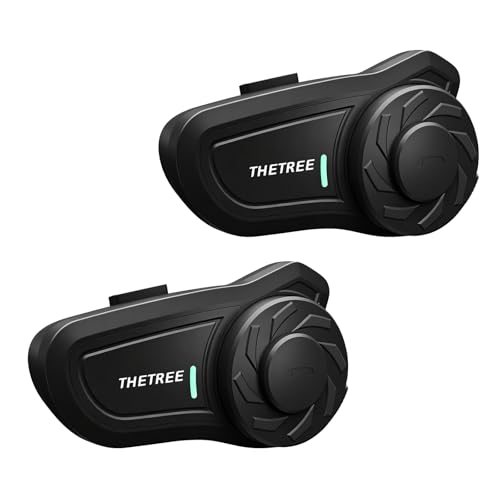 |
Best Budget Two-Up | Type: Bluetooth 2-way intercom | Rider capacity: 2 - rider and one partner | Best for: Budget two-up riders who just need to talk to one partner | VIEW LATEST PRICE | Read Our Analysis |
| EJEAS V6 Pro | 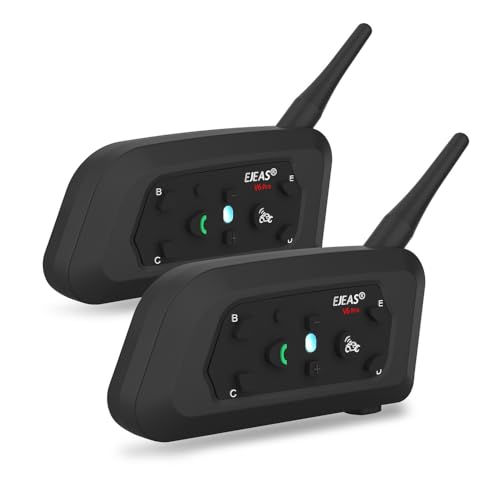 |
Best for Small Groups (3-6) | Type: Bluetooth group intercom (full-duplex for 2 at a time) | Rider capacity: Up to 6, switching across 5 channels | Best for: Small groups of 3-6 who take turns talking | VIEW LATEST PRICE | Read Our Analysis |
| JESIMAIK 2-Way |  |
Best Budget Small Group | Type: Bluetooth intercom, pairs with up to 6 devices | Rider capacity: Up to 6 paired devices; real-time 2-way between the active pair | Best for: Budget small groups who want the most paired devices for the money | VIEW LATEST PRICE | Read Our Analysis |
| Sena 50R |  |
Best Premium Mesh | Type: Open Mesh + Bluetooth intercom | Rider capacity: Not specified by manufacturer as a hard number; runs on 9 Open Mesh channels | Best for: Riders who want Sena's mesh ecosystem with premium audio | VIEW LATEST PRICE | Read Our Analysis |
| LEXIN MeshCom (1-Pack) |  |
Most Riders Supported | Type: Mesh 3.0 + Bluetooth intercom | Rider capacity: Up to 24 riders on one channel (1.2 miles); 10 channels for separate groups | Best for: The largest group or club rides in this lineup | VIEW LATEST PRICE | Read Our Analysis |
| Fodsports FX7 10-Rider Mesh |  |
Best Budget Mesh | Type: Mesh intercom with 3 switchable modes | Rider capacity: Up to 10 riders, one-click pairing | Best for: Outfitting several riders with matching mesh units at once | VIEW LATEST PRICE | Read Our Analysis |
More Details on Our Top Picks
Sena 5S
Most riders shopping for a "motorcycle intercom" do not actually need an intercom most of the time. They need music, turn-by-turn GPS prompts and the ability to take a call without pulling over, and the Sena 5S is built around exactly that, with the two-way intercom function as a bonus for the days you have company.
The built-in LCD screen is the detail that separates it from cheaper no-name units: it shows battery life, radio frequency and volume level at a glance, so you are not guessing whether the unit died mid-ride or just went quiet on its own. The HD speakers are tuned specifically for volume, bass and clarity rather than being an afterthought bolted onto a phone-pairing chip.
Sena's listing does not print a range or battery-life figure for the 5S, so we are not going to invent one here; budget accordingly and check current owner reports if that number matters to your commute. It also only pairs with one other 5S at a time, so it is not the unit to grow into a group with.
For the rider who spends most miles alone and occasionally rides with one other person, the 5S is the simplest, least expensive way into the category without buying capability you will not use.
- Type:Bluetooth intercom (pairs with one other 5S)
- Rider capacity:2 - this headset plus one other Sena 5S
- Range:Not specified by manufacturer
- Battery:Not specified by manufacturer
- Waterproof rating:Not specified by manufacturer
- Audio:HD speakers tuned for volume, bass and clarity
- Best for:Solo riders who mainly want music, GPS and calls
Cardo Freecom 4X
The Freecom 4X is sold as a dual pack, which is a small but telling detail: Cardo built this one for exactly the rider-plus-passenger use case rather than as a scaled-down version of a bigger mesh unit. You open the box already owning a matched pair instead of buying twice.
It carries Cardo's Connect app support with over-the-air firmware updates, so the unit you buy today keeps getting feature updates rather than freezing at whatever software shipped in the box. That is a genuine advantage over the no-name competitors on this list, most of which get one firmware version and nothing else.
Cardo's listing leans on the 4-way Bluetooth capability and 40mm speakers rather than printing a specific range or battery-life number, so treat those as unconfirmed until you check current owner reports. It is rated waterproof, though Cardo does not publish an IP number for this model.
For two-up riding specifically, where you want reliable rider-to-passenger audio plus the option to occasionally pull in one or two more riders, the Freecom 4X is the strongest fit here.
- Type:Bluetooth intercom (4-way)
- Rider capacity:Up to 4; sold as a 2-unit dual pack
- Range:Not specified by manufacturer
- Battery:Not specified by manufacturer
- Waterproof rating:Waterproof (no IP rating given)
- Audio:40mm speakers
- Best for:Two-up riders who want Cardo's app and OTA updates
THETREE X2
The X2 does not pretend to be anything other than a two-person intercom, and that focus keeps the price down. Its Bluetooth 5.4 chip is aimed squarely at one job: stable rider-to-passenger audio, with a manufacturer-quoted 800 to 1000 meters of range in open areas.
The 40mm x 9mm speaker profile is slim enough to fit into most helmet speaker pockets without adding pressure, which matters more than people expect on a long two-up day. IP67 waterproofing and Type-C charging (with support for use while charging) cover the practical basics.
There is no published battery-life figure, and being sold as a 2-pack, it is explicitly a pair-only unit, not something you grow into a bigger group with later. It also includes both a button mic and a boom mic, so fit across full-face and modular helmets is not a guessing game.
For a passenger setup where you do not need mesh, an app, or firmware updates, and just want two headsets that talk to each other reliably, the X2 is the budget pick.
- Type:Bluetooth 2-way intercom
- Rider capacity:2 - rider and one partner
- Range:800-1000 m rider-to-rider in open areas
- Battery:Not specified by manufacturer
- Waterproof rating:IP67
- Audio:40mm x 9mm Hi-Fi speakers
- Best for:Budget two-up riders who just need to talk to one partner
EJEAS V6 Pro
This is the honest middle ground between a two-person headset and a full mesh network: the V6 Pro pairs up to six riders and lets the host switch between five channels, with full-duplex (both sides talking at once) for two riders at a time rather than everyone live simultaneously.
That is not a limitation unique to this unit; it is how most non-mesh group intercoms work, and the manufacturer is upfront about it rather than burying the detail. For a riding group that mostly talks in pairs or takes turns on the radio, it is a non-issue.
The 850 mAh battery is rated for 18 hours of talk time, 25 hours of music, and 260 to 360 hours of standby, which is enough for a full weekend without a charger. IP65/IP67 waterproofing and a 1,200-meter open-terrain range round out a genuinely complete spec sheet for the price.
For groups of three to six who do not want to pay a mesh premium for capability they will rarely use, the V6 Pro is the pick that matches the actual math of a small group ride.
- Type:Bluetooth group intercom (full-duplex for 2 at a time)
- Rider capacity:Up to 6, switching across 5 channels
- Range:1,200 m open terrain
- Battery:850 mAh - 18h talk / 25h music / 260-360h standby
- Waterproof rating:IP65/IP67
- Audio:Hi-Fi stereo with CVC/DSP noise cancellation
- Best for:Small groups of 3-6 who take turns talking
JESIMAIK 2-Way
Despite the "2-Way" name on the box, the JESIMAIK can pair with up to six devices for flexible switching in a group, with a manufacturer-quoted range up to 1,500 meters in open areas, longer than several pricier units on this list.
The listing also claims wireless pairing with "most mainstream helmet intercoms" for cross-brand riding, which is the kind of claim we would confirm with the specific units in your group before relying on it for a ride, not take at face value from packaging copy.
Battery life is a genuine strength: 25 hours of intercom use, 30 hours of music, and 400 hours of standby from an 800 mAh cell, plus a 1.5-hour USB-C fast charge. The 7mm ultra-thin speaker housing matters for anyone whose helmet liner is already snug.
For a small group that wants the switching capability of the EJEAS V6 Pro at a lower price point, and does not mind that intercom and music cannot run at the same time, this is the value pick.
- Type:Bluetooth intercom, pairs with up to 6 devices
- Rider capacity:Up to 6 paired devices; real-time 2-way between the active pair
- Range:Up to 1,500 m in open areas
- Battery:800 mAh - 25h intercom / 30h music / 400h standby
- Waterproof rating:IP67
- Audio:40mm dynamic driver, 4 sound-effect presets
- Best for:Budget small groups who want the most paired devices for the money
Sena 50R
The 50R is Sena's mesh hardware without the touchscreen and camera of its pricier siblings, which keeps the focus on the two things that matter most on a group ride: reliable mesh reconnection and audio quality. The Harman Kardon-tuned speakers and microphone are the clearest step up over the budget units on this list.
Sena's Open Mesh protocol supports switching between 9 communication channels, useful for running one channel for your immediate group and keeping others free for a second pack or a passing rider you don't want joining the conversation. Bluetooth 5 handles phone pairing and voice-assistant access alongside the mesh function.
Sena does not publish a specific rider-count ceiling, range, or battery-life figure for the 50R in this listing, so treat mesh-network size and all-day battery claims as things to confirm with current owner data rather than numbers we can print here.
If your group already runs Sena hardware, or you specifically want the audio upgrade within Sena's own mesh ecosystem, the 50R is the sensible step up from the entry-level Sena units.
- Type:Open Mesh + Bluetooth intercom
- Rider capacity:Not specified by manufacturer as a hard number; runs on 9 Open Mesh channels
- Range:Not specified by manufacturer
- Battery:Not specified by manufacturer
- Waterproof rating:Not specified by manufacturer
- Audio:Speakers and microphone tuned by Harman Kardon
- Best for:Riders who want Sena's mesh ecosystem with premium audio
LEXIN MeshCom (1-Pack)
Twenty-four riders on a single mesh channel, with ten separate channels available for running multiple groups, is the largest stated capacity in this roundup. For a club ride or a large touring pack, that headroom is the entire point of buying mesh instead of a chained Bluetooth unit.
LEXIN's listing states the MeshCom pairs with other LEXIN Bluetooth headsets natively, plus standard 2-way Bluetooth pairing with "most different brands of devices." That second claim is a manufacturer statement about Bluetooth compatibility, not mesh compatibility, and it is worth keeping those two things separate when you are deciding whether your group's mix of brands will actually talk to each other.
A 1,150 mAh battery is rated for 20 to 25 hours of intercom or music use and 300 hours of standby, with a 2-hour full charge over USB-C. IP67 waterproofing and a -10 C to 55 C operating range cover most riding climates.
One caveat worth a bullet of its own: music sharing is limited to only 2 devices even though the mesh intercom itself scales to 24, so do not expect the whole pack to hear the same playlist. For rider-count headroom above everything else on this list, the MeshCom is the pick.
- Type:Mesh 3.0 + Bluetooth intercom
- Rider capacity:Up to 24 riders on one channel (1.2 miles); 10 channels for separate groups
- Range:1.2 miles on one mesh channel
- Battery:1,150 mAh - 20-25h intercom/music, 300h standby
- Waterproof rating:IP67, -10 C to 55 C operating range
- Audio:40mm Mylar + coaxial speaker with CVC/DSP noise cancellation
- Best for:The largest group or club rides in this lineup
Fodsports FX7 10-Rider Mesh
The FX7 is sold as a 2-pack, which makes it the practical choice if you are trying to get an entire riding group onto matching mesh hardware without paying premium-brand prices per unit. Fodsports rates it for up to 10 riders with one-click pairing and a 2 km intercom range.
Three switchable modes handle the social mechanics of a group ride: a two-rider mode for a private one-on-one chat, a Friends mode that locks the group and blocks new devices, and a Make Friends mode that leaves the network open for new riders to join. That is more thoughtful mode design than most budget mesh units bother with.
One real limitation the manufacturer states directly: audio mixing (music/intercom together) works for 2 to 10 FX7 units, or one FX7 plus one other device, but it cannot mix audio with multiple different models at the same time. That is a mesh cross-brand caveat worth knowing before you assume it will slot into a mixed-brand group.
At 15 hours of continuous use with charge-while-using support and IP67 waterproofing, it covers a full day out. For groups building a mesh network from scratch on a budget, buying several FX7 pairs is the most economical way to get everyone connected.
- Type:Mesh intercom with 3 switchable modes
- Rider capacity:Up to 10 riders, one-click pairing
- Range:2 km intercom range
- Battery:15 hours continuous use; supports charge-while-using
- Waterproof rating:IP67
- Audio:40mm speaker with Fodsports HRSQS HD audio, 3 EQ modes
- Best for:Outfitting several riders with matching mesh units at once
How to Choose a Motorcycle Bluetooth Intercom
The right intercom is decided by two questions: how many riders do you need to reach, and how often do you actually ride with them? Everything else, brand, app polish, voice control, is secondary to getting those two answers right first.
What did we actually check for this guide?
Nobody on our research desk clipped these eight units onto a helmet and rode a group loop to test them; a multi-niche site cannot credibly claim hands-on testing across every brand and protocol in this category, and we are not going to pretend otherwise. What we did do is pull each listing's stated specs directly from the Amazon Creators API (title and manufacturer feature text), cross-reference the mesh-versus-Bluetooth claims against how those two protocols are documented to work, and flag every manufacturer claim, like "cross-brand mesh," that is marketing copy rather than an independently verified fact. Where a listing does not print a number (range, battery life, rider cap), we say so instead of guessing. See our honest look at why we use helmet intercoms on and off road for more on how we approach this category.
What is the difference between a mesh and a Bluetooth motorcycle intercom?
A standard Bluetooth intercom pairs a small chain of headsets directly to each other, one link at a time, and if one rider drops out of range the chain can break for everyone behind them. A mesh intercom instead builds a self-healing radio network: riders can fall out of range and rejoin without anyone re-pairing, and the network reroutes around gaps automatically. Mesh is the better technology for a spread-out or growing group; standard Bluetooth is simpler, usually cheaper, and perfectly adequate for two to six riders who stay roughly together.
Does mesh actually work across different brands?
Generally, no, not reliably, and that is the single most important honest point in this guide. Sena, Cardo, LEXIN and the other mesh makers each run their own proprietary mesh protocol, and a Sena mesh network does not talk to a Cardo mesh network by default. Some budget listings advertise "cross-brand" compatibility, and that claim is usually describing standard Bluetooth 2-way pairing bolted alongside the mesh feature, not the mesh network itself talking across brands. If your riding group is not already standardized on one mesh brand, assume you will need to either agree on a brand together or fall back to each unit's standard Bluetooth pairing instead of its mesh mode.
Do you need a mesh intercom just to talk to a passenger?
No. A rider-and-passenger pair is exactly the use case standard Bluetooth intercoms like the Cardo Freecom 4X or THETREE X2 are built for, and paying for mesh capability you will never fill just adds cost and complexity. Mesh earns its keep once a group grows past what a chained Bluetooth pairing can comfortably handle, roughly six or more riders, or spreads out over a full day of touring.
How many riders can these intercoms actually connect at once?
It depends on the unit and, more importantly, on whether the manufacturer means simultaneous full-duplex conversation or a larger network you can switch within. The EJEAS V6 Pro and JESIMAIK 2-Way both pair with up to 6 devices but only run full two-way audio between 2 of them at a time; the LEXIN MeshCom scales to 24 riders on a single mesh channel because mesh does not require every rider to be actively speaking at once. Read the rider-capacity spec for each unit above rather than assuming the headline number means everyone talks simultaneously.
Does the range printed on the box match real-world riding?
Rarely at the full stated distance. Every range figure in this guide, whether it is THETREE's 800 to 1000 meters or LEXIN's 1.2-mile mesh channel, is a manufacturer figure measured in open, unobstructed terrain. Hills, trees, buildings and even other riders' bodies between you and your pack reduce real-world range, sometimes substantially, so treat these numbers as a ceiling rather than a promise. If your rides run through canyons or dense tree cover, buy toward the higher end of the stated range for your group size.
Once you have picked one, how do you actually mount it?
Mounting varies by brand and helmet shell, and getting the boom mic and speaker placement wrong is the most common reason a unit sounds worse than its spec sheet promises. If you land on a Cardo unit specifically, our Cardo installation guide walks through mounting and speaker placement in detail, and much of the general advice (speaker pocket alignment, boom mic distance from your mouth) carries over to the other brands on this list.
Motorcycle Bluetooth Intercom Comparison
| Intercom | Type | Rider capacity | Range | Waterproof rating | Best for |
|---|---|---|---|---|---|
| Sena 5S | Bluetooth intercom (pairs with one other 5S) | 2 - this headset plus one other Sena 5S | Not specified by manufacturer | Not specified by manufacturer | Solo riders who mainly want music, GPS and calls |
| Cardo Freecom 4X | Bluetooth intercom (4-way) | Up to 4; sold as a 2-unit dual pack | Not specified by manufacturer | Waterproof (no IP rating given) | Two-up riders who want Cardo's app and OTA updates |
| THETREE X2 | Bluetooth 2-way intercom | 2 - rider and one partner | 800-1000 m rider-to-rider in open areas | IP67 | Budget two-up riders who just need to talk to one partner |
| EJEAS V6 Pro | Bluetooth group intercom (full-duplex for 2 at a time) | Up to 6, switching across 5 channels | 1,200 m open terrain | IP65/IP67 | Small groups of 3-6 who take turns talking |
| JESIMAIK 2-Way | Bluetooth intercom, pairs with up to 6 devices | Up to 6 paired devices; real-time 2-way between the active pair | Up to 1,500 m in open areas | IP67 | Budget small groups who want the most paired devices for the money |
| Sena 50R | Open Mesh + Bluetooth intercom | Not specified by manufacturer as a hard number; runs on 9 Open Mesh channels | Not specified by manufacturer | Not specified by manufacturer | Riders who want Sena's mesh ecosystem with premium audio |
| LEXIN MeshCom (1-Pack) | Mesh 3.0 + Bluetooth intercom | Up to 24 riders on one channel (1.2 miles); 10 channels for separate groups | 1.2 miles on one mesh channel | IP67, -10 C to 55 C operating range | The largest group or club rides in this lineup |
| Fodsports FX7 10-Rider Mesh | Mesh intercom with 3 switchable modes | Up to 10 riders, one-click pairing | 2 km intercom range | IP67 | Outfitting several riders with matching mesh units at once |
Frequently Asked Questions
What is the difference between mesh and Bluetooth motorcycle intercoms?
Standard Bluetooth pairs a small chain of headsets directly to each other and works well for two to six riders. Mesh builds a self-healing radio network that lets riders drop out of range and rejoin without re-pairing, which matters more once a group is large or spread out. Mesh units generally cost more.
Can different intercom brands talk to each other?
Not reliably in mesh mode. Sena, Cardo, LEXIN and other mesh brands each run a proprietary mesh protocol that does not cross-connect with a competitor's mesh network. Most brands do support standard Bluetooth 2-way pairing across brands, which is a separate, more limited feature from mesh, and should be confirmed with the specific units in your group before you rely on it for a ride.
Do I need a mesh intercom just for two-up riding?
No. A rider-and-passenger pair is the exact use case standard Bluetooth units like the Cardo Freecom 4X or THETREE X2 are designed for. Mesh capability adds cost without adding value if you are only ever talking to one other person.
How many riders can a mesh intercom actually connect at once?
It varies by unit, and the headline rider count is not always the number of people who can talk simultaneously. The LEXIN MeshCom in this guide states up to 24 riders on one mesh channel, while non-mesh units like the EJEAS V6 Pro pair with up to 6 devices but run full-duplex audio between only 2 at a time. Check each product's stated rider capacity rather than assuming.
Does the range printed on the box match real riding conditions?
Rarely at the full distance. Manufacturer range figures, such as THETREE's 800 to 1000 meters or LEXIN's 1.2-mile mesh channel, are measured in open terrain. Hills, trees and buildings between riders reduce real-world range, so treat the printed number as a best case rather than a guarantee.
Is a newer Bluetooth version (5.4) worth choosing over 5.0 or 5.1?
A newer Bluetooth chip generally means a more stable connection and lower audio latency, which several units in this guide (THETREE X2, Fodsports FX7) advertise at version 5.4. It is a reasonable tie-breaker between two otherwise similar units, but it is not a substitute for matching rider capacity and mesh-versus-Bluetooth type to your actual riding group.
DOT vs ECE vs Snell vs MIPS, how to pick the right lid in 60 seconds, and when to replace it. One page, no fluff.
