
Affiliate disclosure As an Amazon Associate we earn from qualifying purchases, at no extra cost to you.
An auto-darkening welding helmet does one job that a passive flip-down hood cannot: it keeps a clear lens until the arc strikes, then it goes dark in a fraction of a millisecond so the strike never reaches the retina. For anyone running more than a few welds a day, that single feature is the difference between steady work and the squinting, neck-flicking routine that wears people down by lunch. Our research desk pulled the leading auto-darkening (ADF) hoods that are widely stocked right now and lined them up against the specs that actually change the experience at the bench.
We weighted the picks on shade range, switching speed, the number of arc sensors, viewing-area size, true-color optics and the safety rating on the shell. We also flag where a helmet falls short, because a fast switching figure means little if the low-amp TIG sensitivity cannot hold a dark state at five amps. Prices and stock move constantly, so we point you to the live listing rather than quote a number that will be stale by the time you read it.
Key Takeaways
- Auto-darkening (ADF) beats passive for almost everyone: the lens stays clear for setup, then darkens the instant the arc lights, so you can position the torch without flipping the hood.
- Arc sensor count matters for tight spots. Two sensors cover open bench work; four sensors hold the dark state when a hand or fixture shadows the lens during out-of-position or robotic-cell welding.
- Low-amp TIG is the real test. A helmet that reliably triggers at five amps and below is doing the hard part; many budget hoods flicker at low current even when the headline switching speed looks fast.
- Look for ANSI Z87.1+ and CSA Z94.3. These markings tell you the shell and lens passed impact and optical testing; treat a hood without them as unverified.
- Viewing area and true-color optics reduce fatigue. A larger window and a 1/1/1/1 optical-clarity lens give a more natural weld-pool view, which helps accuracy on long sessions.
| YESWELDER Large View 4-Sensor Auto Darkening Welding Helmet | 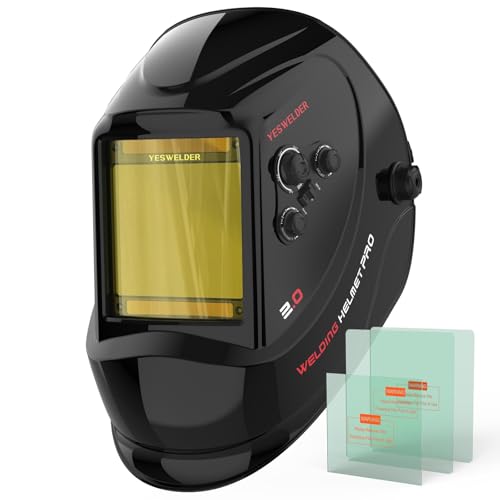 |
Best Overall | Shade range: DIN 3/5-9/9-13 variable | Switching speed: 1/30000 sec | Standard: ANSI Z87.1, CSA Z94.3 | VIEW LATEST PRICE | Read Our Analysis |
| ARCCAPTAIN Large View Welding Helmet with LED Light |  |
Best Large Viewing Area | Shade range: DIN 4/5-8/9-13 variable | Switching speed: 1/25000 sec | Standard: 12-in-1 filter, DIN 16 UV/IR | VIEW LATEST PRICE | Read Our Analysis |
| MIGVAN True Color Large View Welding Helmet |  |
Best Value | Shade range: DIN 4 / 5-9 / 9-13 variable | Switching speed: 1/10000 sec | Standard: ANSI / CE | VIEW LATEST PRICE | Read Our Analysis |
| YESWELDER 2-Sensor Auto Darkening Welding Helmet |  |
Best Budget Pick | Shade range: DIN 3.5/9-13 variable | Switching speed: 1/30000 sec | Standard: ANSI Z87.1, CSA Z94.3 | VIEW LATEST PRICE | Read Our Analysis |
| ARCCAPTAIN HSH-S800 Skeleton Knight Welding Helmet |  |
Best Fast Switching | Shade range: DIN 4/9-13 variable | Switching speed: 1/25000 sec | Standard: ANSI Z87.1, EN379 CE, CSA Z94.3 | VIEW LATEST PRICE | Read Our Analysis |
| ARCCAPTAIN 3.94 x 3.66 in Large View Welding Helmet | 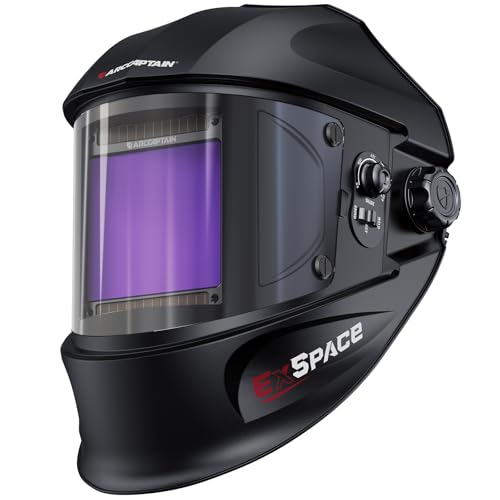 |
Best for Out-of-Position Work | Shade range: DIN 4-5/5-9/9-13 variable | Switching speed: 1/25000 sec | Standard: 12-in-1 filter, DIN 16 UV/IR | VIEW LATEST PRICE | Read Our Analysis |
| Miller Classic Series ClearLight Auto-Darkening Welding Helmet |  |
Best Premium / Low-Amp TIG | Shade range: DIN 8-13 weld, 5-8 cut, 3 grind | Switching speed: 1/23000 sec | Standard: ANSI Z87.1+, CSA, CE | VIEW LATEST PRICE | Read Our Analysis |
More Details on Our Top Picks
YESWELDER Large View 4-Sensor Auto Darkening Welding Helmet
This is the configuration most welders should start from: four arc sensors, a large 3.93 by 3.66 inch window and a 1/1/1/1 true-color lens, all at a price that sits well under the pro-brand hoods. The wide 3/5-9/9-13 shade range covers TIG, MIG, stick, cutting and grinding, and the blue-light-blocking outer lens takes some of the harsh edge off the weld-pool view during long runs.
The four-sensor layout is the reason we rank it ahead of the brand's two-sensor model. When a fixture or your own hand shadows part of the lens on out-of-position work, four sensors are far less likely to let the lens lighten mid-bead. The large view also makes it easier to keep both the puddle and the joint ahead of it in frame.
On the honest side, the headline 1/30000 second figure is a lab number; what matters more is low-amp behavior, and while this hood holds a dark state respectably for the class, very fine sub-five-amp TIG can still show occasional flicker. The pivot-style headgear is comfortable but plainer than a ratchet system, and the reinforced PP shell adds a little weight versus the lightest hoods here.
For a hobbyist or a small shop that wants one helmet to handle everything without overspending, this is the safe default. It carries the ANSI Z87.1 and CSA Z94.3 markings, the parts are replaceable, and the spec sheet leaves little for a mid-range pro hood to beat on paper.
- Shade range:DIN 3/5-9/9-13 variable
- Switching speed:1/30000 sec
- Arc sensors:4
- Viewing area:3.93 x 3.66 in (large)
- Power:Solar + replaceable CR2450
- Standard:ANSI Z87.1, CSA Z94.3
ARCCAPTAIN Large View Welding Helmet with LED Light
This ARCCAPTAIN pairs one of the larger windows in the group with a USB-powered LED work light mounted on the crown, which is genuinely useful for reading a joint in a dim corner or lining up a tack before the arc strikes. Four arc sensors and a 1/1/1/1 true-color lens round out a sheet aimed squarely at people who want maximum visibility.
At roughly one pound the shell is light on the neck, and the flexible PP body shrugs off the knocks of a working bench. The 4/5-8/9-13 shade spread handles stick, MIG and TIG plus grinding, and the smart filter provides automatic DIN 16 UV/IR protection even in the clear state.
Two caveats. The LED light ships uninstalled, so there is a short setup step before first use, and it draws from USB rather than the helmet's own cell. We also could not confirm an explicit ANSI Z87.1 marking in the listing the way we can for the YESWELDER and Miller hoods, so treat the safety claim as the maker's DIN-16 filter spec rather than a stated North American shell rating, and verify on the live listing if that matters to your shop.
If your priority is seeing the work, the big window plus the onboard light make this the easiest hood here to actually see through, and the low weight keeps it comfortable across a full shift.
- Shade range:DIN 4/5-8/9-13 variable
- Switching speed:1/25000 sec
- Arc sensors:4
- Viewing area:3.94 x 3.66 in (large)
- Power:Dual solar + CR2450
- Standard:12-in-1 filter, DIN 16 UV/IR
MIGVAN True Color Large View Welding Helmet
MIGVAN undercuts most of the field while still putting four arc sensors and a true-color golden lens behind a large viewing window. The DIN 4 clear state drops to 5-9 or 9-13 dark, which covers the everyday TIG, MIG, stick, cut and grind rotation, and the kit ships with spare inner and outer lenses plus a storage bag, so the running costs start low.
Power comes from a solar cell backed by a replaceable lithium battery, and the pivoting headgear with breathable padding keeps the fit comfortable for the price bracket. For an occasional welder or someone outfitting a second station, the value here is hard to argue with.
The trade-off shows in the switching speed: at 1/10000 second this is the slowest lens in our lineup. That is still fast enough that you will not see the strike on normal work, but it is a step behind the 1/25000 and 1/30000 second hoods, and we would not choose it for the most delicate low-amp TIG. The listing cites ANSI and CE compliance generally rather than naming CSA Z94.3, so confirm the exact markings if you weld in a regulated environment.
Taken for what it is, a budget hood with a real four-sensor lens and replaceable optics, it delivers more than its price suggests and earns the value pick.
- Shade range:DIN 4 / 5-9 / 9-13 variable
- Switching speed:1/10000 sec
- Arc sensors:4
- Viewing area:Large true-color
- Power:Solar + rechargeable battery
- Standard:ANSI / CE
YESWELDER 2-Sensor Auto Darkening Welding Helmet
This is the entry point into the YESWELDER line and a sensible first auto-darkening hood. Two arc sensors, a 1/30000 second switching figure on paper and a 3.5/9-13 shade range cover TIG, MIG, stick and grinding for someone learning the trade or doing weekend repairs. It carries the same ANSI Z87.1 and CSA Z94.3 markings as the pricier large-view model.
The blue-light-blocking outer lens and 1/1/1/1 optical clarity are a real step up from a bare passive hood, and the helmet accepts magnifying cheater lenses for close work. Solar plus a replaceable CR2450 keeps it running for years with no recurring cost beyond the occasional outer lens.
Where it gives ground is exactly where you would expect at this price. The 3.64 by 1.67 inch window is noticeably smaller than the large-view hoods, which makes out-of-position work feel cramped, and two sensors are easier to shadow than four, so the lens can lighten if your hand blocks them in a tight joint. It is a fine starter hood, not a production tool.
For a beginner who wants protection that is clearly rated and reliably triggers on open bench work, this is a low-risk way in. Welders who move on to fixtured or out-of-position jobs will want the four-sensor large-view step up.
- Shade range:DIN 3.5/9-13 variable
- Switching speed:1/30000 sec
- Arc sensors:2
- Viewing area:3.64 x 1.67 in
- Power:Solar + replaceable CR2450
- Standard:ANSI Z87.1, CSA Z94.3
ARCCAPTAIN HSH-S800 Skeleton Knight Welding Helmet
The Skeleton Knight is the most clearly certified hood in the ARCCAPTAIN group, listing ANSI Z87.1, EN379 CE and CSA Z94.3 together, which is the marking set we want to see on a welding helmet. Four arc sensors and a 1/25000 second switching figure give it a fast, dependable trigger, and the 12-in-1 smart filter holds DIN 16 UV/IR protection at all times.
The PA-material shell is tougher and more heat-resistant than the common PP bodies, with high tensile strength and a one-pound weight that keeps it easy on the neck. A 1/1/1/1 true-color lens and cheater-lens compatibility make it a capable choice for precision MIG and TIG.
The honest limitation is the window. At 3.86 by 1.69 inches it is a narrow strip compared with the large-view hoods, so you trade peripheral awareness for the strong certification and tough shell. The 4/9-13 range also lacks the intermediate 5-9 cut band that some of the wider-range hoods offer, which matters if you plasma-cut often.
If your priority is a well-marked, fast-triggering hood in a durable shell and you mostly run open bench beads, this is a strong pick; just go in knowing the viewing slot is on the smaller side.
- Shade range:DIN 4/9-13 variable
- Switching speed:1/25000 sec
- Arc sensors:4
- Viewing area:3.86 x 1.69 in
- Power:Solar + replaceable CR2450
- Standard:ANSI Z87.1, EN379 CE, CSA Z94.3
ARCCAPTAIN 3.94 x 3.66 in Large View Welding Helmet
This large-view ARCCAPTAIN combines a wide 4-5/5-9/9-13 shade range with four arc sensors and a glove-friendly external shade knob, which is the detail that makes it suited to out-of-position work where you adjust without taking the hood off. Dual solar panels and two CR2450 cells stretch the service life well past the single-cell hoods.
The 3.94 by 3.66 inch window and 1/1/1/1 true-color lens give the same generous, natural view as the LED model, and the interior has been reshaped for a closer fit to the head. The eco-friendly PP shell tolerates a wide operating temperature range, which helps if you weld outdoors in the cold.
As with the other ARCCAPTAIN large-view hoods, the listing leans on the 12-in-1 DIN 16 filter spec rather than naming an ANSI Z87.1 shell rating, so if a stated North American standard is a hard requirement, verify it before buying. The dual-battery system also means two cells to replace eventually rather than one.
For welders who spend real time on vertical, overhead or fixtured joints and want a wide shade band plus glove-friendly controls, this is the most purpose-built large-view option in the group.
- Shade range:DIN 4-5/5-9/9-13 variable
- Switching speed:1/25000 sec
- Arc sensors:4
- Viewing area:3.94 x 3.66 in (large)
- Power:Dual solar + dual CR2450
- Standard:12-in-1 filter, DIN 16 UV/IR
Miller Classic Series ClearLight Auto-Darkening Welding Helmet
Miller is the pro-brand benchmark, and the Classic Series earns its place for one reason above the spec sheet: it is built to trigger reliably at five amps and below, the exact low-amp TIG window where budget hoods flicker. The ClearLight lens technology delivers a high-definition, true-color view that makes fine puddle control noticeably easier.
The shell carries the full ANSI Z87.1+, CSA and CE marking set, the digital controls cover shade, delay and sensitivity, and the ratchet headgear dials in a more secure fit than the pivot systems on the budget hoods. A three-year warranty and an auto-on power control that wakes the lens at the strike of an arc reflect the production focus.
The honest trade-offs are price and window size. This is the most expensive helmet here by a wide margin, and the six-square-inch ClearLight window, while excellent optically, is smaller than the 3.94 by 3.66 inch budget large-view hoods. It also runs two arc sensors rather than four, which is fine for open bench TIG but less forgiving of shadowing than the four-sensor crowd.
If low-amp TIG accuracy and a trusted, fully marked shell justify the spend, the Miller is the one to buy and keep. For general MIG and stick on a budget, the four-sensor large-view hoods give most of the practical benefit for a fraction of the cost.
- Shade range:DIN 8-13 weld, 5-8 cut, 3 grind
- Switching speed:1/23000 sec
- Arc sensors:2
- Viewing area:6 sq in ClearLight
- Power:Auto-on, arc-strike activated
- Standard:ANSI Z87.1+, CSA, CE
How to Choose a Welding Helmet
The right hood depends less on brand than on the processes you run and the positions you weld in. Here is what each spec on the table above actually changes at the bench.
Auto-darkening (ADF) vs passive
A passive hood holds a fixed dark shade, so you flip it down only after the arc is struck, which means tacking blind or nodding the hood with a neck flick. An auto-darkening filter stays clear until the arc fires, then darkens in well under a millisecond, letting you position the torch with the hood already down. For anyone past the occasional repair, ADF is the obvious choice, and every helmet in our lineup is auto-darkening.
Shade range (DIN 9 to 13)
Welding shades run from DIN 9 for low-amp TIG up to DIN 13 for high-amp stick and MIG. A variable lens that spans 9-13 covers the common processes; a wider hood that also offers a 5-9 band adds plasma cutting and a clearer grind state. Match the dark range to your highest-amperage work and make sure the clear or grind state is light enough to read the joint between welds.
Switching speed and low-amp sensitivity
Headline figures like 1/25000 or 1/30000 of a second describe how fast the lens darkens once it detects the arc. The number you cannot see on the box matters more: whether the sensors reliably detect a low-amp TIG arc at five amps and below. A fast lens that misses a faint arc still lets the strike through, so for fine TIG work, low-amp sensitivity beats a big switching-speed claim.
Arc sensors: two vs four
Two sensors are enough for open, flat bench welding. Four sensors keep the lens dark when a fixture, your hand or the workpiece itself shadows part of the filter, which is common in out-of-position, pipe and robotic-cell work. If you weld vertical, overhead or inside tight assemblies, pay for four.
Viewing area and true-color optics
A larger window keeps the puddle and the joint ahead of it in frame at once, and a true-color 1/1/1/1 optical-clarity lens shows a more natural weld pool with less green cast, which reduces eye strain across a long session. The optical-clarity rating (the 1/1/1/1 marking) grades optical class, light diffusion, homogeneity and angle dependence, with 1 being best on each.
Power: solar plus battery
Most modern hoods combine a solar cell that harvests energy from the arc with a replaceable lithium battery as backup, so they wake reliably and run for years. Confirm the battery is user-replaceable rather than sealed, and that spare outer lenses are cheap and available, since the outer cover lens is a consumable.
Safety rating: ANSI Z87.1+ and CSA
In North America, look for ANSI Z87.1 (or Z87.1+ for high-impact) on the shell and CSA Z94.3 on the filter; European hoods add EN 379 CE. These markings mean the helmet passed impact and optical testing rather than just claiming a DIN filter number. A hood that only cites a DIN-16 filter without a stated shell standard is not necessarily unsafe, but it is unverified, so confirm the marking before you rely on it. Our guide to helmet certifications explained breaks down what each stamp covers.
Weight and comfort
A hood you wear all day should be light and balanced, ideally around one pound, with a ratchet or well-padded pivot headgear that spreads the load off your neck. Heavier shells and basic headbands cause the slow fatigue that ends a session early, so weight is a real spec, not a footnote. If you also run a chainsaw or do forestry work, our best chainsaw and forestry helmets guide covers the equivalent head protection for that job.
Welding Helmet Comparison
| Helmet | Arc sensors | Switching speed | Viewing area | Standard |
|---|---|---|---|---|
| YESWELDER Large View 4-Sensor Auto Darkening Welding Helmet | 4 | 1/30000 sec | 3.93 x 3.66 in (large) | ANSI Z87.1, CSA Z94.3 |
| ARCCAPTAIN Large View Welding Helmet with LED Light | 4 | 1/25000 sec | 3.94 x 3.66 in (large) | 12-in-1 filter, DIN 16 UV/IR |
| MIGVAN True Color Large View Welding Helmet | 4 | 1/10000 sec | Large true-color | ANSI / CE |
| YESWELDER 2-Sensor Auto Darkening Welding Helmet | 2 | 1/30000 sec | 3.64 x 1.67 in | ANSI Z87.1, CSA Z94.3 |
| ARCCAPTAIN HSH-S800 Skeleton Knight Welding Helmet | 4 | 1/25000 sec | 3.86 x 1.69 in | ANSI Z87.1, EN379 CE, CSA Z94.3 |
| ARCCAPTAIN 3.94 x 3.66 in Large View Welding Helmet | 4 | 1/25000 sec | 3.94 x 3.66 in (large) | 12-in-1 filter, DIN 16 UV/IR |
| Miller Classic Series ClearLight Auto-Darkening Welding Helmet | 2 | 1/23000 sec | 6 sq in ClearLight | ANSI Z87.1+, CSA, CE |
DOT vs ECE vs Snell vs MIPS, how to pick the right lid in 60 seconds, and when to replace it. One page, no fluff.
Frequently Asked Questions
Is an auto-darkening welding helmet worth it over a passive one?
For nearly everyone, yes. An auto-darkening filter stays clear so you can position the torch, then darkens in under a millisecond when the arc strikes, which means no flipping the hood and no tacking blind. Passive hoods still have a niche for very high-amp, single-process production where a fixed shade is all you need, but for mixed TIG, MIG, stick and grind work an ADF hood is the better tool. Every helmet in this roundup is auto-darkening.
How many arc sensors do I need, two or four?
Two sensors handle open, flat bench welding without trouble. Choose four if you weld out of position, on pipe, inside fixtures or anywhere a hand or the workpiece can shadow part of the lens, because four sensors keep the filter dark when one or two are blocked. For a first hobby hood, two is fine; for production or out-of-position work, pay for four.
What shade range do I need for TIG and MIG?
A variable lens covering DIN 9 to 13 handles most TIG, MIG and stick welding, with the lighter end for low-amp TIG and the darker end for high-amp stick and MIG. If you also plasma-cut, a hood that adds a 5-9 band gives you a cut state too. Set the shade by amperage and material, going darker as current rises.
Will these helmets work for low-amp TIG below five amps?
This is the hardest test for an auto-darkening hood. The arc at five amps and below is faint, and budget lenses can flicker or fail to fully darken on it even when their switching-speed figure looks fast. The Miller Classic in our list is built specifically to trigger reliably at five amps and under, which is why it earns the low-amp TIG pick; the four-sensor budget hoods handle it adequately but can show occasional flicker at the very lowest currents.
What safety certifications should a welding helmet have?
In North America, look for ANSI Z87.1 on the shell (Z87.1+ for high-impact rating) and CSA Z94.3 on the filter; European-spec hoods carry EN 379 CE as well. These markings confirm the helmet passed impact and optical testing. Some imported hoods only cite a DIN-16 filter spec without naming a shell standard, which is not the same thing, so verify the markings on the listing before buying if you work in a regulated shop.
