
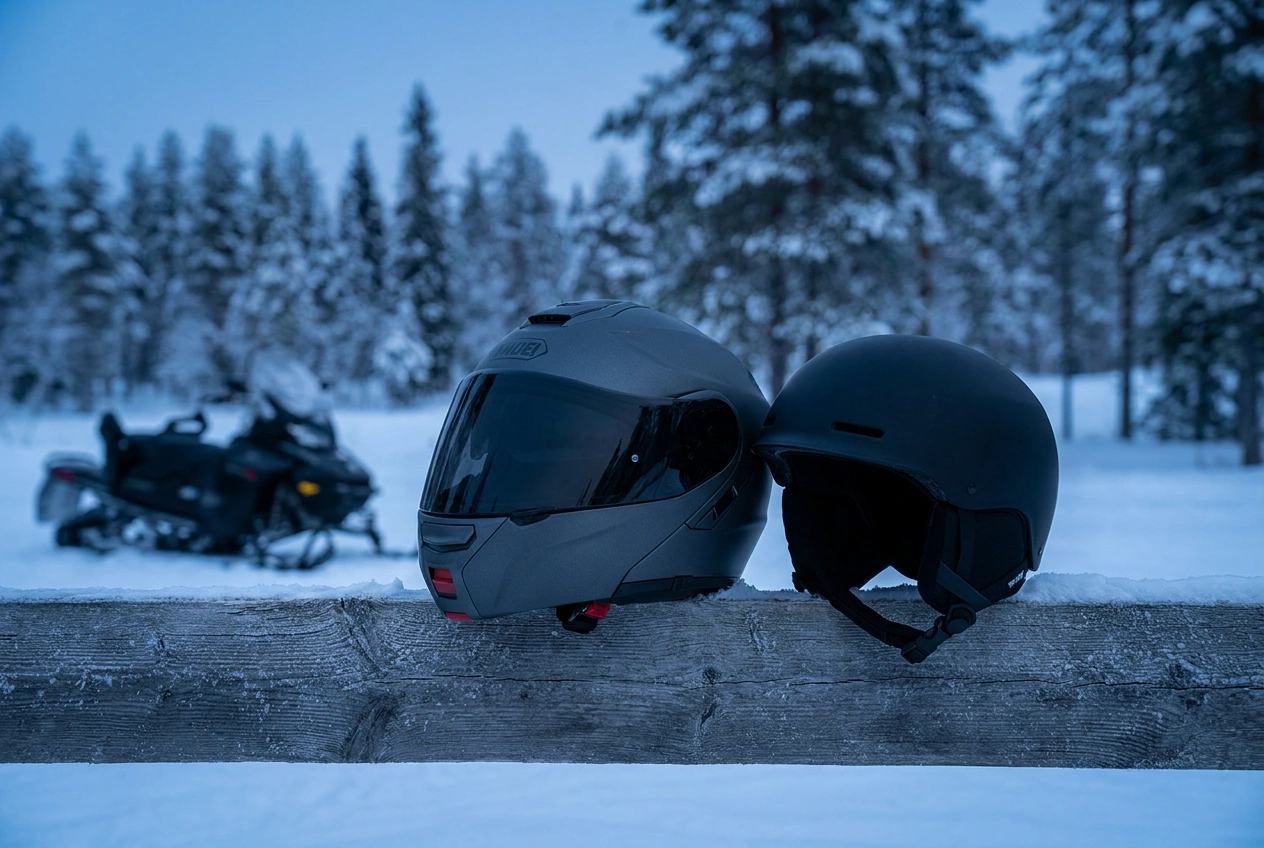
For real snowmobiling, no. A snowboard or ski helmet is built and certified for a self-powered fall, not motor-vehicle speeds. It carries the wrong impact rating, has no chin bar, and lacks the cold-weather optics a sled rider needs. A helmet certified to DOT (FMVSS 218) or ECE 22.06 is the right tool for the job.
It is a fair question, and the helmets look close enough to confuse. Both are foam-lined, both keep your head warm, and both sit in the same gear closet over the winter. So if a ski helmet already lives in your house, why buy a second lid for the sled? Our research desk pulled the actual certification standards and a stack of owner reports to answer that honestly.
The short version: the two helmets are tested against different worlds. One is built around a skier tripping at their own speed on a slope. The other is built around a machine that can clear 90 mph on a packed trail. That gap is the whole story, and it shows up in both the lab numbers and the gear bolted to the helmet.
What each helmet is actually certified for
Certification is not marketing. It is a defined drop test, and the speed and pass mark tell you what crash the helmet was designed to survive. Here is how the four relevant standards line up.
- ASTM F2040 (snowsports, US): dropped onto a flat anvil at roughly 6.2 m/s, with peak head acceleration capped at 300 g.
- EN 1077 (snowsports, Europe): a lower-energy test at about 5.42 m/s, capped at 250 g, split into Class A and Class B coverage.
- DOT FMVSS 218 (motorcycle, US): flat-anvil impacts near 6.0 m/s plus a higher hemispherical drop, with the pass mark set at 400 g and a separate penetration test.
- ECE 22.06 (motorcycle, Europe): the toughest of the group, with impacts up to 7.5 m/s, high-energy hits to 8.2 m/s, plus rotational and oblique testing a snowsports helmet never faces.
Read those side by side and the pattern is clear. The snowsports standards assume you are the only engine. The motorcycle standards assume a motor is doing the work, which is exactly the situation you are in on a snowmobile.
The speed gap is the whole argument
A skier falling on a slope tends to arrive at the ground at speeds the snowsports test is tuned for. A snowmobile is a different animal. Even a small sled runs 50 to 60 mph, mid-size machines hit 90 to 105 mph, and big 800cc sleds clear 110 mph in stock trim. A 600cc sled can reach 60 mph in well under six seconds. Hit a tree, a groomer berm, or hard-packed trail at those speeds and the energy involved is in motorcycle territory, not slope territory.
The honest gray zone exists. A parent walking a child on a small kid's sled across a flat yard, or a slow trail-side crawl, is closer to the snowsports world the ski helmet was built for. We will not pretend a ski helmet is worthless in every scenario. But the moment the throttle opens and the trees start moving past you, the helmet is operating outside the crash it was certified against.
Beyond the impact rating: the cold-and-speed features a ski helmet skips
Even setting the crash numbers aside, a snowmobile helmet is built for a job a ski helmet was never asked to do: keep your vision clear at 50 mph in below-zero air. That is why dedicated sled helmets carry hardware a ski helmet has no provision for.
- Chin bar and face protection. A full-face or modular snowmobile helmet wraps the jaw and face. Most ski helmets are open-face by design, leaving everything below the eyes exposed to branches, ice chunks, and the ground.
- Dual-pane heated shield. Snowmobile shields use a double-pane visor, often with a heating element wired through it, to stop fog and frost forming in cold, moist air. A ski helmet has no shield socket and no power path for one.
- Breath box. A breath deflector sits between the shell and cheek pads and routes your warm exhale down and out, away from the visor. Ski helmets, worn with separate goggles, never needed this part.
- Comms and power routing. Sled helmets leave room for speaker pockets and the wiring a heated shield draws from the machine. A ski helmet has neither pocket nor pass-through.
- Ventilation that works against you. Ski helmet vents are tuned to dump heat while you are working uphill. On a sled you are sitting still and the wind chill is doing the work, so those open vents just feed cold air into the shell.
None of this is a knock on ski helmets. They are excellent at the job they were built for. They were simply never built for a windscreen-less machine doing highway speeds on snow.
Snowsport helmet vs snowmobile helmet, feature and certification by feature
| Feature | Snowsport helmet (ASTM F2040 / EN 1077) | Snowmobile helmet (DOT / ECE 22.06) |
|---|---|---|
| Certified impact speed | ~5.42 m/s (EN 1077) to ~6.2 m/s (ASTM, flat anvil) | ~6.0 m/s flat (DOT) up to 7.5-8.2 m/s (ECE 22.06) |
| Designed crash | Self-powered fall on a slope | Motor-vehicle speeds, 50-110+ mph sleds |
| Chin bar / face protection | Usually none (open-face) | Yes (full-face or modular) |
| Penetration and rotational tests | Not in scope | Penetration (DOT); rotational and oblique (ECE 22.06) |
| Dual-pane heated shield | No socket or power path | Yes, often electrically heated |
| Breath box / breath deflector | No provision (goggles worn separately) | Yes, routes exhale away from shield |
| Comms and power routing | No | Speaker pockets and wiring path for heated shield |
| Cold-air ventilation | Vents dump heat while you work uphill | Sealed and curtained for sitting in wind chill |
DOT vs ECE vs Snell vs MIPS, how to pick the right lid in 60 seconds, and when to replace it. One page, no fluff.
Frequently Asked Questions
Can I use my ski helmet for snowmobiling just on slow trails?
At a genuine crawl it is closer to what the helmet was certified for, but it is still missing the chin bar and the cold-weather shield. Once you carry any real speed, the snowsports impact rating is below what a sled crash can produce, so a DOT or ECE 22.06 helmet is the safer call.
Why is a snowmobile helmet rated for a harder hit than a ski helmet?
Because it is certified to motorcycle standards. DOT FMVSS 218 and ECE 22.06 test higher impact speeds (up to 7.5-8.2 m/s for ECE) and add penetration and rotational tests, since they assume a motor is producing the speed rather than the rider's own legs.
What is a breath box and does a ski helmet have one?
A breath box is a deflector between the shell and cheek pads that channels your warm exhale down and out, away from the visor, to stop fogging. Ski helmets do not have one because skiers wear separate goggles rather than a sealed face shield.
Will a ski helmet's visor fog up on a snowmobile?
A ski helmet does not have a face shield at all; skiers run goggles. Snowmobile helmets use a dual-pane shield, frequently with an electric heating element, specifically because a single-pane visor fogs and frosts fast in the cold, moist air around your face at speed.
Is a snowmobile helmet good enough for skiing or snowboarding?
It will protect your head, but it is heavier, warmer, and harder to hear and breathe in while you work uphill, and the sealed visor is not built for the active heat-dumping skiing demands. The reverse swap is safer than using a ski helmet on a sled, but a purpose-built snowsports helmet is still the more comfortable choice on the slope.
