
Affiliate disclosure As an Amazon Associate we earn from qualifying purchases, at no extra cost to you.
Let's be honest: this is one of the most competitive corners of the action-camera market. GoPro, DJI, and Insta360 have each spent years and hundreds of millions of dollars refining their stabilization, sensor size, and ecosystem integration. No budget clone is going to dethrone them for image quality. That said, there are real decisions to make here - the best helmet camera for a daily commuter logging evidence is a completely different tool than what a motovlogger wants for cinematic sunset canyon runs. Our Research Desk has researched and evaluated the field to give you an honest, position-by-position breakdown, including where the budget options genuinely compete and where they fall short.
For motorcycle use specifically, we weight three things above raw resolution: stabilization in wind blast, battery endurance across a full ride, and mount security (a camera peeling off at 60 mph is a real hazard to riders behind you). We cover all three, plus legal mounting considerations, wind noise, and low-light performance on unlit roads. Here is what we found worth your money in 2026.
Key Takeaways
- DJI Osmo Action 5 Pro leads the field in 2026 - the 1/1.3" sensor, 360-degree HorizonSteady stabilization, and 4-hour battery make it the most capable all-rounder for moto use.
- GoPro HERO13 Black remains the ecosystem king - unmatched third-party accessory compatibility and the deepest mount library of any action cam.
- For long-distance touring, prioritize battery: the MUFU V40T's built-in 4,000 mAh cell delivers 8 hours of continuous recording without a spare battery swap.
- Budget cams (AKASO EK7000 Pro) are genuinely viable for evidence/insurance footage at 4K/30fps - just accept shorter battery life and softer low-light.
- The mount matters as much as the camera - a chin-mount setup keeps the camera low and aerodynamic; side mounts catch more wind blast and amplify audio wind noise.
- Integrated systems like the FreedConn R1 Plus combine camera and intercom in a single unit - a real workflow win for group riders who already run Bluetooth comms.
| DJI Osmo Action 5 Pro |  |
Best Overall | Resolution: 4K/120fps | Stabilization: 360° HorizonSteady | Screens: Dual OLED touchscreens (front + rear) | VIEW LATEST PRICE | Read Our Analysis |
| GoPro HERO13 Black |  |
Best Ecosystem / Mount Compatibility | Resolution: 5.3K/60fps | Stabilization: HyperSmooth 6.0 | Screens: Rear touchscreen + front status display | VIEW LATEST PRICE | Read Our Analysis |
| MUFU V40T Dual Camera | 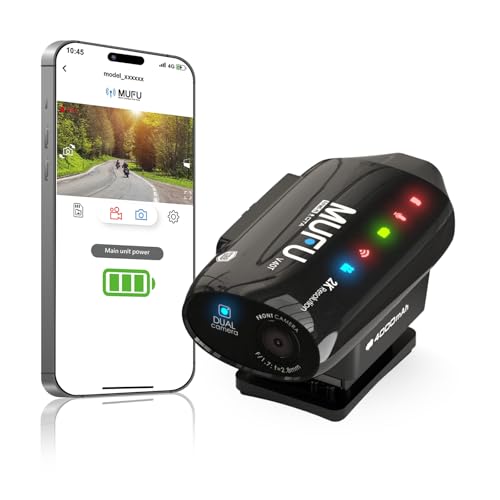 |
Best for Long-Distance Touring | Resolution: 2K front + 2K rear simultaneous | Stabilization: Electronic stabilization | Extras: Loop recording, tilt-detection emergency lock, LED status indicators | VIEW LATEST PRICE | Read Our Analysis |
| FreedConn R1 Plus Bluetooth Camera |  |
Best for Group Riders (Integrated Intercom) | Resolution: 1080p HD, 120-degree wide-angle | Stabilization: None (fixed mount) | Extras: 6-rider Bluetooth intercom, FM radio, GPS nav compatible, loop recording, collision lock | VIEW LATEST PRICE | Read Our Analysis |
| AKASO EK7000 Pro |  |
Best Budget 4K Action Cam | Resolution: 4K/30fps, 1080p/60fps | Stabilization: Electronic Image Stabilization (EIS) | Screen: 2-inch IPS touch screen | VIEW LATEST PRICE | Read Our Analysis |
| Lupholue Chin Strap Mount for GoPro/DJI/Insta360 |  |
Best Chin Mount Accessory | Compatibility: GoPro Hero 13/12/11/10/9/8/7/6, DJI Osmo Action 5 Pro/4/3/2, Insta360 ONER/X4/X3 | Material: Premium plastic, silicone, woven belt | Safety: Reusable, stable chin strap design | VIEW LATEST PRICE | Read Our Analysis |
| TELESIN Chin Strap Helmet Mount |  |
Best Budget Chin Mount | Compatibility: GoPro Max/Hero 13-5, DJI Action 6/5 Pro/4/3/Nano, Insta360 X5/X4/X3/X2/RS/R | Material: Food-grade non-slip silicone, ABS Y-shape base | Extras: Camera mount adapter adjustable upside-down for full angle flexibility | VIEW LATEST PRICE | Read Our Analysis |
More Details on Our Top Picks
DJI Osmo Action 5 Pro
The Osmo Action 5 Pro is the most capable helmet camera we would recommend in 2026, and the spec sheet explains most of why. The 1/1.3-inch sensor - shared with the Osmo Action 4 - is meaningfully larger than the sensors in budget action cams, and the 2.4-micrometer pixel size pays off most on night rides and in tunnels where ambient light drops quickly. DJI rates 13.5 stops of dynamic range, which keeps headlight glare and dark road edges in frame simultaneously. For motovlogging at dusk or logging commute footage after dark, the low-light gap between the Action 5 Pro and cheaper alternatives is the real story.
On stabilization, DJI's 360-degree HorizonSteady is the headline feature and it genuinely delivers. It corrects full roll-axis rotation, which means frame-level footage even on rough pavement or gravel. Our Research Desk notes that earlier DJI action cams used RockSteady (excellent) but HorizonSteady is a step further - the horizon stays locked regardless of lean angle, something useful in corners. Voice control stays active continuously, so you can start and stop recording without taking a hand off the bars.
The battery situation is a realistic weak point at 4 hours of continuous recording - that is excellent for an action cam, but touring riders doing full-day routes will want a spare battery or a USB-C power bank connection. The magnetic quick-release system is DJI-proprietary; it is fast and secure, but aftermarket mount options are narrower than GoPro's ecosystem. For chin-mount use on a full-face helmet, DJI-compatible chin mount straps are widely available and work reliably. The dual OLED screens make setup and playback framing easy without pulling out a phone.
Bottom line: if you are buying one helmet camera in 2026 and image quality and stabilization are your top priorities, this is the one. It is not cheap, but it is priced appropriately for what it delivers. The GoPro HERO13 Black is its only genuine peer, and the Action 5 Pro's low-light and stabilization edge it on pure performance.
- Resolution:4K/120fps
- Stabilization:360° HorizonSteady
- Battery:1,950 mAh / up to 4 hrs
- Waterproof:IP68, 20m rated
- Mount System:Magnetic quick-release + standard adapter
- Field of View:155° ultra-wide
- Low-light:1/1.3" sensor, 2.4 µm pixels, 13.5-stop dynamic range
- Screens:Dual OLED touchscreens (front + rear)
GoPro HERO13 Black
GoPro's HERO13 Black delivers best-in-class resolution at 5.3K/60fps and retains its position as the standard-bearer for mount ecosystem compatibility. If you are building around a helmet camera and want to eventually use the same camera on a chest harness, handlebars, or a surfboard, no other platform has as many third-party mount options across as many sports. For motorcycle-specific use, that means a decade of chin mounts, side mounts, and windshield clamps designed specifically for GoPro's mounting standard.
HyperSmooth 6.0 stabilization is excellent - not quite as aggressive on the horizon-lock side as DJI's HorizonSteady, but very close. In real-world riding conditions - steady highway cruising and smooth canyon roads - both cameras produce footage that is essentially indistinguishable. The gap shows up more on aggressive off-road riding or extreme lean angles in corners. For typical street riding and motovlogging, the HERO13 Black is fully capable.
The battery life honest caveat: at 5.3K, battery life drops substantially. For full-day recording, you either step down to 1080p or 4K and gain significant runtime, or you carry spare Enduro batteries. GoPro's Enduro batteries (sold separately) extend runtime noticeably over the standard battery. For motorcycle touring without a USB power source, plan around 90-120 minutes of 4K recording per battery. The HB-Series lens mods are a genuine differentiator - the Ultra Wide Lens Mod is particularly effective for full-face helmet chin mounts where the camera's natural FOV may not be optimal.
Our recommendation: choose the GoPro HERO13 Black if you are already invested in GoPro's mount ecosystem, if you plan to use the camera across multiple sports, or if the HB-Series lens mods matter to you. Choose the DJI Action 5 Pro if low-light and stabilization are your only criteria. Both are excellent cameras.
- Resolution:5.3K/60fps
- Stabilization:HyperSmooth 6.0
- Battery:1,720 mAh / up to 70 min at 5.3K (longer at 1080p)
- Waterproof:33ft (10m) without housing
- Mount System:GoPro universal (widest accessory library available)
- Field of View:Wide / SuperView / HyperView modes
- Low-light:Auto low-light mode, Night Photo / Night Lapse modes
- Screens:Rear touchscreen + front status display
MUFU V40T Dual Camera
The MUFU V40T solves a problem that single-lens action cams do not: recording both what is happening ahead of you and what is happening behind simultaneously. This is a meaningful difference for insurance and evidence purposes - rear-end incidents are captured from your perspective rather than relying on the other party's dash cam. For touring riders doing full-day rides in unfamiliar territory, this dual-perspective approach provides coverage that a GoPro mounted on a chin cannot.
The battery story is the headline spec here. A built-in 4,000 mAh cell delivering up to 8 hours of continuous recording genuinely differentiates this from any standard action cam. Battery swaps on the road are a nuisance; packing multiple spares adds weight and planning overhead. If you are doing a full Iron Butt-style day or a multi-stop tour, the V40T removes battery anxiety from the equation. The trade-off is that it is a purpose-built motorcycle camera - it is not going to jump to a surfboard or a mountain bike the way a GoPro will.
The tilt-detection emergency lock is well-implemented: when the camera detects a sudden lean/impact that suggests a drop or crash, it automatically protects the current clip from loop-recording overwrite. For commuters who leave loop recording active all day and don't actively manage clips, this is an important safety net for incident documentation. The IP66 rating handles rain and road spray without issue, though it is not a submersible rating.
The image quality at 2K is honest for the price point - adequate for identification of vehicle plates and documentation, but not the cinematic quality you get from a DJI or GoPro sensor. If documentation and endurance are your top priorities over cinematic quality, the MUFU V40T is genuinely the most practical choice in the field. The quick-power buckle allows fast mounting and removal with gloves on, which is a real-world usability win.
- Resolution:2K front + 2K rear simultaneous
- Stabilization:Electronic stabilization
- Battery:4,000 mAh / up to 8 hrs continuous
- Waterproof:IP66 rated
- Mount System:Helmet-dedicated mount with quick-release buckle
- Field of View:Wide angle front + rear
- Low-light:F1.7 aperture, advanced low-light sensor
- Extras:Loop recording, tilt-detection emergency lock, LED status indicators
FreedConn R1 Plus Bluetooth Camera
The FreedConn R1 Plus approaches helmet cameras from a completely different direction: instead of adding a separate mount and cable to an existing intercom system, it integrates a 1080p camera into the intercom unit itself. For group riders who already run Bluetooth communication systems, this collapses two separate pieces of hardware into one. There is no chin mount strap to fidget with, no separate camera to charge, and no footage sync issues between devices.
The intercom capabilities are substantive: 6-rider simultaneous communication at up to 3,280 feet, Bluetooth 5.0 stability, and compatibility with GPS navigation and phone calls while riding. CVC intelligent noise cancellation handles wind noise in intercom audio, which is a recurring frustration with helmet camera microphones generally. If you want to record ride audio for vlogs and use it for communication, the R1 Plus is the most integrated solution available at this price.
The camera quality does come with honest caveats. 1080p at 120 degrees is noticeably behind DJI and GoPro in dynamic range and low-light performance. Stabilization is mechanical (fixed mount) rather than electronic, which means wind vibration at speed can produce shakier footage than the top-tier cams. For documentation purposes and casual ride recording, 1080p is fully adequate. For motovlogging with serious production ambitions, the image gap versus a DJI/GoPro chin-mounted setup is real.
The built-in gravity-shock sensor for collision-locking footage is a smart addition for a camera that effectively runs continuously during rides. The R1 Plus requires an SD card (not included) - factor that into the total cost. Our recommendation: this is the right choice if you already want an intercom system and want to avoid carrying two separate devices. It is not the right choice if pure image quality is the priority.
- Resolution:1080p HD, 120-degree wide-angle
- Stabilization:None (fixed mount)
- Battery:1,500 mAh / up to 4-5 hrs video, 30 hrs intercom
- Waterproof:IP65 rated
- Mount System:Helmet-specific mount (integrated unit)
- Field of View:120 degrees
- Low-light:Standard 1080p sensor
- Extras:6-rider Bluetooth intercom, FM radio, GPS nav compatible, loop recording, collision lock
AKASO EK7000 Pro
The AKASO EK7000 Pro makes the case for budget action cameras on motorcycles clearly: if your primary purpose is insurance/evidence documentation and you are recording at 4K/30fps in daylight conditions, the footage quality gap versus a DJI or GoPro is smaller than the price gap. The 4K/30fps output is real and sharp in good light; the 2-inch IPS touch screen makes setup straightforward; and the adjustable field of view from 70 to 170 degrees gives you control over how much of the road versus sky ends up in frame.
The two included 1,350 mAh batteries with up to 140 minutes each per charge is a genuine advantage over single-battery competitors in this price range. Carrying both batteries gives you roughly 4-5 hours of riding before you need a charge, which covers most day rides. The EIS stabilization is noticeably less sophisticated than DJI's RockSteady or GoPro's HyperSmooth - it handles steady highway vibration acceptably, but rough roads and aggressive riding produce visibly shakier footage.
The GoPro-compatible mounting is a significant practical advantage: the EK7000 Pro uses the same mount standard as GoPro, so all those chin mount straps, side mounts, and handlebar clamps designed for GoPro work with the AKASO. You are not locked into a proprietary mount ecosystem. For a budget camera, this is a meaningful benefit.
Where this camera falls short honestly: low-light performance drops off noticeably at dusk and in tunnels, and wind noise is more pronounced than on cameras with dedicated wind-noise reduction microphone systems. If you ride primarily during daylight and want a capable evidence cam or casual vlog backup camera without spending on a flagship, the EK7000 Pro is a genuinely solid choice. Do not expect it to match DJI or GoPro in low-light or stabilization.
- Resolution:4K/30fps, 1080p/60fps
- Stabilization:Electronic Image Stabilization (EIS)
- Battery:2x 1,350 mAh / up to 140 min each
- Waterproof:131ft (40m) with included case
- Mount System:GoPro-compatible mounting
- Field of View:Adjustable 170° / 140° / 110° / 70°
- Low-light:Standard sensor; adequate for daylight
- Screen:2-inch IPS touch screen
Lupholue Chin Strap Mount for GoPro/DJI/Insta360
If you already own a GoPro, DJI, or Insta360 action camera, adding a chin mount to a full-face motorcycle helmet is the single best upgrade for moto footage quality. The chin position keeps the camera close to the rider's line of sight, reduces wind blast versus a top-of-helmet mount, and produces more natural POV framing. The Lupholue chin strap mount is one of the most widely compatible options available, covering GoPro Hero 13 through 6, DJI Osmo Action 5 Pro/4/3/2, and Insta360 ONER, X4, and X3.
Installation takes under five minutes: thread the woven strap around the helmet's chin bar, tighten the buckle, and attach your camera via the J-Hook. The silicone anti-shock, anti-slip base conforms to the chin bar's curved surface and prevents the mount from rotating during riding. Our Research Desk recommends always using an additional safety tether (most cameras ship with one, or buy separately) - a chin mount at highway speed needs redundant retention if a strap shifts. This mount's strap design is solid, but no mechanical mount is infallible.
One honest limitation: the Lupholue mount explicitly does not fit helmets with a long or extended chin guard (some adventure/ADV helmets and full-face MX helmets). For those, a flexible bendable-base mount or an adhesive pad system works better. Check your helmet's chin bar geometry before purchasing. For standard full-face sport and touring helmets with a conventional chin bar, this mount is reliable, well-built, and affordable.
The practical tip we tell everyone starting with chin-mount footage: mount the camera at a slight downward angle so the horizon sits in the upper third of the frame. Pure forward-pointing mounts often show too much sky and too little road. A 10-15 degree downward tilt produces much more natural moto footage framing, and the J-Hook connection allows easy angle adjustment.
- Compatibility:GoPro Hero 13/12/11/10/9/8/7/6, DJI Osmo Action 5 Pro/4/3/2, Insta360 ONER/X4/X3
- Material:Premium plastic, silicone, woven belt
- Attachment:Strap-and-buckle around helmet chin bar
- Base:Silicone anti-shock, anti-slip
- Connector:J-Hook standard (universal action cam)
- Helmet Compatibility:Full-face with chin bar; NOT for helmets with long extended chin
- Weight:Negligible (mount only, no camera)
- Safety:Reusable, stable chin strap design
TELESIN Chin Strap Helmet Mount
The TELESIN chin strap mount covers the widest camera compatibility list we have seen in this category - GoPro Hero 13 through 5, DJI Action 6, 5 Pro, 4, 3, and Nano, and Insta360 X5, X4, X3, X2, RS, and R are all explicitly supported. The food-grade non-slip silicone is genuinely softer against the helmet's chin bar than harder plastic alternatives, and the rounded Y-shape base distributes contact across more surface area, which reduces the chance of the mount rotating under wind load.
The 180-degree pivot arm adjustment is a meaningful feature at this price point. Being able to flip the camera mount adapter upside-down and reposition it allows you to adapt to different camera body sizes and chin bar geometries without buying a different mount. For riders who upgrade cameras more often than they replace helmets, this versatility matters. The elastic strap with buckle is rated for 1,000 reuse cycles by TELESIN, which is a more useful durability metric than most competitors provide.
The rounded corner design deserves specific mention: early helmet chin mounts often had sharp plastic corners that sat against the rider's face or neck when the camera was removed. TELESIN redesigned specifically to eliminate this. It is a small detail but a welcome one for riders who put on and take off the mount frequently.
Our realistic assessment: the TELESIN is a fully capable chin mount for daily use. The image quality you get is limited by the camera attached to it, not by the mount itself. If you are pairing it with an AKASO or budget 4K cam, it will deliver consistent results. If you are running a DJI Action 5 Pro or GoPro HERO13, it is a cost-effective alternative to brand-name mounts with functionally equivalent performance. See our guide on how to install a chin mount on a motorcycle helmet for setup tips before your first ride.
- Compatibility:GoPro Max/Hero 13-5, DJI Action 6/5 Pro/4/3/Nano, Insta360 X5/X4/X3/X2/RS/R
- Material:Food-grade non-slip silicone, ABS Y-shape base
- Attachment:Elastic strap with buckle
- Adjustment:180-degree angle adjustment via pivot arms
- Safety:Rounded corners (no sharp edges), reusable up to 1,000 times
- Design:Y-shape base for wide helmet surface contact
- Weight:Lightweight ABS construction
- Extras:Camera mount adapter adjustable upside-down for full angle flexibility
How to Choose a Helmet Camera for Motorcycles in 2026
Most buyers walk into this decision thinking resolution is the main variable. It is not. Once you are at 4K/30fps - a threshold nearly every camera in this guide clears - the practical differences in footage quality come down to stabilization, sensor size, and wind noise management. Here is how to prioritize.
Stabilization: The Real Differentiator
Motorcycle road surfaces, wind buffeting, and engine vibration all work against clean footage. Electronic image stabilization (EIS) ranges from basic gyroscope correction to DJI's HorizonSteady, which locks a full 360 degrees of roll rotation. For smooth highway riding, most modern EIS handles the job adequately. For spirited riding, rough roads, or off-road touring, the gap between budget EIS and DJI/GoPro implementations becomes visible quickly. Our recommendation: if smooth footage is a priority, invest in a flagship camera's stabilization rather than trying to compensate with post-processing.
Battery Life: Planning for the Full Ride
Action cam batteries are small. The DJI Action 5 Pro's 4-hour runtime and the MUFU V40T's 8-hour built-in cell are the high end; most cameras manage 60-120 minutes at 4K before needing a swap or charge. For commuting or track days, this is rarely a problem. For touring - especially overseas where charging stops are less predictable - plan your battery strategy before you leave. USB-C charging from a phone mount power bank works on most modern cams and eliminates battery swap hassles on moving bikes.
Mounting: Safety and Legality
In most jurisdictions, there is no explicit law against mounting a camera on a motorcycle helmet. However, adding a protrusion to a helmet can technically void the helmet's certification if it compromises the shell structure - adhesive mounts on the outer surface are lower risk than drilling or permanent modifications. Our strong recommendation is to use strap-based chin mounts rather than adhesive pads on the outer helmet surface. If the adhesive fails at speed, the camera becomes a projectile. Strap-and-buckle designs have secondary retention; adhesive pads do not. See our step-by-step guide to installing a chin mount on a motorcycle helmet for safe fitment techniques.
Chin Mount vs. Side Mount
The chin mount position - at the bottom of a full-face helmet's chin bar - is the standard for motorcycle use because it keeps the camera in the aerodynamic shadow of the helmet rather than sticking out in the wind stream. A side-mounted camera (on the temple area) catches significantly more wind blast, which amplifies wind noise in the microphone and can cause vibration that EIS struggles to fully compensate. For motovlogging or any footage where audio quality matters, a chin mount is the right call. For action-focused footage where you want a wider environmental perspective, a side or top mount gives more context. Riders who are serious about motovlogging will want to read our best helmet for motovlogging guide - helmet aerodynamics and visor acoustics affect camera audio as much as the camera itself.
Wind Noise Management
Wind noise is the enemy of moto footage audio. At 60+ mph, even with electronic noise reduction, onboard microphones pick up a significant roar that makes speech unintelligible. Solutions include: chin mounts (lower wind exposure), aftermarket foam wind screens on microphone ports, and external wireless microphones clipped inside the jacket collar (DJI Mic 2 and Rode Wireless GO 2 are common solutions). No action camera's built-in microphone produces broadcast-quality audio on a moving motorcycle - plan for it.
Low-Light Performance on Night Rides
If you ride at dusk, dawn, or after dark, sensor size matters more than anything else on the spec sheet. The DJI Action 5 Pro and Action 4 share a 1/1.3-inch sensor with 2.4-micrometer pixels - significantly larger than budget camera sensors. In practice, this means darker roads, tunnel entrances, and low-contrast conditions where your eyes are adapting show up as usable footage rather than noise. Budget cameras at sub-4K performance in low light are often adequate for plate identification in well-lit urban environments but struggle on unlit rural roads. If night riding is regular, the sensor investment pays off. Our Virginia Tech helmet ratings guide covers how safety certifications are evaluated - a useful parallel to how camera performance ratings work.
Helmet Camera for 2026 Comparison
| Helmet | Resolution | Stabilization | Battery | Waterproof | Best For |
|---|---|---|---|---|---|
| DJI Osmo Action 5 Pro | 4K/120fps | 360° HorizonSteady | 1,950 mAh / up to 4 hrs | IP68, 20m rated | Best Overall |
| GoPro HERO13 Black | 5.3K/60fps | HyperSmooth 6.0 | 1,720 mAh / up to 70 min at 5.3K (longer at 1080p) | 33ft (10m) without housing | Best Ecosystem / Mount Compatibility |
| MUFU V40T Dual Camera | 2K front + 2K rear simultaneous | Electronic stabilization | 4,000 mAh / up to 8 hrs continuous | IP66 rated | Best for Long-Distance Touring |
| FreedConn R1 Plus Bluetooth Camera | 1080p HD, 120-degree wide-angle | None (fixed mount) | 1,500 mAh / up to 4-5 hrs video, 30 hrs intercom | IP65 rated | Best for Group Riders (Integrated Intercom) |
| AKASO EK7000 Pro | 4K/30fps, 1080p/60fps | Electronic Image Stabilization (EIS) | 2x 1,350 mAh / up to 140 min each | 131ft (40m) with included case | Best Budget 4K Action Cam |
| Lupholue Chin Strap Mount for GoPro/DJI/Insta360 | - | - | - | - | Best Chin Mount Accessory |
| TELESIN Chin Strap Helmet Mount | - | - | - | - | Best Budget Chin Mount |
DOT vs ECE vs Snell vs MIPS, how to pick the right lid in 60 seconds, and when to replace it. One page, no fluff.
Frequently Asked Questions
Is it legal to mount a camera on a motorcycle helmet?
In most countries and US states, there is no explicit law prohibiting a camera mount on a helmet. The key concern is helmet integrity: adhesive modifications to the outer shell can technically affect certification status. Strap-based chin mounts are the safest approach from both a safety and certification standpoint. Some European countries have begun reviewing camera mount regulations - check local regulations before riding in new jurisdictions.
Will a helmet camera void my helmet's safety certification?
Strap-based mounts that do not penetrate or adhere to the helmet's outer shell are generally considered non-modifying. Adhesive pad mounts bonded to the outer surface are a grey area under DOT and ECE certification language. If certification integrity is a concern, strap mounts are the conservative choice. Never drill into a helmet shell for any purpose.
How do I reduce wind noise in my helmet camera footage?
The most effective approaches in order of impact: (1) use a chin mount rather than a side or top mount, (2) add a foam wind screen to the camera's microphone port, (3) use an external wireless microphone clipped inside the jacket collar, (4) use post-production audio cleanup tools. No single approach eliminates wind noise completely at highway speeds, but a combination of chin-mount positioning and a foam screen makes a significant difference.
What frame rate should I use for motorcycle footage?
4K/30fps is the standard for natural-looking moto footage. If you plan to create slow-motion clips, 1080p/120fps or 4K/60fps gives you 4x or 2x slow-motion respectively in post. For pure documentation or evidence recording where file size matters, 1080p/60fps balances quality and storage efficiency well. Avoid 4K/120fps unless your camera handles it without significant heat throttling - some cameras overheat quickly at the highest framerates.
How long do helmet camera batteries last on a long ride?
Most standalone action cams deliver 60-120 minutes of continuous recording at 4K before needing a battery swap. The DJI Osmo Action 5 Pro extends this to roughly 4 hours. The MUFU V40T's built-in 4,000 mAh cell reaches 8 hours. For touring, either carry multiple spare batteries, run USB-C charging from a handlebar-mounted power bank, or use a dedicated touring camera like the MUFU with a large built-in cell.
Can I use the same camera for my helmet and other sports?
GoPro's universal mount standard gives the HERO13 Black the widest cross-sport versatility - surf mounts, chest harnesses, handlebars, drones, and more all use the same GoPro base. DJI's magnetic quick-release system is proprietary but DJI-compatible third-party adapters exist for most sports applications. Budget cams like the AKASO that use GoPro-compatible mounts also benefit from the ecosystem. If cross-sport use matters, GoPro's ecosystem depth is still unmatched.
