
Affiliate disclosure As an Amazon Associate we earn from qualifying purchases, at no extra cost to you.
Half-shell motorcycle helmets are the gear choice that requires the most honest conversation in our Research Desk. Riders choose them for a reason - cruiser aesthetics, summer heat, that effortless low-profile look that makes a Harley look like a Harley. We get it. But we also respect your skull enough to say upfront: a half-shell covers your head and nothing else. No chin, no face, no jaw protection. Full-face helmets protect more. That is not a caveat buried in footnote five - it is the first thing you should know before reading any further.
With that out of the way: if you have made your choice, the difference between a well-made DOT half-shell and a cheap novelty piece is enormous. We cross-referenced eight popular models across skull-cap, 3/4 open-face, and low-profile "no-mushroom" styles - looking at shell construction, EPS liner quality, certification status (DOT FMVSS 218 vs. the "novelty" label that is basically a hard hat), and what thousands of cruiser riders actually report after long miles. Here are the eight that cleared our bar for 2026.
One clarification on terminology: in this guide, "half-shell" covers both true skull-caps (minimum coverage, sits above the ears) and low-profile 3/4 open-face designs that extend to the ears but leave the face open. If you want maximum low-profile "no mushroom" styling specifically, check our guide on no-mushroom half helmets. For the German-bucket heritage look, we have a separate deep-dive on German-style motorcycle helmets.
Key Takeaways
- Half-shells protect less than full-face or modular helmets - cover your head, not your face or chin. Know this going in.
- DOT FMVSS 218 certification matters - "novelty" helmets look identical but have no tested liner; skip them for road use.
- Low-profile fit = no mushroom effect - GMAX and Daytona skull caps excel here; the shell stays close to the head for a cleaner silhouette.
- Weight is real on a half-shell - the best options come in under 2 lbs (roughly 900 g); heavier shells fatigue your neck on long rides.
- Sizing runs large on most German-style models - measure your head in centimeters and size down one if between sizes.
| GMAX HH-75 Half Helmet |  |
Best Overall | Type: Skull-cap / low-profile | Certification: DOT FMVSS 218 | Best for: Cruiser riders wanting a polished, feature-rich half-shell | VIEW LATEST PRICE | Read Our Analysis |
| GMAX HH-65 Naked Half Helmet |  |
Best Clean Silhouette | Type: Skull-cap / low-profile | Certification: DOT FMVSS 218 | Best for: Riders who want GMAX quality without a peak visor | VIEW LATEST PRICE | Read Our Analysis |
| Daytona Helmets Skull Cap DOT |  |
Best Skull Cap | Type: Skull-cap (minimal coverage) | Certification: DOT FMVSS 218 | Best for: Riders prioritizing minimum coverage with DOT certification | VIEW LATEST PRICE | Read Our Analysis |
| Daytona Helmets Carbon Fiber Skull Cap | 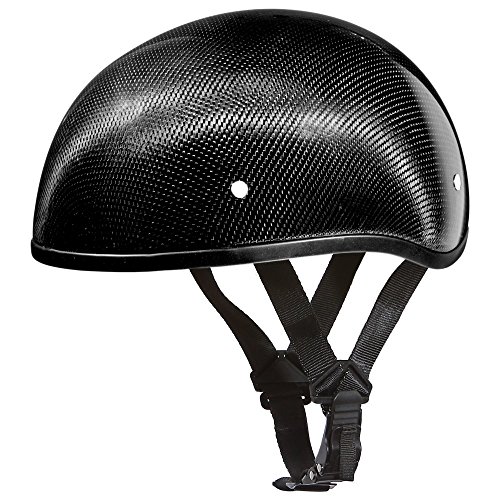 |
Best Lightweight Upgrade | Type: Skull-cap (minimal coverage) | Certification: DOT FMVSS 218 | Best for: Long-distance riders who want DOT coverage with minimal weight | VIEW LATEST PRICE | Read Our Analysis |
| ILM 205V Half Helmet with Sun Visor |  |
Best Budget Pick | Type: Half-shell with integrated visor | Certification: DOT FMVSS 218 | Best for: Budget-conscious riders who want sun protection without a separate shield purchase | VIEW LATEST PRICE | Read Our Analysis |
| ILM MH201 Half Helmet with Retractable Visor | 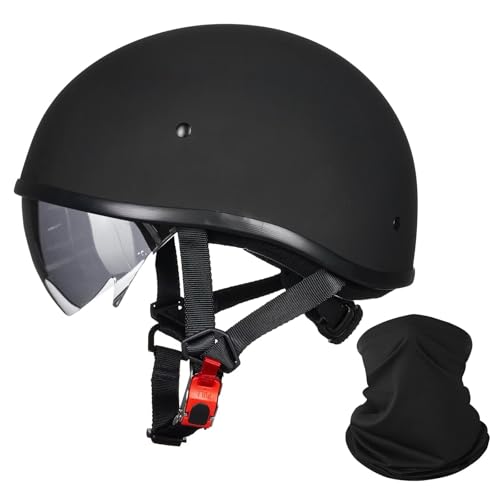 |
Best Modern Half-Shell | Type: Half-shell with retractable visor + size dial | Certification: DOT FMVSS 218 | Best for: Riders who want a visor, size adjustability, and modern styling in one package | VIEW LATEST PRICE | Read Our Analysis |
| SanQing 3/4 Open Face Helmet |  |
Best 3/4 Open-Face | Type: 3/4 open-face | Certification: DOT FMVSS 218 + ECE 22.05 | Best for: Riders who want more ear and side coverage than a skull cap, dual-certified | VIEW LATEST PRICE | Read Our Analysis |
| TCMT 3/4 Open Face Dual Visor Helmet |  |
Most Visors Included | Type: 3/4 open-face with drop-down sun visor | Certification: DOT | Best for: Riders who want a 3/4 open-face with three visors and Bluetooth speaker recesses | VIEW LATEST PRICE | Read Our Analysis |
More Details on Our Top Picks
GMAX HH-75 Half Helmet
The GMAX HH-75 is where the brand put its best engineering into the half-shell format. Dual-density EPS foam means the liner is not a single-stiffness block that either bottoms out on big impacts or feels like a foam hat on small ones - two layers with different compression rates handle the range in between. The drop-down sun shield is UV400 rated and retracts cleanly without the loose-rattle feel common in cheap visor mechanisms.
Fit is snug and close to the skull, which is the whole point in a low-profile design. GMAX calls it the "no-mushroom" silhouette: the shell sits tight to the head rather than flaring at the base the way mid-tier half-shells often do. The removable COOLMAX liner is washable and actually does wick moisture on hot days - a feature that matters more on a half-shell than a full-face because airflow means sweat.
Speaker pockets for intercom systems are standard, and the quick-release chin strap buckle works with gloves. Riders on touring forums consistently note the HH-75 as the half-shell they stop returning - which given how often cruiser helmets get exchanged for fit reasons, says something.
The downside: the ABS shell is on the heavier side compared to carbon fiber options, and the single-shield configuration means you are swapping the included clear and smoke shields rather than running a flip-down tinted inner with a clear outer simultaneously. Not a dealbreaker at this price point, but worth knowing if you ride at dawn and dusk regularly.
- Type:Skull-cap / low-profile
- Certification:DOT FMVSS 218
- Shell:ABS
- Profile:Low / no-mushroom
- Weight:~1.9 lbs
- Best for:Cruiser riders wanting a polished, feature-rich half-shell
GMAX HH-65 Naked Half Helmet
The HH-65 Naked is the HH-75's sibling with a deliberately stripped-down aesthetic - no peak visor, no external trim, just the clean shell. GMAX markets this as the "alter ego" of the Full Dressed version, and for riders who want the helmet to disappear against their riding jacket rather than shout about itself, the Naked is the better pick.
Same dual-density EPS and COOLMAX liner as the rest of the HH-65 line, same DOT certification, same speaker pockets. The drop-down sun shield is retained - which is the one feature that keeps the Naked from being a true minimalist piece, but it is recessed enough when stowed that it does not break the clean profile.
The Rose Matte colorway in particular has picked up a following in cruiser forums - it photographs well against chrome and aged leather in a way that all-black does not. That is not a performance factor, but half-shell buying decisions live at the intersection of safety and style more than any other helmet category.
Sizing note: GMAX tends to run slightly large in their half-shell line. If you are borderline between sizes, the smaller shell will give you the low-profile fit the HH-65 is designed around. The liner can be swapped for a thinner pad if needed.
- Type:Skull-cap / low-profile
- Certification:DOT FMVSS 218
- Shell:ABS
- Profile:Low / no-mushroom
- Weight:~1.8 lbs
- Best for:Riders who want GMAX quality without a peak visor
Daytona Helmets Skull Cap DOT
Daytona built its reputation on skull caps, and this one is the proof of concept. It covers the top of the head and nothing else - no ear coverage, no visor, just the certified shell and liner in the smallest package that still meets DOT FMVSS 218. The Y-strap retention system with quick-release sliding adjuster is a detail that distinguishes Daytona from generic alternatives: the chin strap stays positioned correctly rather than migrating forward on long rides.
The 1.4-lb weight is the standout spec. Full-shell half-helmets regularly creep toward 2 lbs; this one stays below 700 grams. That matters on three-hour cruises where neck fatigue is a real factor, and it is why riders who have tried heavier half-shells often come back to a proper skull cap.
Honest limitations: minimum coverage means minimum protection. The skull cap style leaves your face, ears, and the lower sides of your head completely unprotected. This is not a design flaw - it is the product category. Anyone telling you a skull cap "protects just as well" with enough confidence to skip that caveat is selling you something. Daytona does not make that claim, and neither do we.
The butterfly graphic version for this ASIN adds visual interest without the cheap decal-peel problem common to cheaper graphic helmets. The moisture-wicking liner is removable, which at this price point and weight is standard - but appreciated.
- Type:Skull-cap (minimal coverage)
- Certification:DOT FMVSS 218
- Shell:ABS
- Profile:Ultra-low
- Weight:~1.4 lbs
- Best for:Riders prioritizing minimum coverage with DOT certification
Daytona Helmets Carbon Fiber Skull Cap
The carbon fiber shell changes the value proposition of the Daytona skull cap. Where the ABS version is about minimum coverage at minimum cost, this one is about minimum coverage at minimum weight - roughly 1.1 lbs on your head instead of 1.4 lbs. That sounds trivial until hour four on a hot day, when the difference between a 500-gram and a 900-gram object on your neck becomes noticeable.
Carbon fiber in motorcycle helmets does three things: reduces weight, increases rigidity relative to thickness, and looks expensive. All three apply here. The DOT FMVSS 218 certification is the same as the ABS sibling - the shell material does not change the certification standard, just the mass and impact energy distribution.
The contoured fit is described by owners as tighter than the ABS version, which is typical of carbon fiber shells - they are formed with less material tolerance. This is a feature for riders who want the skull cap to sit as close as possible without movement; it is a frustration for riders whose heads run oval or who need half a size between standard sizes.
The price premium over the ABS Daytona is real. Whether it is worth it comes down to how many miles you put in per season. Commuters and weekend riders: ABS is fine. Long-mileage touring riders who have chosen the skull cap format: the carbon version is one of the more honest weight-to-protection investments available.
- Type:Skull-cap (minimal coverage)
- Certification:DOT FMVSS 218
- Shell:Carbon fiber
- Profile:Ultra-low
- Weight:~1.1 lbs
- Best for:Long-distance riders who want DOT coverage with minimal weight
ILM 205V Half Helmet with Sun Visor
ILM's 205V is the answer to the half-shell question most riders do not think to ask: "what do I do about sun glare without a face shield?" The drop-down integrated sun visor solves that problem for at a very accessible price point. It is not a sophisticated mechanism - it deploys manually and has a bit of play in the mechanism - but it works, and it covers the gap between the skull cap aesthetic and practical highway riding.
The DOT FMVSS 218 certification is confirmed on the shell, and the ABS construction is adequate for the price. Quick-release chin strap buckle is standard. The venting at the top reduces heat buildup more than a solid-shell half-helmet - important on a design that already leaves the face open to airflow.
Fit tends to run true to size or slightly small per ILM buyers, which is the opposite of many German-style competitors. The gloss black finish has held up in long-term owner reports without the flaking that affects some low-cost painted shells. Women riders specifically call out the visor drop-down as a reason to choose the 205V over simpler skull caps.
The main limitation is weight and profile - at 2 lbs and a slightly taller shell, the 205V does not deliver the low-profile "no mushroom" silhouette that the GMAX or Daytona skull cap options provide. The sun visor mechanism adds height. Riders who prioritize aesthetics should look up; riders who prioritize value and function at speed should look here.
- Type:Half-shell with integrated visor
- Certification:DOT FMVSS 218
- Shell:ABS
- Profile:Mid-profile
- Weight:~2.0 lbs
- Best for:Budget-conscious riders who want sun protection without a separate shield purchase
ILM MH201 Half Helmet with Retractable Visor
The MH201 adds a size-adjustable dial retention system to the half-shell format, which is less common than it should be. The Boa-style dial on the back of the shell lets you fine-tune the fit without swapping liners - useful when head circumference falls between standard S/M/L shell sizes, which happens more often than helmet packaging acknowledges.
The retractable tinted visor is similar to the 205V mechanism but with a tighter retraction groove per ILM's newer tooling. It retracts cleanly enough that it does not add visible bulk to the shell profile when stowed. The included face mask is a bonus layer for cold mornings or dusty roads rather than a primary protection feature.
At 2.07 lbs, the MH201 is similar in weight to the 205V. The shell sits slightly taller than a pure skull cap style, which is the tradeoff for the visor mechanism and the dial adjuster. Riders who have measured the HH-75 against the MH201 on the same head report the GMAX sits lower, but the ILM has better fit fine-tuning out of the box.
Where the MH201 earns its spot on this list is the combination of features at a realistic price: retractable visor, adjustable fit dial, face mask, DOT certification, and quick-release strap together in a single SKU. The feature stack is hard to beat for riders who want half-shell coverage without buying accessories separately.
- Type:Half-shell with retractable visor + size dial
- Certification:DOT FMVSS 218
- Shell:ABS
- Profile:Mid-profile
- Weight:~2.07 lbs
- Best for:Riders who want a visor, size adjustability, and modern styling in one package
SanQing 3/4 Open Face Helmet
The SanQing 3/4 is the one helmet in this list certified to both DOT FMVSS 218 and ECE 22.05. The ECE standard - unlike DOT - requires third-party lab verification rather than self-certification by the manufacturer. That does not make the SanQing invulnerable, but it does mean the safety claim has been checked by someone other than the company selling it.
The 3/4 open-face format gives more lateral coverage than a skull cap: the shell extends down to cover the ears and sides of the head while leaving the face entirely open. This is the format that sits between a true skull cap and a modular or full-face helmet on the protection spectrum. The dual visor design - inner retractable smoke plus outer clear shield - is a genuine feature at this price point.
The removable and washable liner is a practical necessity on an open-face design where bugs, dust, and weather have more contact with the interior. Flow-through ventilation keeps the lid comfortable in summer heat. The ABS shell and EPS foam construction is standard at this tier; the dual certification is the spec that sets it apart.
The tradeoff versus skull caps is profile and weight. At 2.2 lbs and standard 3/4 coverage height, the SanQing is not a low-profile piece. It is the pick for riders who have chosen open-face coverage based on a real assessment of risk versus comfort, and want a second opinion from a certification body on their side.
- Type:3/4 open-face
- Certification:DOT FMVSS 218 + ECE 22.05
- Shell:ABS
- Profile:Standard 3/4 coverage
- Weight:~2.2 lbs
- Best for:Riders who want more ear and side coverage than a skull cap, dual-certified
TCMT 3/4 Open Face Dual Visor Helmet
This is a 3/4 open-face pick rather than a half shell, included for riders who want more coverage around the ears and sides than a half shell gives. Per the listing, it is DOT-certified, with an ABS outer shell and EPS foam.
The visor setup is the main draw. The listing describes a clear outer visor and a built-in drop-down sun visor, plus an extra tinted visor included in the box, for three visors in total. That lets one helmet cover day, night and changing light without buying a separate shield.
The manufacturer states the liner is a removable, washable non-woven fabric, which is useful on an open-face design that collects more road grime than a full-face. It also lists an adjustable top vent switch with front and rear vents, and speaker recesses meant for most Bluetooth communication systems (the communication device is not included). A helmet bag comes in the package.
The trade-offs are the usual ones for a 3/4 open-face: more bulk than a half shell and no chin or face protection. Sizes run S to XL, covering 55 to 62 cm head circumference per the listing, so measure your head before ordering.
- Type:3/4 open-face with drop-down sun visor
- Certification:DOT
- Shell:ABS, EPS foam
- Visors:Clear outer, built-in sun visor, extra tinted visor included
- Sizes:S-XL (55-62 cm)
- Best for:Riders who want a 3/4 open-face with three visors and Bluetooth speaker recesses
How to Choose a Half-Shell Helmet
More helmets get bought for style in this category than in any other. We understand. We also think you can have both - good looks and a helmet that actually does something useful if the road comes up to meet you. Here is what matters.
Coverage tradeoff vs. full-face and modular helmets
A half-shell helmet protects the top of your skull. Period. The face, chin, and jaw - the parts most likely to contact the road in a forward fall - are fully exposed. According to data from the NHTSA and the Hurt Report, chin bar impacts account for a significant share of motorcycle helmet contact zones in crashes. A half-shell does not have a chin bar. This is not a reason to refuse to sell them - riders make their own risk decisions - but it is a reason to be honest about what you are buying. If you want more protection with a lower profile than a full-face, look at German-style motorcycle helmets with proper EPS liners, or modular designs that can open for the cruiser feel. For riders who know the tradeoffs and have made their choice, read on. If you want a broader view across more brands before narrowing down, our best-rated half helmet roundup covers additional options including novelty-versus-certified comparisons in more depth.
Low-profile "no mushroom" fit
The "mushroom effect" is what happens when a half-shell helmet flares at the base - the shell extends outward at the edges rather than following the skull shape, making the helmet look oversized and perched. It is most common in mid-tier ABS shells where the tooling did not invest in a tapered base. Brands that specifically engineer for low-profile fit - GMAX HH-series, Daytona skull caps, some ILM models - taper the shell to follow the head contour. If this matters to you aesthetically (and for half-shells, it often does), check the profile photos rather than relying on descriptions. Our guide on no-mushroom half helmets goes deeper on this specific sub-category.
DOT vs. novelty - the certification question
DOT FMVSS 218 is the minimum federal standard for motorcycle helmets sold in the US. It covers impact attenuation, penetration resistance, retention system strength, and peripheral vision. Critically, DOT is self-certification: the manufacturer attests compliance without independent lab verification. This is different from ECE 22.06 (Europe) or Snell M2025, both of which require third-party testing. The SanQing 3/4 in this list carries both DOT and ECE 22.05 - which means the same shell has been checked by a lab that does not have a financial interest in the result. Novelty helmets are labeled as such and do not meet FMVSS 218; they may look identical to DOT-approved helmets on a shelf but lack the tested liner. For road use, DOT minimum; for extra assurance, look for the ECE mark.
Sizing and head oval
Measure your head circumference in centimeters at the widest point - usually about 1 inch above the eyebrows. Most manufacturers provide size charts in centimeters; use them. German-style half-shells in particular tend to run large, and multiple models in this category note "order one size down if between sizes." Head shape also matters: round oval vs. long oval heads fit differently in skull caps than in 3/4 designs. GMAX runs slightly large; Daytona skull caps run true to size; ILM MH201 lets you dial-adjust after purchase. Read our guide on when to replace a motorcycle helmet for the fit-over-time considerations - shell deformation and liner compression change the fit of a half-shell more noticeably than a full-face over the same mileage.
Half-Shell Motorcycle Helmet Comparison
| Helmet | Type | Certification | Profile | Best For |
|---|---|---|---|---|
| GMAX HH-75 Half Helmet | Skull-cap / low-profile | DOT FMVSS 218 | Low / no-mushroom | Cruiser riders wanting a polished, feature-rich half-shell |
| GMAX HH-65 Naked Half Helmet | Skull-cap / low-profile | DOT FMVSS 218 | Low / no-mushroom | Riders who want GMAX quality without a peak visor |
| Daytona Helmets Skull Cap DOT | Skull-cap (minimal coverage) | DOT FMVSS 218 | Ultra-low | Riders prioritizing minimum coverage with DOT certification |
| Daytona Helmets Carbon Fiber Skull Cap | Skull-cap (minimal coverage) | DOT FMVSS 218 | Ultra-low | Long-distance riders who want DOT coverage with minimal weight |
| ILM 205V Half Helmet with Sun Visor | Half-shell with integrated visor | DOT FMVSS 218 | Mid-profile | Budget-conscious riders who want sun protection without a separate shield purchase |
| ILM MH201 Half Helmet with Retractable Visor | Half-shell with retractable visor + size dial | DOT FMVSS 218 | Mid-profile | Riders who want a visor, size adjustability, and modern styling in one package |
| SanQing 3/4 Open Face Helmet | 3/4 open-face | DOT FMVSS 218 + ECE 22.05 | Standard 3/4 coverage | Riders who want more ear and side coverage than a skull cap, dual-certified |
| TCMT 3/4 Open Face Dual Visor Helmet | 3/4 open-face with drop-down sun visor | DOT | Standard 3/4 coverage | Riders who want a 3/4 open-face with three visors and Bluetooth speaker recesses |
DOT vs ECE vs Snell vs MIPS, how to pick the right lid in 60 seconds, and when to replace it. One page, no fluff.
Frequently Asked Questions
Are half-shell motorcycle helmets safe?
A DOT-certified half-shell meets the federal minimum standard for motorcycle helmets and provides real impact protection for the top of the skull. What it does not provide is chin, face, or jaw protection - the parts of the head most likely to make contact in a forward fall. Half-shells are legal and certified; they are also the least protective motorcycle helmet style available. Riders who choose them should understand that tradeoff, not be told it does not exist.
What is the difference between a skull cap and a 3/4 open-face helmet?
A skull cap sits at or slightly above the ears, covering only the top of the head. A 3/4 open-face helmet extends down to cover the ears and the sides of the head, stopping at the chin line. Both leave the face entirely open. The 3/4 design offers more lateral protection, slightly more weight, and a taller profile. The skull cap is the lower-coverage, lower-weight option. Both styles are represented in this list.
What does 'no mushroom' mean for a half-shell helmet?
The mushroom effect is the visual result of a half-shell shell that flares outward at the base rather than tapering to follow the skull contour. It makes the helmet look oversized and perched on top of the head. Low-profile or no-mushroom designs have a tapered shell base that follows the head shape more closely, producing a cleaner silhouette. GMAX's HH-series and Daytona skull caps are specifically engineered for this fit.
I'm between sizes on a half-shell. Should I size up or down?
For German-style half helmets and most skull cap designs, size down if you are between sizes. Loose half-shells have more movement than full-face helmets because there is less shell structure to stabilize the fit, and a helmet that shifts on your head at speed provides less protection in the event of a fall. Check the manufacturer's centimeter chart, measure your head properly, and if the chart puts you between two sizes, go smaller. The ILM MH201 has a dial-adjust system that gives you half-size flexibility after purchase.
How long does a motorcycle helmet last before I should replace it?
The standard industry guidance is 5 years from date of manufacture, or sooner if the helmet has been in any impact - including drops from standing height. EPS foam liners compress permanently with use and do not return to their pre-impact absorption capacity. Half-shell helmets often show liner compression sooner than full-face designs because the smaller liner area takes the same forces from a more exposed position. See our full guide on when to replace a motorcycle helmet for the specific signs of liner wear and what CPSC recommends.
