

Affiliate disclosure As an Amazon Associate we earn from qualifying purchases, at no extra cost to you.
The open-face motorcycle helmet occupies a very specific psychological space in riding gear: riders know it is not as protective as a full-face, know it is not as light as a half-shell skull cap, and choose it anyway, because nothing else balances airflow, road feel, and that wide-open field of view quite the same way. Most people who ride cruisers, scooters, or cafe racers have at least one 3/4 open-face in the rotation - and for summer riding, the natural airflow advantage is hard to beat. If heat is your primary driver, see also our best hot-weather motorcycle helmet guide. We understand the appeal completely.
For this guide our research desk looked at what the cruiser and vintage-moto communities actually run, cross-referenced DOT and ECE certification claims (which in this category vary wildly between "self-certified honor system" and "actually tested by a third party"), and focused on the shield and visor situation that defines the open-face experience: snap-on bubble shields, drop-down inner sun visors, or bare-face with goggles. Eight made the cut. Each one we could verify through real certification documentation or consistent owner consensus, not just the product listing.
One thing to be upfront about before we get into the picks: a 3/4 open-face covers your ears, sides, and back of the head, but leaves your face completely exposed. That is not a design flaw, it is the category. The Hurt Report data on chin bar contact zones is real. Anyone buying an open-face already knows the tradeoff; we just think it deserves a sentence more than a footnote buried at the bottom of the page.
Key Takeaways
- The Bell Custom 500 is the benchmark open-face for a reason: fiberglass shell, dual DOT and ECE 22.06 certification, and a 5-snap pattern that accepts aftermarket shields from nearly every third-party maker.
- Open-face helmets split into two visor camps: snap-on external shields (Biltwell, Bell) that give a classic bubble-shield aesthetic, and integrated drop-down inner visors (BEON, TRIANGLE, TCMT) that let you flip tint on and off at a traffic light.
- DOT alone is self-certification by the manufacturer. ECE certification requires third-party lab verification. Bell Custom 500 and BEON B-100 both carry ECE alongside DOT, which means an independent body has also checked the claim.
- A 3/4 open-face covers ears and sides but leaves the face exposed. That is the whole category. Match your risk tolerance to the right lid before reading any further.
- The TORC T-50 Retro and ILM 726X offer the best flexibility for riders who want options: the T-50 has removable cheek pads and 3-snap visor; the ILM converts between open-face and a modest chin guard configuration.
| Bell Custom 500 |  |
Best Overall | Type: 3/4 open-face | Certification: DOT FMVSS 218 + ECE 22.06 | Best for: Cruiser and cafe racer riders who want the industry reference open-face | VIEW LATEST PRICE | Read Our Analysis |
| Biltwell Bonanza |  |
Best Retro Style | Type: 3/4 open-face | Certification: DOT FMVSS 218 | Best for: Riders who want the definitive bubble-shield aesthetic at a real-world price | VIEW LATEST PRICE | Read Our Analysis |
| BEON B-100 Dual Visor Open Face Helmet |  |
Best Dual-Shield | Type: 3/4 open-face | Certification: DOT FMVSS 218 + ECE 22.05 | Best for: Riders who want dual-standard certification and a flip-down tint in one package | VIEW LATEST PRICE | Read Our Analysis |
| TORC T-50 Retro Open Face Helmet |  |
Best Value | Type: 3/4 open-face | Certification: DOT FMVSS 218 | Best for: Riders who want TORC's retro character and multi-density EPS at a modest price | VIEW LATEST PRICE | Read Our Analysis |
| TRIANGLE Retro 3/4 Helmet with Sun Visor | 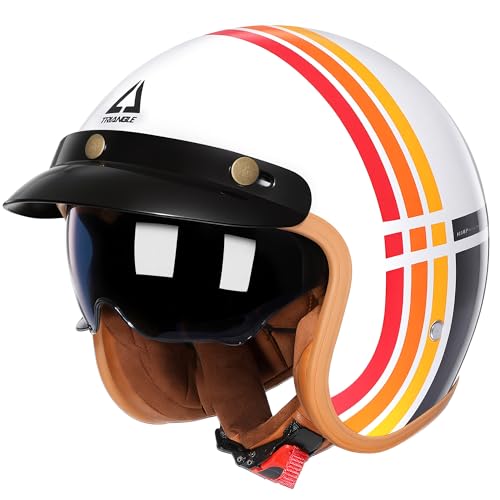 |
Best Retro Commuter | Type: 3/4 open-face | Certification: DOT FMVSS 218 | Best for: Daily commuters who want drop-down tint plus a removable peak in a retro package | VIEW LATEST PRICE | Read Our Analysis |
| ILM 726X Open Face 3/4 Helmet | 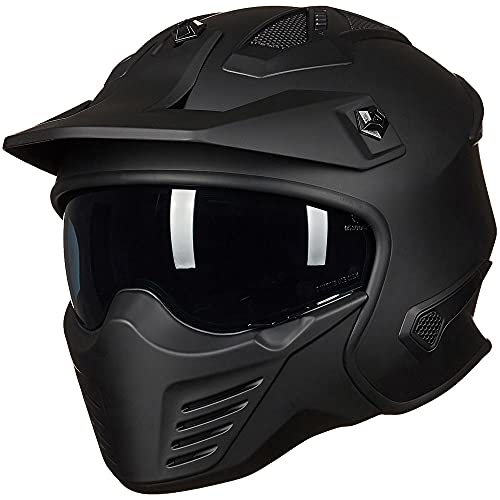 |
Best Modular 3/4 | Type: 3/4 open-face with optional chin guard | Certification: DOT FMVSS 218 | Best for: Riders who want the option to add chin coverage when conditions call for it | VIEW LATEST PRICE | Read Our Analysis |
| VCAN V85C 3/4 Open Face Helmet |  |
Best Clean Minimalist | Type: 3/4 open-face | Certification: DOT FMVSS 218 | Best for: Riders who want a no-nonsense DOT open-face from an established manufacturer | VIEW LATEST PRICE | Read Our Analysis |
| TCMT 3/4 Open Face Dual Visor Helmet |  |
Best Feature Set | Type: 3/4 open-face | Certification: DOT | Best for: Riders who want a drop-down sun visor, an extra tinted visor, and speaker recesses in one package | VIEW LATEST PRICE | Read Our Analysis |
More Details on Our Top Picks
Bell Custom 500
The Bell Custom 500 is the helmet that the rest of this category is measured against. A fiberglass composite shell with dual certification to both DOT FMVSS 218 and ECE 22.06 is the headline spec, and ECE 22.06 matters because it is the European standard that requires third-party lab testing rather than manufacturer self-certification. If you want someone other than Bell checking Bell's work, the ECE mark is that confirmation.
The IONIC+ padding is designed to manage sweat and fight odor, which matters more than it sounds on an open-face helmet where the whole face is generating heat toward the liner on warm days. The D-ring closure is the retention system traditionalists expect at this end of the market, and it is reliable, if not as glove-friendly as a quick-release buckle.
The 5-snap brow pattern is the Custom 500's secret weapon: it accepts Bell's own bubble shields and visors, plus a wide range of aftermarket options including Biltwell's bubble shield catalog and various third-party goggles. You can configure this helmet from bare-face with goggles to a full clear visor to a tinted bubble shield without buying a new helmet.
The main limitation is the weight. The fiberglass version with carbon composite construction sits around 1,060 g, which is on the heavier end for an open-face compared to ABS alternatives. That is the price of fiberglass construction and real certifications. For occasional or shorter rides it is not an issue; for a daily three-hour commute, your neck will eventually have an opinion.
- Type:3/4 open-face
- Certification:DOT FMVSS 218 + ECE 22.06
- Shell:Fiberglass composite
- Shield:5-snap for aftermarket shields
- Weight:~1,060 g (size M, carbon version)
- Best for:Cruiser and cafe racer riders who want the industry reference open-face
Biltwell Bonanza
Biltwell built its reputation on affordable, honest gear that looks good without pretending to be something it is not, and the Bonanza is the company's flagship 3/4 open-face. The injection-molded ABS shell with EPS safety liner is DOT-certified and lightweight, and the 5-snap brow accepts all Biltwell bubble shields plus most compatible third-party accessories.
The brushed fleece Lycra liner absorbs and evaporates moisture well, and it is fully removable and replaceable, which matters when the liner gets to the point no amount of washing can fix. The chin strap system uses a brushed Lycra touch point for comfort and an adjustable strap end retainer to keep excess strap from flapping in the wind.
The Bonanza is the honest DOT open-face choice for riders who are not interested in European certification premiums and know what they are getting: a lightweight, good-looking shell with real foam, real certification, and a shield system that opens up the whole catalog of Biltwell visual options. Available in more colorways than probably any other open-face on Amazon.
Worth being clear: this is DOT self-certification only, not ECE third-party verified. That is normal for its price bracket, and DOT is a real standard with real test criteria. For riders who specifically want third-party lab verification, the Bell Custom 500 or BEON B-100 are the alternatives in this list.
- Type:3/4 open-face
- Certification:DOT FMVSS 218
- Shell:Injection-molded ABS
- Shield:5-snap brow for bubble shields and visors
- Liner:Brushed fleece Lycra, removable and replaceable
- Best for:Riders who want the definitive bubble-shield aesthetic at a real-world price
BEON B-100 Dual Visor Open Face Helmet
The BEON B-100 is one of the few budget-bracket open-face helmets that carries both DOT FMVSS 218 and ECE 22.05, meaning a European third-party lab has checked the construction claims alongside the manufacturer's own DOT self-certification. At this price tier, dual certification is unusual and worth flagging.
The visor setup is genuinely practical: an outer clear anti-scratch shield for full wind and debris protection, plus a retractable inner sun visor that you flip down at a button press rather than pulling over to the side of the road to swap lenses. For riders who deal with sun and shade on the same commute, this configuration is the right one.
The quick-release buckle is a meaningful upgrade over D-ring only at this end of the market. Riders who have struggled with D-ring closures with gloves on will appreciate a buckle that works one-handed. The inner liner is removable and washable, and the metal visor base is designed to be adjustable without tools.
The thermoplastic shell sits in the middle of the construction hierarchy: more protective than cheap polycarbonate, less stiff than fiberglass. For the certification level and feature set, the value proposition here is strong. The clear outer visor is on the larger side, which some riders prefer for the full wind protection and others find visually heavy.
- Type:3/4 open-face
- Certification:DOT FMVSS 218 + ECE 22.05
- Shell:Advanced thermoplastic ABS
- Shield:Outer clear visor + retractable inner sun visor
- Closure:Quick-release buckle (one-gloved-hand operation)
- Best for:Riders who want dual-standard certification and a flip-down tint in one package
TORC T-50 Retro Open Face Helmet
TORC has been making the T-50 family for long enough that the design has become something of a standard in the retro-moto community, and the newer T-50 Retro builds on that legacy with a multi-density EPS impact absorption system. That is the spec that matters most: two foam densities means the liner handles a wider range of impact energies than a single-density block, which is a construction detail worth paying for at any price.
The removable suede comfort liner with custom fit adjustment lets you dial in the fit beyond what a fixed pad set allows, and the D-ring chin strap with padded cushion is the classic retention system the retro look calls for. The 3-snap visor mount and removable cheek pads give you configuration options without buying additional accessories.
The lightweight ABS shell is DOT certified and the construction is honest: this is not trying to be a Bell Custom 500, it is trying to be a well-built, good-looking open-face at a price that does not require a financial commitment before you know if you like the style. For newer riders or those building a second helmet rotation, that is a legitimate design goal.
Available in matte and metallic finishes, and the retro proportions photograph well against period-correct bikes. The one consistent note from owners is that TORC's sizing runs slightly on the larger side of stated dimensions, so verify with their centimeter chart before ordering.
- Type:3/4 open-face
- Certification:DOT FMVSS 218
- Shell:Lightweight ABS
- Shield:3-snap visor + removable cheek pads
- Closure:D-ring with padded chin strap
- Best for:Riders who want TORC's retro character and multi-density EPS at a modest price
TRIANGLE Retro 3/4 Helmet with Sun Visor
The TRIANGLE is the pick when the riding includes enough sun-angle variation that having the drop-down visor on hand is genuinely useful rather than a checkbox feature. The retractable inner sun visor blocks 99% of UV and deploys with a push or pull rather than a dedicated slider button, which sounds like a minor difference until you try to operate a slider with full-fingered winter gloves. The mechanism is simple and that is the point.
The removable peak brim is a detail that vintage-moto riders either love or ignore: useful for shading the face from overhead sun on a cruiser, odd-looking at speed on a sport bike. It detaches without tools. The quick-release buckle works with one gloved hand, which is the standard any open-face helmet should meet in 2026.
ABS shell, EPS liner, and DOT FMVSS 218 self-certification is the construction story. TRIANGLE is not a household name in premium helmet circles, but the build quality at this price is consistent with what the DOT cert requires, and the retro proportions are well-executed.
The storage bag included in every unit is a genuinely useful detail: open-face helmets scratch easily when tossed in a luggage bag unprotected, and having a proper pouch eliminates the problem. For commuters who carry the helmet on and off transit, that matters.
- Type:3/4 open-face
- Certification:DOT FMVSS 218
- Shell:High-impact ABS
- Shield:Retractable inner sun visor (99% UV block) + removable peak brim
- Closure:Quick-release buckle
- Best for:Daily commuters who want drop-down tint plus a removable peak in a retro package
ILM 726X Open Face 3/4 Helmet
The ILM 726X is the Swiss Army knife of this list: the lens is detachable, the sun shield is detachable, and so is the chin guard. When everything is in place it becomes something close to a modular helmet; when stripped down it is a standard open-face. That flexibility is particularly useful for riders who want open-air riding on most days but want some chin coverage for highway speeds or cold mornings.
The DOT FMVSS 218 certification covers the base helmet. The chin guard is a secondary attachment rather than a structural component built to its own impact standard, so it is worth being clear about that: the configuration with chin guard is more wind protection than it is crash protection at the level of a certified full-face chin bar. The lens and sun shield are both designed to be replaced individually without tools.
Ventilation is a strength here: multiple vent channels mean the helmet breathes better than sealed designs, which matters in the open-face category where riders often choose it partly for airflow. The quick-release buckle is glove-compatible, and the overall fit tends to run true to size per ILM owner reports.
For riders who like the idea of a 3/4 open-face but occasionally regret the face exposure in specific riding conditions, the 726X offers a conversion path without requiring a separate full-face purchase. The trade-off is that the assembled configuration is bulkier than a clean open-face shell.
- Type:3/4 open-face with optional chin guard
- Certification:DOT FMVSS 218
- Shell:ABS
- Shield:Detachable clear lens + detachable sun shield + detachable chin guard
- Closure:Quick-release buckle
- Best for:Riders who want the option to add chin coverage when conditions call for it
VCAN V85C 3/4 Open Face Helmet
VCAN has been manufacturing motorcycle helmets for over 30 years, and the V85C is the clean-lines open-face from a company that does not need flashy marketing copy to sell helmets. Two outer shell sizes for proper scale across the size range is a detail that budget brands skip: it means a small shell is actually sized for a small head, not a large shell with extra padding stuffed in. The visual proportions are better and the fit is more honest.
The removable sun visor keeps the external profile clean when stowed. The ultra-suede interior padding is fully washable and replaceable, which matters for a helmet that accumulates road grime on an open-face design faster than a sealed full-face. The retention system uses standard buckle hardware and the fit runs intermediate oval, per the product documentation.
This is the pick for riders who want a DOT open-face from an established manufacturer without the visual noise of extra visor mechanisms, snap patterns, or peak brims. The V85C is simply a well-proportioned, cleanly finished 3/4 shell that does what an open-face is supposed to do.
The only limitation worth flagging is that the removable visor mechanism on the V85C is relatively simple: it covers the sun-visor function adequately but is not the multi-position, anti-UV rated system found on the BEON or TRIANGLE options in this list. For riders who want sophisticated visor mechanics, those are the better picks. For a clean, no-clutter open-face, the VCAN is the one.
- Type:3/4 open-face
- Certification:DOT FMVSS 218
- Shell:Lightweight advanced ABS (2 outer shell sizes)
- Shield:Removable sun visor
- Liner:Washable ultra-suede inner comfort padding
- Best for:Riders who want a no-nonsense DOT open-face from an established manufacturer
TCMT 3/4 Open Face Dual Visor Helmet
The TCMT packs a visor setup into an open-face that few helmets in this list match: per the listing, it ships with a clear outer visor, a built-in drop-down sun visor, and an additional tinted visor, for three visors in total. That gives you options for day, night and changing light without a separate purchase. The listing also describes speaker recesses that support most Bluetooth communication systems (the device is not included), so riders who plan to add an intercom have a place for it.
The manufacturer states the shell is ABS over EPS foam and that the helmet is DOT-certified. Ventilation is handled by an adjustable top vent switch working with front and rear vents, which the listing says is meant to reduce fogging without adding wind noise. The liner is a non-woven fabric that is removable and washable, and a helmet bag comes in the box.
The listing gives four sizes, S to XL, covering head circumferences of roughly 55 to 62 cm, so measure your head before ordering. It does not list a weight, so we cannot say how it compares with the lighter options in this roundup on neck fatigue. For commuting and city riding where the visor flexibility matters most, the feature set is the reason it earns a spot.
- Type:3/4 open-face
- Certification:DOT
- Shell:ABS with EPS foam
- Shield:Clear outer visor + built-in drop-down sun visor + extra tinted visor
- Liner:Removable, washable non-woven fabric
- Best for:Riders who want a drop-down sun visor, an extra tinted visor, and speaker recesses in one package
How to Choose an Open-Face Helmet
More helmet buying decisions involve aesthetic preferences in the open-face category than in any other. That is fine, and we are not here to override it. But a few technical decisions matter a lot more than most people realize before they commit to a specific helmet, and this section covers them.
Coverage: where a 3/4 sits between half-shell and full-face
A 3/4 open-face covers the top, sides, and back of the head, and extends down to protect the ears. It does not have a chin bar. A half-shell skull cap stops above the ears; a 3/4 open-face goes further down the sides and back. A full-face adds a chin bar that closes the loop around the face. The coverage gap in the open-face category is the entire face: chin, jaw, nose, and cheeks are all exposed. That is not a criticism of the style, it is the design intent. For riders weighing this decision, our guide on best half-shell motorcycle helmets covers the skull-cap end of the spectrum, while German-style lids with full EPS liners and proper certification are in our best German-style motorcycle helmets roundup.
Shields, visors, and goggles: the open-face configuration decision
Open-face helmets split into two major shield philosophies. Snap-on external bubble shields (Bell Custom 500, Biltwell Bonanza) attach to the brow of the helmet and give the classic 1960s retro aesthetic with full face coverage when deployed. They are removable and swappable, which lets you match the shield to the conditions or the bike. Integrated drop-down inner visors (BEON, TRIANGLE, TCMT) flip down from inside the shell without adding visual bulk to the exterior. They are more practical for in-traffic use but do not provide the same wide-angle coverage as a full external bubble shield. A third option is goggles, which work with bare-face open helmets and the Bell 5-snap pattern, popular in the vintage moto and scrambler community. All three approaches are legitimate; the right one depends on your riding context.
DOT vs. novelty: the certification question
This matters more in the open-face category than almost anywhere else, because the open-face aesthetic is popular with riders who want a vintage look, and that market has historically been flooded with novelty helmets that look like motorcycle helmets but have no certified impact liner. DOT FMVSS 218 is the minimum US standard. It covers impact attenuation, penetration resistance, and retention system strength. The problem is that DOT is self-certification: the manufacturer attests compliance, no external lab required. ECE certification requires third-party lab testing. Bell Custom 500 and BEON B-100 carry ECE alongside DOT, which means an independent body has also verified the construction. For riders who want that extra confirmation, those two are the picks. For everyone else, DOT from a known manufacturer is a real standard, not a meaningless label.
Fit, head oval, and sizing
Measure your head circumference in centimeters with a soft tape, just above the eyebrows. Most open-face manufacturers provide centimeter charts; use them rather than converting from inches. Open-face helmets with removable cheek pads (TORC T-50, BEON B-100) give you more post-purchase fit adjustment than fixed-liner shells. TORC tends to run slightly large; TRIANGLE and ILM run true to size per owner consensus. The retention system test: with the helmet buckled, grab the shell and try to roll it forward off your head. If it moves easily, the fit is too loose. For a complete guide on what to look for as a helmet ages and liner foam compresses, see our article on when to replace a motorcycle helmet.
Open-Face Motorcycle Helmet Comparison
| Helmet | Type | Certification | Shield | Best For |
|---|---|---|---|---|
| Bell Custom 500 | 3/4 open-face | DOT FMVSS 218 + ECE 22.06 | 5-snap for aftermarket shields | Cruiser and cafe racer riders who want the industry reference open-face |
| Biltwell Bonanza | 3/4 open-face | DOT FMVSS 218 | 5-snap brow for bubble shields and visors | Riders who want the definitive bubble-shield aesthetic at a real-world price |
| BEON B-100 Dual Visor Open Face Helmet | 3/4 open-face | DOT FMVSS 218 + ECE 22.05 | Outer clear visor + retractable inner sun visor | Riders who want dual-standard certification and a flip-down tint in one package |
| TORC T-50 Retro Open Face Helmet | 3/4 open-face | DOT FMVSS 218 | 3-snap visor + removable cheek pads | Riders who want TORC's retro character and multi-density EPS at a modest price |
| TRIANGLE Retro 3/4 Helmet with Sun Visor | 3/4 open-face | DOT FMVSS 218 | Retractable inner sun visor (99% UV block) + removable peak brim | Daily commuters who want drop-down tint plus a removable peak in a retro package |
| ILM 726X Open Face 3/4 Helmet | 3/4 open-face with optional chin guard | DOT FMVSS 218 | Detachable clear lens + detachable sun shield + detachable chin guard | Riders who want the option to add chin coverage when conditions call for it |
| VCAN V85C 3/4 Open Face Helmet | 3/4 open-face | DOT FMVSS 218 | Removable sun visor | Riders who want a no-nonsense DOT open-face from an established manufacturer |
| TCMT 3/4 Open Face Dual Visor Helmet | 3/4 open-face | DOT | Clear outer visor + built-in drop-down sun visor + extra tinted visor | Riders who want a drop-down sun visor, an extra tinted visor, and speaker recesses in one package |
DOT vs ECE vs Snell vs MIPS, how to pick the right lid in 60 seconds, and when to replace it. One page, no fluff.
Frequently Asked Questions
What is the difference between a 3/4 open-face and a half-shell motorcycle helmet?
A half-shell (skull cap) typically sits at or above the ear line and covers only the top of the head. A 3/4 open-face extends further down to cover the ears, sides, and back of the head while still leaving the face completely exposed. The 3/4 design offers more lateral and rear coverage than a skull cap, slightly more weight, and a taller profile. Both styles leave the face unprotected. For riders weighing the two options, our guide on best half-shell motorcycle helmets covers the skull-cap category in depth.
Is an open-face motorcycle helmet safe?
A DOT-certified open-face helmet provides real impact protection for the top, sides, and back of the skull. What it does not provide is chin, jaw, or face protection. The Hurt Report data shows chin bar contact is a meaningful injury zone in motorcycle crashes. Open-face helmets are legal, certified, and widely used; they are also less protective than full-face or modular helmets on the face coverage dimension. Riders who choose them are making an informed tradeoff, not a reckless one, but the tradeoff should be understood clearly rather than dismissed. Some riders come to open-face helmets specifically because enclosed full-face shells feel too confining - if that describes you, our guide to the best helmets for claustrophobic riders covers modular and open options worth considering.
What does the ECE certification on the Bell Custom 500 mean compared to DOT only?
DOT (FMVSS 218) is a US self-certification standard: the manufacturer tests the helmet internally and attests that it meets the standard. No external lab is required. ECE 22.06 (or 22.05) is a European standard that requires third-party laboratory testing before the certification is granted. A helmet with both DOT and ECE has been checked by an independent body with no financial interest in the result, in addition to the manufacturer's own testing. The Bell Custom 500 carries both. BEON B-100 carries DOT plus ECE 22.05.
I want the bubble-shield look. Which helmet works with bubble shields?
The Bell Custom 500 and Biltwell Bonanza both use a 5-snap brow pattern that accepts snap-on bubble shields. Bell's own shield lineup includes clear, tinted, and mirrored options. The Biltwell Bonanza accepts all Biltwell bubble shields and most compatible third-party snap accessories. Both helmets also work with goggles for the bare-face touring look. If you are coming from the vintage scrambler or cafe racer aesthetic, the 5-snap bubble shield system is the classic configuration. For more options in the retro open-face space, our best German-style motorcycle helmets guide covers DOT and ECE jet-style lids with deep European pedigree.
How often should I replace an open-face motorcycle helmet?
Replace immediately after any impact, even if the shell looks undamaged. EPS foam crushes permanently and does not recover its absorption capacity after a real hit. Absent a crash, manufacturers generally recommend replacement every 3 to 5 years as the foam and liner materials age. Open-face helmets are also exposed to more UV, road grime, and perspiration than full-face designs due to the open configuration, which can accelerate liner degradation. See our full guide on when to replace a motorcycle helmet for the specific signs to look for.
