
Affiliate disclosure As an Amazon Associate we earn from qualifying purchases, at no extra cost to you.
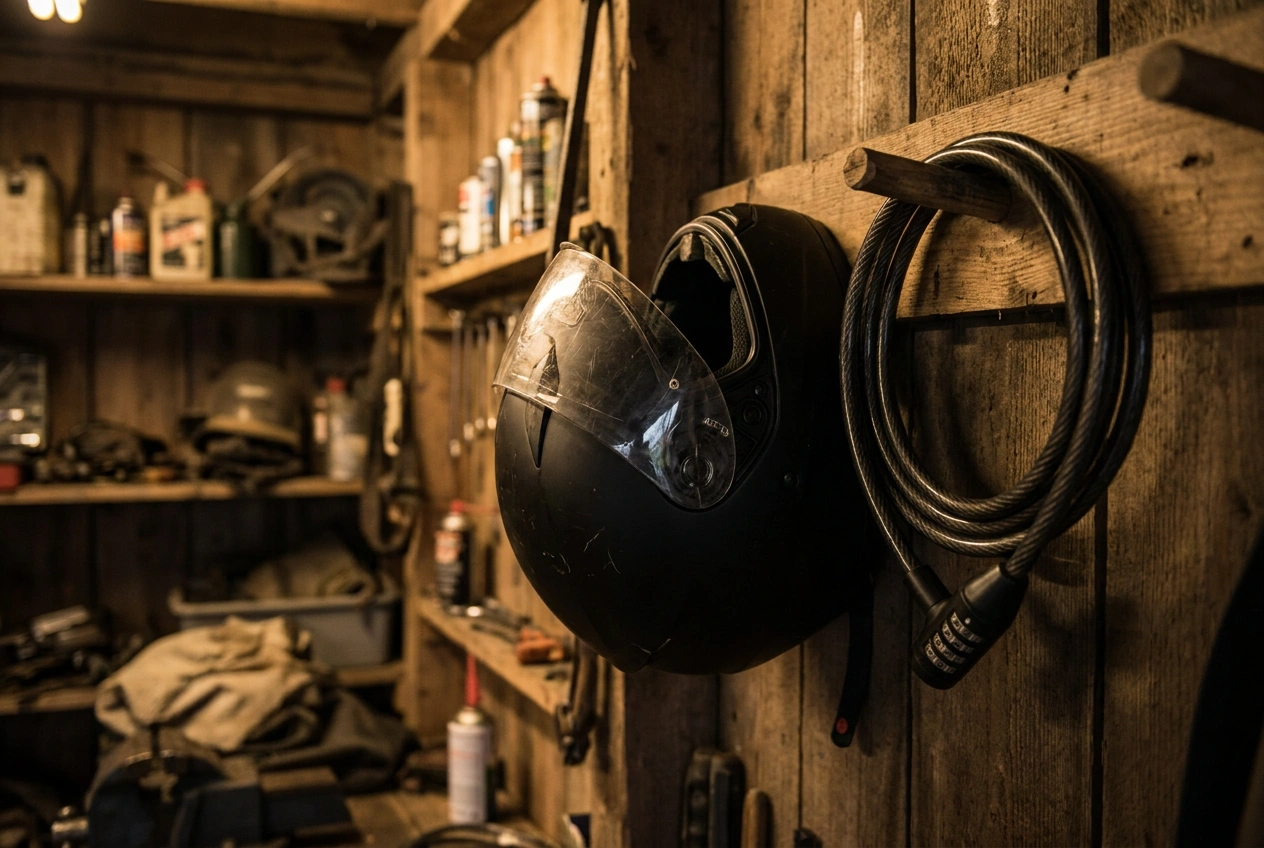
At home, rest your helmet on a shelf or a dedicated peg by the crown, away from direct sunlight, heat sources, and solvents. On the bike while parked, use a handlebar helmet lock or a cable lock threaded through a D-ring and bolted to the frame. Never hang it long-term on a mirror or rearview post.
Where you set your helmet down matters more than most riders realize. EPS foam, the liner that actually absorbs crash energy, can be degraded by UV exposure, heat, and household chemicals long before the shell shows any visible damage. A helmet stored carelessly for a season can offer less protection than its rating promises.
This guide covers the full picture: safe storage at home, on-the-bike placement while parked, and how to lock your helmet against theft.
Where NOT to Put Your Helmet (and Why)
Most riders default to a few convenient spots that are actually harmful. Here is what to avoid.
- Resting on the mirror or rearview post (long-term): The narrow post contacts a small area of the EPS liner, concentrating pressure and compressing the foam over time. Fine for 30 seconds while you fish out your key; not fine as a daily parking habit.
- On the fuel tank: Tank paint and clearcoat are chemical-based. Off-gassing from fresh paint, fuel residue, or cleaning products can attack the polycarbonate or ABS shell and degrade EPS over time. Even a padded tank bag cover does not fully eliminate contact risk.
- On the ground (bare): A helmet that tips over and rolls even a few inches on asphalt counts as an impact. EPS does not show damage externally.
- Near heat sources: Dashboards in direct sun, garage heaters, or close to an engine that has just been run can raise the interior temperature above 50°C. EPS begins to soften and permanently deform above that threshold.
- Near paint thinners, fuel, or solvent sprays: These dissolve the adhesives that bond the shell layers, weaken the liner bond, and can craze the visor. Keep your helmet on a separate shelf, not on the workbench beside your aerosol cans.
Best At-Home Storage Options
The goal is stable, dark, cool, and away from fumes. A few options that tick all boxes:
Wall peg or helmet hook
A wide-diameter peg (at least 2 inches across) supports the helmet at the chin bar opening rather than pressing on the liner. Mount it at eye level on a garage or hallway wall so the helmet is easy to grab and impossible to kick. Avoid thin metal hooks that dig into the interior padding.
Dedicated shelf
A flat shelf lets the helmet rest upright by the crown or on its side. Add a folded microfiber cloth or a piece of foam mat to prevent the shell from scratching on rough shelving material. Keep it away from the window side of the garage where afternoon sun hits.
Helmet bag or case
The microfibre bag that ships with most quality helmets is there for a reason. It blocks UV, prevents dust and chemical vapour from settling on the liner, and cushions minor knocks. Use it whenever the helmet will sit unused for more than a few days.
What the shelf environment should look like
- Away from direct sunlight or UV-transmitting skylight panels
- Ambient temperature consistently below 35°C
- No aerosol cans, paints, or fuel containers on the same surface
- Stable surface where a nudge will not send it rolling
- Interior face pointing away from dusty open doors
Leaving Your Helmet on the Bike While Parked
Sometimes you need both hands free and you are only stepping away for a few minutes. Here is how to do it without damaging the helmet or inviting theft.
Under the seat
Many sport bikes and scooters have an under-seat compartment designed for a full-face or modular helmet. This is the safest on-bike option: the helmet is shielded from sun and rain, cannot fall, and is locked with the bike. If the lid fits, use it.
On a dedicated handlebar helmet lock
A clamp-mounted helmet lock bolts to the handlebar or crash bar. The helmet D-ring clips onto a steel pin that locks closed. The helmet hangs at the side of the bike, protected from the mirror-pressure problem. See the theft section below for product guidance.
Bungeed to the passenger grab rail
Loop the chin strap around the grab rail and secure a bungee cord through the vent openings or around the chin bar to hold it flat. Acceptable in a pinch for short stops but prone to wind-blow at the wrong parking angle. Not suitable on exposed lots.
What to avoid
- Hanging by the chin strap from a mirror stem for more than a minute or two
- Resting on the seat with no securing cord (even slight wind will topple it)
- Leaving it on the tank where fuel and chemical fumes concentrate
- Leaving an unsecured helmet on the bike in any public space
How to Secure Your Helmet Against Theft
Helmets are a popular grab-and-go theft target because they are high-value, lightweight, and often left unattended outside cafes or shops. A lock is not a guarantee, but it significantly raises the effort level required and deters casual opportunists.
Handlebar helmet locks (clamp-type)
These bolt permanently to the handlebar, mirror stem, or crash bar. A steel pin locks through the helmet's D-ring retainer, holding it flush against the bike. They are the most secure mount-style option because the helmet cannot be pulled free without tools. Look for zinc-alloy or steel construction and at least two included keys.
Cable combination locks
A retractable steel cable threads through the helmet's chin bar or D-ring and then around a fixed object (a post, a fence railing, the bike's frame). Four-digit combination locks remove the need for a key. The cable extends 100-150 cm, which is enough to reach a nearby rack or the bike's rear wheel. These are lighter and more versatile than clamp locks; many riders carry one in a jacket pocket.
What to lock it to
The lock is only as good as the anchor. Preferred anchors, in order: a fixed ground ring or bike rack, the motorcycle frame or swingarm (not the fork, which can be removed), a solid post or railing that cannot be lifted over. Avoid: thin wire fencing, shopping trolley racks, or anything a thief could cut with basic tools in under 30 seconds.
Quick do/don't checklist
- DO use a dedicated helmet lock or a cable loop through the D-ring, not just the chin strap buckle
- DO thread the cable around a fixed anchor point, not just around the bike itself
- DO keep your helmet out of sight when locked outside overnight
- DON'T assume the mirror is a safe anchor (they unscrew in seconds)
- DON'T leave a high-value helmet unlocked on a public street, even for a minute
- DON'T hang an expensive helmet on the outside of a pannier bag without securing the cable to the bag itself
Traveling and Transporting Your Helmet
Whether you are on a multi-day tour or throwing the lid in a car boot for a track day, the same rules apply: protect the shell from impact and the liner from chemicals.
On a luggage rack or top box
A top box is the gold standard for touring storage. If using an open rack, place the helmet inside its microfibre bag first, then use purpose-made luggage straps (not bungee cords that cross the visor) to secure it flat. Position the chin bar down so the crown takes no load.
In a car
Boot is better than back seat because the helmet will not become a projectile in an emergency stop. Wrap it in a fleece or its bag to prevent it sliding into hard boot walls. Never leave it on a car seat in direct sunlight with the windows up; the interior can reach 70°C on a summer day, well above the EPS deformation threshold.
Checked luggage (flying)
Airline baggage handlers are not gentle. Use a purpose-built helmet bag with thick padding (not just the thin microfibre bag), fill the interior void with rolled-up riding gear, and mark the bag as FRAGILE. Consider shipping the helmet separately in a dedicated hard-shell case if it is a high-end lid worth more than your flight.
- Always store the helmet visor-side up or chin-bar down, never on the crown
- Keep the interior away from oily or chemically treated surfaces in the boot
- For long storage (off-season): clean the liner, dry it fully, then store in the bag in a cool dark cupboard
Helmet Storage Situations at a Glance
| Situation | Best Option | Avoid |
|---|---|---|
| At home - daily use | Wall peg (wide diameter) or flat shelf | Mirror, ground, near solvents or heat |
| At home - off-season | Microfibre bag, cool dark cupboard | Unbagged near a window or garage heater |
| On the bike - quick stop | Under-seat compartment or handlebar lock | Resting on tank, hanging from mirror |
| On the bike - long park | Handlebar lock + cable to fixed anchor | Unsecured on any public surface |
| In a car | Boot, wrapped in fleece or bag | Front or rear seat in direct sunlight |
| On a luggage rack | Helmet bag + luggage straps, chin-bar down | Bungee cord across visor, crown-down |
If your helmet is getting old or took a knock, see when to replace a motorcycle helmet. For cleaning the liner and shell before storage, read how to clean a motorcycle helmet. Taking a passenger? How to carry a passenger helmet covers the transport question.
DOT vs ECE vs Snell vs MIPS, how to pick the right lid in 60 seconds, and when to replace it. One page, no fluff.
Leaving it on the bike is the other option, within limits. Our helmet lock roundup is honest about what a cable lock does and does not stop.
Frequently Asked Questions
Is it OK to hang a helmet by the chin strap?
Briefly, yes. The chin strap and retainer hardware are tested to withstand far more than the weight of the helmet. The risk is more about liner compression from a narrow hook than strap integrity. Use a wide peg or a dedicated helmet hook rather than a thin nail or mirror stem.
Can I leave my helmet on my motorcycle overnight?
Only if it is inside a lockable top box or under a locked seat. An unsecured helmet left outside overnight is almost certain to disappear in an urban area. Even a locked helmet on a handlebar is visible and may attract thieves with enough time and tools.
Do helmet locks actually prevent theft?
They deter opportunistic theft effectively. Most casual thieves move on if a helmet requires more than 30-60 seconds to remove. A determined thief with bolt cutters can defeat a cable lock. For high-value lids, combine a handlebar clamp lock with a cable looped around a fixed anchor, and keep the helmet out of sight when possible.
Does storing a helmet in a hot car damage it?
Yes. Car interiors on sunny summer days can reach 60-80 degrees Celsius, which is above the EPS softening threshold of around 50 degrees. Regular exposure degrades the foam's ability to absorb impact energy. Store the helmet in a shaded boot or take it indoors.
How do I store a helmet long-term (off-season)?
Clean the liner and interior padding and dry them fully before storage. Place the helmet in its microfibre bag to block UV and dust. Store in a cool, dark location away from paint, fuel, or cleaning products. Avoid compression from heavy items stacked on top. Most manufacturers recommend a 5-year replacement cycle regardless of condition.
