
Affiliate disclosure As an Amazon Associate we earn from qualifying purchases, at no extra cost to you.
Yes: a drop-down sun visor is a second tinted shield mounted inside the shell that you deploy with a slider, usually on the left side near your temple, and it is standard equipment on most modern modular helmets and on a growing number of full-face helmets too. Riders searching for this feature are usually trying to stop swapping shields at every sunset, and the honest answer is that the mechanism works well most of the time and has three specific failure modes worth knowing before you buy.
There are three different things people mean by "sun visor," and mixing them up is how a reader ends up disappointed. An internal drop-down sun visor is a second tinted shield sealed inside the shell that slides down over your eyes independent of the main visor. An external tinted or dual shield is a second face shield you physically swap onto the helmet in place of the clear one. A photochromic shield darkens and lightens on its own in response to UV, with no lever at all. Listings use these terms loosely, so our research desk read the actual title and feature text on each product's own Amazon listing rather than guessing from the category or the marketing photo.
Below are eight helmets whose own listings state a drop-down internal visor or a dual-visor shield system, spanning modular and full-face designs from budget to mid-range, plus the mechanism explainer and the failure modes riders actually report: the visor sitting too high and leaving a bright gap at the bottom of your vision, the slider stiffening in cold weather, the internal visor scratching where it retracts against the EPS liner, and the extra fogging risk that comes from adding a second surface in front of your eyes.
Key Takeaways
- A drop-down sun visor is a second tinted shield sealed inside the shell and deployed with a slider; it is a different thing from an external swap shield or a photochromic lens, and listings use the terms loosely.
- The Trnzoptcy Bluetooth Modular and JZZLSJT Bluetooth Modular pair a built-in sun visor with Bluetooth, so riders do not have to choose between the two features.
- The most-reported real-world complaint is not the visor failing, it is the visor sitting too high on some faces and leaving a bright gap along the bottom edge of your vision, which is a fit issue, not a defect.
- Sliders on cheaper mechanisms are reported to stiffen or stick in cold weather, so test the action with gloves on before a long winter ride.
- A dropped internal visor adds a second surface between your eyes and the outside air, which means an extra fogging risk on top of whatever the main shield already does; see our hot-weather helmet guide for ventilation that helps with both heat and fog.
| 1Storm Full Face Dual-Visor |  |
Best Budget Full-Face Dual-Visor | Type: Full-face, fixed chin bar | Visor system: Internal drop-down smoked sun visor + separate clear outer shield (stated) | Best for: A sun visor without paying modular prices | VIEW LATEST PRICE | Read Our Analysis |
| GLX GX11 Compact Full Face |  |
Best Quick-Swap External Shield | Type: Full-face, fixed chin bar | Visor system: External tinted shield with quick-change swap mechanism (no internal drop-down, stated) | Best for: Riders who prefer a swappable shield over an internal lever | VIEW LATEST PRICE | Read Our Analysis |
| Trnzoptcy Bluetooth Modular |  |
Best Bluetooth Modular | Type: Modular, flip-up chin bar | Visor system: Retractable internal sun shield + clear outer visor, dual visor design (stated) | Best for: One helmet that does sun visor and Bluetooth | VIEW LATEST PRICE | Read Our Analysis |
| JZZLSJT Bluetooth Modular Dual Visor |  |
Best Value Bluetooth Modular | Type: Modular, flip-up chin bar | Visor system: External sunshade + internal dark sunshade, openable/hideable (dual visor, stated) | Best for: Bluetooth and a sun visor at a lower price than the Trnzoptcy | VIEW LATEST PRICE | Read Our Analysis |
| LEM Touring Modular |  |
Best for Long-Distance Touring | Type: Modular, flip-up chin bar, touring-oriented | Visor system: Fingertip-deployed internal tinted visor, "instant sun defense" (stated) | Best for: Highway riders who want a light shell and a quick slider | VIEW LATEST PRICE | Read Our Analysis |
| 1Storm Modular with LED Tail Light |  |
Best Modular With Integrated Tail Light | Type: Modular, flip-up chin bar | Visor system: Dual lens: inner smoked lens + outer clear shield (stated) | Best for: Riders who commute after dark as often as in daylight | VIEW LATEST PRICE | Read Our Analysis |
| OUMURS Modular Dual Visor |  |
Best Budget Modular Dual-Visor | Type: Modular, flip-up chin bar | Visor system: Outer clear wind visor + inner dark sun visor (dual visor, stated) | Best for: Tightest budget for a dual-visor modular | VIEW LATEST PRICE | Read Our Analysis |
| ILM 902 Modular Dual Visor | 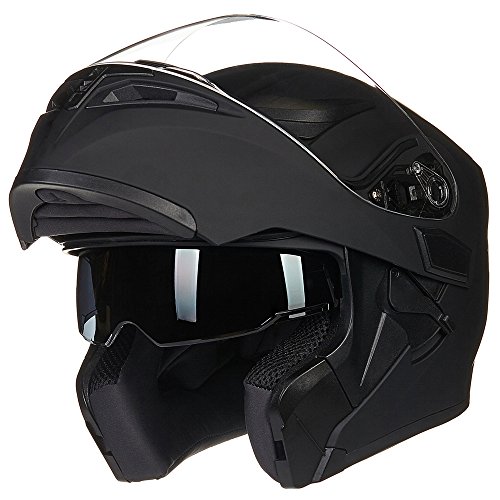 |
Best Established-Brand Modular Dual-Visor | Type: Modular, flip-up chin bar | Visor system: Dual visor flip-up design, anti-scratch/anti-fog wide-view clear visor (stated) | Best for: A recognizable modular brand with a stated dual-visor system | VIEW LATEST PRICE | Read Our Analysis |
More Details on Our Top Picks
1Storm Full Face Dual-Visor
The listing calls this an "advanced dual-visor system": an inner drop-down smoked sun visor for daytime glare, paired with a separate clear outer shield you keep on for the ride and swap only if you need a spare. That is the internal-drop-down mechanism in its simplest, cheapest form, on a fixed-chin full-face rather than a pricier modular.
Because the chin bar does not flip, there is one fewer moving assembly to wear out compared to a modular helmet, which is worth factoring in if the modular slider mechanism itself is what worries you. The shell is described as a lightweight, aerodynamic thermoplastic alloy, and the interior padding is removable and washable, which is standard at this price band.
The listing does not state a weight figure or a Bluetooth option, and there is no rotational-impact system named (MIPS or equivalent), which is typical for a helmet at this price. Confirm current sizing on the listing, since fixed-shell full-face helmets run less forgiving than a modular's flip-up fit.
For a reader who wants the internal drop-down mechanism explained above without paying for a flip-up chin bar or Bluetooth, this is the straightforward entry point.
- Type:Full-face, fixed chin bar
- Visor system:Internal drop-down smoked sun visor + separate clear outer shield (stated)
- Certification:DOT FMVSS 218 (stated)
- Shell:Lightweight, aerodynamic thermoplastic alloy (stated)
- Liner:Removable, washable
- Bluetooth:Not specified by manufacturer
- Weight:Not specified by manufacturer
- Best for:A sun visor without paying modular prices
GLX GX11 Compact Full Face
This is the second mechanism from the intro in practice: a tinted visor you fit in place of the clear one, with a listing-stated "quick-change mechanism for effortless shield replacement," rather than a lever that drops a second shield inside the shell. If you already own a spare tinted shield for another helmet, or you would rather not add a moving internal part, this is the more mechanically simple route to the same daytime-glare result.
GLX states a wind-tunnel-tested design with three adjustable intakes and four exhaust outlets, plus a Multi-Density EPS liner described as providing "first and second-layer defense." The interior is fully removable, washable and adjustable.
The trade-off against a true drop-down visor is obvious: swapping a shield mid-ride at a stoplight is slower than flicking a slider, and you need to carry the shield you are not using. There is no stated rotational-impact system or Bluetooth option.
For riders who understand the difference between an internal visor and a swap shield and deliberately want the latter, the GX11 is a well-specified, budget-friendly way to get it.
- Type:Full-face, fixed chin bar
- Visor system:External tinted shield with quick-change swap mechanism (no internal drop-down, stated)
- Certification:DOT (stated)
- Shell:GLX shell molding, Multi-Density EPS liner (stated)
- Ventilation:3 adjustable intakes, 4 exhaust outlets (stated)
- Bluetooth:Not specified by manufacturer
- Weight:Not specified by manufacturer
- Best for:Riders who prefer a swappable shield over an internal lever
Trnzoptcy Bluetooth Modular
The listing pairs "built-in Bluetooth 5.3 technology for hands-free calls and music streaming" with what it calls an "advanced Bluetooth dual visor system": a retractable sun shield for daytime glare and a separate clear lens for night visibility, both operated with quick-release lens mechanisms. If the reader's actual goal is to stop juggling two separate purchases (a comms unit and a tinted shield), this is built around exactly that.
It is a flip-up modular, so the chin bar lifts for talking or drinking without removing the whole helmet, and the retractable sun shield still works independently of that. The liner is described as removable and washable with an eyeglass groove, which matters if you also wear glasses; see our glasses-compatible helmet guide for how that groove interacts with temple arms.
No weight figure is stated, and a modular chin-bar hinge plus a Bluetooth unit adds mass over a simple full-face, which is the standard modular trade-off. Bluetooth pairing range and call quality are stated in the listing's own marketing language rather than independently verified here.
For a rider unwilling to compromise on either feature, the built-in Bluetooth is the differentiator over the other modular sun-visor helmets on this list.
- Type:Modular, flip-up chin bar
- Visor system:Retractable internal sun shield + clear outer visor, dual visor design (stated)
- Certification:DOT FMVSS 218 (stated)
- Bluetooth:Built-in Bluetooth 5.3 (stated)
- Ventilation:Multi-ventilation ports: top, mouth, rear (stated)
- Liner:Removable, washable, eyeglass groove (stated)
- Weight:Not specified by manufacturer
- Best for:One helmet that does sun visor and Bluetooth
JZZLSJT Bluetooth Modular Dual Visor
This is the second Bluetooth-plus-visor option on this list, and it is a useful contrast to the Trnzoptcy above because it is priced lower while still stating the same core combination: a modular flip-up shell, an internal dark sunshade the listing says "can be hidden or opened," and a built-in Bluetooth headset with automatic call answering.
The listing describes a "technical ABS" shell over high-density EPS foam and calls out a streamlined aerodynamic design aimed at reducing wind noise. Liner and cheek pads are removable and washable, which is the baseline expectation at this price.
As with the Trnzoptcy, no weight figure is given, and Bluetooth performance claims ("ultra strong signal transmission, ultra low power consumption") come from the manufacturer's own listing copy rather than an independent test. Riders who have used cheaper integrated Bluetooth units before will recognize the pattern: functional for calls and music, not a substitute for a dedicated comms brand if two-way intercom range matters.
If the budget stretch to the Trnzoptcy is the only thing stopping a Bluetooth-plus-visor purchase, this is the more affordable way into the same category.
- Type:Modular, flip-up chin bar
- Visor system:External sunshade + internal dark sunshade, openable/hideable (dual visor, stated)
- Certification:DOT FMVSS 218 (stated)
- Bluetooth:Built-in Bluetooth headset (stated)
- Shell:ABS composite shell + high-density EPS liner (stated)
- Liner:Removable, washable liner and cheek pads (stated)
- Weight:Not specified by manufacturer
- Best for:Bluetooth and a sun visor at a lower price than the Trnzoptcy
LEM Touring Modular
LEM markets this specifically for touring, and the listing frames the visor as "instant sun defense": "a quick press of your fingertip instantly deploys the built-in tinted visor, no need to stop or change visors," which is the drop-down mechanism at its most direct. The chin bar flips up for talking or drinking at a stop, independent of the sun visor.
The stated selling point is weight: an ABS shell the listing says "remains impressively light, significantly reducing neck strain during long rides and highway journeys." Manually operable vents at the top, mouth and rear are aimed at multi-hour comfort rather than aggressive summer airflow, and the liner is moisture-wicking and fully machine-washable.
No weight figure in grams or ounces is stated, so "lightweight" here is the manufacturer's own framing rather than a number a reader can compare against another helmet. Slider action on lower-cost modular helmets is one of the parts riders report stiffening in cold weather, so it is worth testing the mechanism with winter gloves before committing to it for a cold-climate commute.
For a rider whose priority is neck fatigue on long highway stretches with a sun visor that deploys with one finger, this is built around exactly that use case.
- Type:Modular, flip-up chin bar, touring-oriented
- Visor system:Fingertip-deployed internal tinted visor, "instant sun defense" (stated)
- Certification:DOT FMVSS No. 218 (stated)
- Shell:Lightweight ABS (stated)
- Ventilation:Manually operable vents: top, mouth, rear (stated)
- Liner:Removable, machine-washable, moisture-wicking (stated)
- Bluetooth:Not specified by manufacturer
- Weight:Not specified by manufacturer
- Best for:Highway riders who want a light shell and a quick slider
1Storm Modular with LED Tail Light
The dual-lens system here is the familiar inner smoked lens plus outer clear shield, but the feature that separates this helmet from the rest of the list is a rechargeable LED tail light built into the rear shell with selectable modes, aimed at riders who are on the road in low light as much as in bright sun.
That combination is worth noticing: a helmet built around a sun visor for daytime glare that also addresses the opposite problem, being seen at dusk and at night. The shell is described as an ultra-light, durable aerodynamic thermoplastic alloy, with a venturi-effect rear spoiler the listing credits with reducing wind noise.
The LED unit needs charging like any accessory battery, and the listing does not state runtime, so riders relying on it for a daily commute should plan to check charge before longer trips. No weight or Bluetooth figures are given.
For a rider whose ride spans both ends of the light spectrum, glare at noon and visibility at dusk, this is the one helmet on the list addressing both directly.
- Type:Modular, flip-up chin bar
- Visor system:Dual lens: inner smoked lens + outer clear shield (stated)
- Certification:DOT FMVSS 218 (stated)
- Extra:Rechargeable LED tail light with multiple modes (stated)
- Shell:Aerodynamic thermoplastic alloy (stated)
- Bluetooth:Not specified by manufacturer
- Weight:Not specified by manufacturer
- Best for:Riders who commute after dark as often as in daylight
OUMURS Modular Dual Visor
OUMURS states the same dual-visor layout as several helmets above, an outer clear wind visor plus an inner dark sun visor, on a flip-up modular shell built from ABS over EPS lining. It is one of the cheaper modular options on this list that still states the internal-visor mechanism rather than requiring a shield swap.
The listing includes extras uncommon at this price: a pair of gloves, a face mask, an anti-fog film for the visor, and a spare outer lens. That anti-fog film inclusion is a tacit acknowledgment of the fogging risk that comes with running two shield layers close to your face, which is worth applying before a humid ride rather than after the visor mists up.
No weight figure, rotational-impact system, or Bluetooth option is stated. Fit and finish at this price point tend to be the trade-off against pricier modular helmets, so check current sizing and return policy on the listing.
For a reader who wants the dual-visor mechanism and does not want to spend modular-plus-Bluetooth money, this is the value option, extra accessories included.
- Type:Modular, flip-up chin bar
- Visor system:Outer clear wind visor + inner dark sun visor (dual visor, stated)
- Certification:DOT FMVSS 218 (stated)
- Shell:ABS shell with EPS liner (stated)
- Ventilation:Adjustable air vents (stated)
- Extras:Gloves, mask, anti-fog film, extra lens included (stated)
- Bluetooth:Not specified by manufacturer
- Weight:Not specified by manufacturer
- Best for:Tightest budget for a dual-visor modular
ILM 902 Modular Dual Visor
ILM's Model 902 is titled a "Dual Visor Flip up Modular Full Face Helmet," and the feature text specifically calls out an "anti-scratch, anti-fog" wide-view clear visor alongside the modular flip-up function, which is one of the more direct anti-fog claims among the helmets on this list. ILM is a more established name in the budget-to-mid modular space than several other brands here, with six color options stated.
The shell is described as a high-resistance ABS with a micrometrically adjustable strap, and the interior liner and cheek pads are removable and washable. As with the OUMURS above, the listing's anti-fog framing is a reminder that a dropped internal visor is a second surface in front of your eyes, and fogging risk rises with it regardless of brand.
No weight figure or rotational-impact system is stated, and the listing does not specify Bluetooth. Sizing runs by the manufacturer's own chart; modular helmets in general fit slightly differently than fixed-shell full-face helmets because of the hinge mechanism, so check the current size guide on the listing.
For a rider who wants the dual-visor mechanism from a brand name they may already recognize from other modular listings, this is the pick.
- Type:Modular, flip-up chin bar
- Visor system:Dual visor flip-up design, anti-scratch/anti-fog wide-view clear visor (stated)
- Certification:Meets or exceeds FMVSS-218 and DOT (stated)
- Shell:High-resistance ABS shell, micrometrically adjustable strap (stated)
- Liner:Removable, washable liner and cheek pads (stated)
- Colors:6 color options (stated)
- Bluetooth:Not specified by manufacturer
- Weight:Not specified by manufacturer
- Best for:A recognizable modular brand with a stated dual-visor system
How to Choose a Motorcycle Helmet With a Sun Visor
The mechanism matters more than the helmet category: decide whether you want an internal drop-down visor, an external swap shield, or a photochromic lens before you shortlist by brand or price, because the three solve the same glare problem in different ways with different failure modes.
Internal Drop-Down vs External Swap Shield vs Photochromic
An internal drop-down sun visor, the mechanism on six of the eight helmets above, is a second tinted shield sealed inside the shell above your forehead, released with a slider so you can deploy or retract it without stopping. An external tinted or dual shield, like the GLX GX11's swap system above, is a separate shield you physically fit onto the helmet in place of the clear one, which is mechanically simpler and has one fewer moving part but is slower to switch mid-ride. A photochromic shield is a third option, not represented on this list because none of the eight listings state one; it darkens automatically with UV exposure and needs no lever at all, but it responds to light rather than to what you actually want to see through at that moment, and it does nothing once you are already wearing tinted lenses indoors or in a tunnel.
Why Some Riders Get a Bright Gap at the Bottom of Their Vision
The most common real-world complaint about internal drop-down visors is not that the mechanism fails, it is that the visor sits slightly too high for some face shapes once deployed, leaving an unshaded strip along the bottom of your field of view exactly where a low sun sits at dawn or dusk. This is a fit interaction between the helmet's internal geometry and your face, not a manufacturing defect, and it varies by rider even within the same helmet model. There is no way to check this from a listing; it only shows up once the visor is down on your specific head, which is a reason to buy from a retailer with a straightforward return policy.
Why the Slider Sticks in Cold Weather
The small plastic slide mechanism that drops the internal visor relies on a track and a spring-loaded or friction catch, and both can stiffen when the ambient temperature drops, along with the lubricant (if any) the manufacturer used on the track. Riders report this most on lower-cost mechanisms rather than a specific brand pattern. If cold-weather riding is part of your use case, work the slider with the gloves you actually ride in before you rely on it, since a visor you cannot operate one-handed at speed with winter gloves on is a visor you will not use.
Why the Internal Visor Scratches
An internal drop-down visor retracts into a slot built into the EPS foam liner just under the outer shell, and repeated retraction against that foam edge, plus whatever dust and grit rode along on the last trip, is the most commonly reported source of scratching on the visor's face-side surface, separate from anything the outer shield picks up from road debris. Wiping the visor before retracting it and avoiding forcing a gritty slider both reduce this. If a visor is already scratched, our guide to removing scratches from a helmet visor covers what actually works against a plastic shield versus what makes it worse.
Does a Dropped Sun Visor Fog More Than a Single Shield?
Yes, and the reason is straightforward: dropping the internal visor adds a second surface between your eyes and the outside air, which means a second boundary layer where warm, moist breath and skin-temperature air can condense, on top of whatever the main outer shield already does. Two of the helmets above (OUMURS and ILM) specifically state anti-fog treatment on the visor as a listed feature, which is a tacit acknowledgment of the same issue. Good chin-curtain fit and airflow reduce it either way; see our hot-weather helmet guide for helmets built around ventilation, which helps with fogging as much as with heat.
Modular or Full-Face for a Sun Visor?
The sun-visor mechanism itself works the same way in a modular or a fixed-chin full-face helmet; the choice between the two is about the chin bar, not the visor. A modular's flip-up chin bar adds convenience at a stop but is one more moving assembly to maintain, which is a separate consideration from the sun-visor slider covered above; our modular motorcycle helmet explainer covers that hinge mechanism and its own trade-offs in full.
What We Did and Did Not Test
Our research desk did not physically ride, wear, or operate the slider mechanism on any of these eight helmets. What we did: pulled the visor-system language directly from each product's own Amazon listing (title and feature text, via the Amazon Creators API) and only included a helmet here when its own listing stated a drop-down, internal, or dual-visor sun-shield system, rather than inferring the feature from a photo or a model name. The failure modes described above, the bright gap at the bottom of vision, cold-weather slider stiffness, retraction scratching, and added fogging risk, are patterns widely reported by riders about drop-down sun visors as a mechanism, not claims about any single ASIN's individual unit, and no listing here states or disclaims any of them directly. Prices, star ratings, and review counts change too often to print reliably in an article, so none appear above; check current figures on the retailer's page before buying.
Motorcycle Helmets With a Built-In Sun Visor Comparison
| Helmet | Type | Visor system | Certification | Bluetooth | Best for |
|---|---|---|---|---|---|
| 1Storm Full Face Dual-Visor | Full-face, fixed chin bar | Internal drop-down smoked sun visor + separate clear outer shield (stated) | DOT FMVSS 218 (stated) | Not specified by manufacturer | A sun visor without paying modular prices |
| GLX GX11 Compact Full Face | Full-face, fixed chin bar | External tinted shield with quick-change swap mechanism (no internal drop-down, stated) | DOT (stated) | Not specified by manufacturer | Riders who prefer a swappable shield over an internal lever |
| Trnzoptcy Bluetooth Modular | Modular, flip-up chin bar | Retractable internal sun shield + clear outer visor, dual visor design (stated) | DOT FMVSS 218 (stated) | Built-in Bluetooth 5.3 (stated) | One helmet that does sun visor and Bluetooth |
| JZZLSJT Bluetooth Modular Dual Visor | Modular, flip-up chin bar | External sunshade + internal dark sunshade, openable/hideable (dual visor, stated) | DOT FMVSS 218 (stated) | Built-in Bluetooth headset (stated) | Bluetooth and a sun visor at a lower price than the Trnzoptcy |
| LEM Touring Modular | Modular, flip-up chin bar, touring-oriented | Fingertip-deployed internal tinted visor, "instant sun defense" (stated) | DOT FMVSS No. 218 (stated) | Not specified by manufacturer | Highway riders who want a light shell and a quick slider |
| 1Storm Modular with LED Tail Light | Modular, flip-up chin bar | Dual lens: inner smoked lens + outer clear shield (stated) | DOT FMVSS 218 (stated) | Not specified by manufacturer | Riders who commute after dark as often as in daylight |
| OUMURS Modular Dual Visor | Modular, flip-up chin bar | Outer clear wind visor + inner dark sun visor (dual visor, stated) | DOT FMVSS 218 (stated) | Not specified by manufacturer | Tightest budget for a dual-visor modular |
| ILM 902 Modular Dual Visor | Modular, flip-up chin bar | Dual visor flip-up design, anti-scratch/anti-fog wide-view clear visor (stated) | Meets or exceeds FMVSS-218 and DOT (stated) | Not specified by manufacturer | A recognizable modular brand with a stated dual-visor system |
Frequently Asked Questions
Which motorcycle helmets have a built-in drop-down sun visor?
Among current listings, modular helmets from Trnzoptcy, JZZLSJT, LEM, 1Storm (LED tail light model), OUMURS and ILM state an internal drop-down or dual sun-visor system, as does the fixed-chin 1Storm full-face above. The GLX GX11 uses an external swap shield instead of an internal drop-down. Always confirm the current listing states the mechanism before buying, since sellers change specs between batches.
What is the difference between a drop-down sun visor and a tinted shield?
A drop-down sun visor is a second tinted shield sealed inside the helmet shell that you deploy with a slider without removing anything. A tinted shield, like the one on the GLX GX11 above, is a separate shield you physically swap onto the helmet in place of the clear one, which takes longer to switch but has one fewer moving part to fail.
Why does my helmet's sun visor leave a gap at the bottom?
This is usually a fit interaction between the visor's deployed position and your specific face shape, not a defect. Some riders find the visor sits slightly too high once dropped, leaving the bottom edge of their vision unshaded at low sun angles. It varies by rider even on the same helmet model, so it is worth checking in person or buying from a retailer with an easy return policy.
Do drop-down sun visors fog up more than a regular shield?
Yes, because dropping the internal visor adds a second surface between your eyes and the outside air, creating an additional boundary layer where condensation can form. Helmets with stated anti-fog treatment on the visor, like the OUMURS and ILM helmets above, are addressing this directly; good ventilation and chin-curtain fit help regardless of brand.
Can I add a drop-down sun visor to a helmet that does not have one?
Some full-face and modular shells accept an aftermarket internal visor kit sized for that specific model, but fit is model-specific and not universal. It is more reliable to choose a helmet whose own listing states the drop-down visor as a built-in feature, like the helmets above, than to retrofit one.
Why does the sun-visor slider get stiff in cold weather?
The slider is a small plastic track-and-catch mechanism, and both the plastic and any lubricant on the track can stiffen as temperature drops. This is reported more often on lower-cost mechanisms. If you ride in cold weather, test the slider with the gloves you actually wear before relying on it at speed.
DOT vs ECE vs Snell vs MIPS, how to pick the right lid in 60 seconds, and when to replace it. One page, no fluff.
