Affiliate disclosure As an Amazon Associate we earn from qualifying purchases, at no extra cost to you.
Via ferrata routes protect climbers with a fixed steel cable, iron rungs, and ladders bolted into the rock, and that fixed protection is exactly why the sport draws people who would never attempt an unroped alpine route. But a via ferrata helmet has a job that a general climbing helmet, or worse, a bicycle helmet, does not fully cover: it has to handle rockfall knocked loose by climbers above, a sideways trip-and-swing fall against the cable and rock face, and hours of exposed, sun-baked wear on a guided or park-managed route. The helmets below are all built to a mountaineering-grade standard and selected specifically for that mix of risks, not repurposed from a different sport.
This roundup pulls listing data directly from each product's Amazon page: stated weight, size range, certification where the manufacturer prints it, and features like headlamp clips that matter specifically for via ferrata's early starts and tunnel sections. Not every listing states a certification code even when the physical helmet carries one; each product entry below flags that gap explicitly, so you know exactly what to double-check before you buy.
Key Takeaways
- Via ferrata needs a climbing helmet, not a bike helmet - EN 12492 (and often UIAA 106) tests impacts to the top, sides, and rear of the head plus retention under an upward pull; EN 1078 bike helmets test one downward impact and use a buckle designed to release under load.
- The risk pattern is different from cragging - rockfall from climbers above combines with a trip-and-swing fall onto the cable, so side and rear coverage matter as much as the crown.
- Kids need their own certified helmet, not a downsized adult shell or a bike helmet borrowed for the trailhead - look for an adjustable strap in the roughly 48-58 cm range and a stated EN 12492/UIAA 106 rating.
- Weight and ventilation drive all-day comfort - guided routes often run two to six hours in direct sun; the lightest certified picks here run 200-250 g against hardshell designs that trade weight for durability.
- Headlamp clips matter more here than on a normal climbing day - many routes start before sunrise or pass through short tunnels, so front clips (and sometimes a rear band) are worth checking before you buy.
| Petzl BOREO Helmet (White) |  |
Best Overall for Via Ferrata | Type: Hardshell ABS outer shell with dual-foam (EPP + EPS) liner | Certifications: Not stated on this listing; Petzl markets BOREO under its "Top and Side Protection" design as a climbing/mountaineering helmet | Listed Use: Caving, climbing, canyoning (per manufacturer) | VIEW LATEST PRICE | Read Our Analysis |
| Black Diamond Half Dome (Denim) | 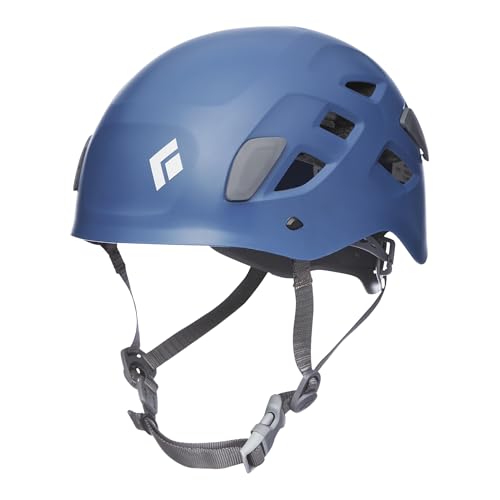 |
Best Value | Type: Tough outer shell with impact-absorbing foam liner | Certifications: Not stated on this listing; Black Diamond markets Half Dome as an all-purpose climbing helmet for cragging through alpine routes | Listed Use: Cragging to alpine climbing (per manufacturer) | VIEW LATEST PRICE | Read Our Analysis |
| CAMP Ikon Helmet |  |
Best Certified Ventilation | Type: Durable ABS shell with molded EPP + EPS foam | Certifications: EN 12492 and UIAA 106 (stated on this listing) | Listed Use: Technical climbing pursuits (per manufacturer) | VIEW LATEST PRICE | Read Our Analysis |
| Mammut Wall Rider Helmet |  |
Best Hybrid Comfort for All-Day Wear | Type: Hybrid construction: EPP foam core with partial hard shell | Certifications: Not stated on this listing; Mammut markets Wall Rider as a climbing helmet built for comfort and light weight | Listed Use: Climbing with a multi-adjustment fit system (per manufacturer) | VIEW LATEST PRICE | Read Our Analysis |
| OutdoorMaster Rock Climbing Helmet |  |
Best Budget EN 12492 Pick | Type: PC shell with EPS in-mold core | Certifications: EN 12492:2012 (stated on this listing) | Weight: 290 g (stated on this listing) | VIEW LATEST PRICE | Read Our Analysis |
| Petzl Meteor Helmet |  |
Best Premium Ultralight | Type: Polycarbonate shell with EPS foam liner | Certifications: Not stated on this listing; Petzl markets Meteor under its "Top and Side Protection" design as a climbing/mountaineering helmet | Listed Use: Climbing and mountaineering (per manufacturer) | VIEW LATEST PRICE | Read Our Analysis |
| Singing Rock Penta 2 Helmet |  |
Best for Guided Groups & Long Routes | Type: Hard PC shell with PS foam | Certifications: Not stated on this listing; Singing Rock markets Penta 2 as "ideal for sport climbing, trad climbing, mountaineering and via ferratas" | Listed Use: Sport climbing, trad climbing, mountaineering, via ferratas (per manufacturer) | VIEW LATEST PRICE | Read Our Analysis |
| Edelrid Ultralight Junior II (Kids) |  |
Best Kids/Family Option | Type: Impact-resistant polypropylene shell | Certifications: EN 12492 and UIAA 106 (stated on this listing); manufacturer notes it is not intended for bicycle, motorcycle, or equestrian use | Listed Use: Youth climbing courses, summer camps, rental use (per manufacturer) | VIEW LATEST PRICE | Read Our Analysis |
More Details on Our Top Picks
Petzl BOREO Helmet (White)
Petzl builds the BOREO around a thick, hard ABS outer shell paired with a dual-foam liner (EPP and EPS), and that hybrid construction suits via ferrata's mixed risk profile: exposed rock can send loose stone down onto the cable, and the shell's rigidity holds up to repeated knocks against rungs and rock as you move along a route. Petzl designs the BOREO to its own "Top and Side Protection" layout, extending coverage further down the back and sides of the head than a helmet that only shields the crown.
Via ferrata routes can swing climbers wide on their lanyards during a fall, which means an impact is just as likely to land on the side of the head as the top. That side coverage, combined with the hard ABS shell, is a big part of why this style of helmet keeps showing up as the standard recommendation on guided via ferrata routes.
The four headlamp clips matter more here than on a typical cragging day. Alpine via ferrata routes often start before sunrise or pass through tunnels and gallery sections cut into the rock, and a helmet without a secure mount means juggling a handheld light on exposed cable. The soft headband also folds flat into the shell for packing, useful if the route requires a cable car or hut approach first.
At M/L (53-61 cm), this listing covers most adult heads; Petzl also sells the BOREO in S/M and other colorways for a closer fit. This specific Amazon listing does not print a certification code, so shoppers who want to see the EN 12492 stamp before buying should check the helmet's printed label or Petzl's own product page.
- Type:Hardshell ABS outer shell with dual-foam (EPP + EPS) liner
- Certifications:Not stated on this listing; Petzl markets BOREO under its "Top and Side Protection" design as a climbing/mountaineering helmet
- Weight:Not specified by manufacturer on this listing
- Size:M/L, 53-61 cm (per listing)
- Ventilation:Large ventilation holes across the shell
- Headlamp Mounts:4 clips (per manufacturer)
- Listed Use:Caving, climbing, canyoning (per manufacturer)
Black Diamond Half Dome (Denim)
The Half Dome has been a standard beginner-to-intermediate climbing helmet for years, and its low-profile shell with large ventilation ports makes it a reasonable crossover into via ferrata, where routes can run for several hours in direct alpine sun. Black Diamond builds it with a tough outer shell over an impact-absorbing foam liner.
The listed head circumference on this M/L converts to roughly 58-64 cm (Amazon's own listing states it in inches, 23-25 in), which covers a wide band of adult heads. The low-profile suspension system and adjustable chin strap are meant for quick, one-handed tightening, useful when you are re-clipping a lanyard at the same time as adjusting fit.
Integrated headlamp clips are built into the shell, though the listing does not state a specific clip count. For guided groups that start at dawn to beat afternoon thunderstorms on exposed ridgelines, that headlamp compatibility is a practical feature rather than an afterthought.
This listing does not print a certification code either, though Black Diamond markets the Half Dome as an all-purpose climbing helmet built for everything from gym cragging to alpine routes. Shoppers who want certification confirmed in writing before purchase should check the printed label on the shell or Black Diamond's own spec sheet.
- Type:Tough outer shell with impact-absorbing foam liner
- Certifications:Not stated on this listing; Black Diamond markets Half Dome as an all-purpose climbing helmet for cragging through alpine routes
- Weight:Not specified by manufacturer on this listing
- Size:M/L, approx. 58-64 cm (converted from the listed 23-25 in head circumference)
- Ventilation:Large ventilation ports, streamlined low-profile shell
- Headlamp Mounts:Integrated clips (count not specified by manufacturer)
- Listed Use:Cragging to alpine climbing (per manufacturer)
CAMP Ikon Helmet
The CAMP Ikon's listing is one of the more transparent in this roundup: CAMP states directly that it meets EN 12492 and UIAA 106, the two standards that matter most for via ferrata, where a fall can load the helmet from the top, side, or rear depending on where the cable and rock catch you.
The shell combines a durable ABS outer layer with molded EPP and EPS foam, a hybrid build that CAMP positions for "technical pursuits" rather than casual use. Eighteen side and rear vents are built in, a meaningful number for a route that keeps you moving in full sun for several hours with no shade on exposed cable sections.
This particular listing is sized Small, so shoppers with larger heads should check CAMP's other size listings before ordering; the certification and construction carry across sizes, but head circumference in centimeters is not printed on this specific listing.
For a route that mixes rock scrambling with cabled sections, an EN 12492/UIAA 106-rated helmet with strong ventilation like the Ikon is a reasonable middle ground between the lightest ultralight shells and the more rugged hardshell picks elsewhere on this list.
- Type:Durable ABS shell with molded EPP + EPS foam
- Certifications:EN 12492 and UIAA 106 (stated on this listing)
- Weight:Not specified by manufacturer on this listing
- Size:Small (no cm range published on this listing)
- Ventilation:18 side and rear vents (per manufacturer)
- Headlamp Mounts:Not specified by manufacturer
- Listed Use:Technical climbing pursuits (per manufacturer)
Mammut Wall Rider Helmet
Mammut builds the Wall Rider around an EPP foam core with a partial hard shell rather than a full ABS outer layer, a hybrid approach that trims weight without leaving the crown or sides bare. That combination is aimed squarely at long days on the rock, which via ferrata routes tend to become once you add approach hiking and the descent.
The 52-57 cm size on this listing suits smaller-to-average adult heads; Mammut sells the Wall Rider across a range of sizes, so shoppers outside that band should look for a different size listing rather than assume this one stretches to fit.
Large ventilation holes and a multi-adjustment fit system are both called out in the listing, and two front clips hold a headlamp in place, useful on routes that start in the dark to avoid afternoon storms at altitude, a common guiding practice on longer via ferrata circuits.
This listing does not print a certification code. Mammut markets the Wall Rider as a climbing helmet built for comfort and low weight rather than as a budget option, so shoppers who need the EN 12492 stamp confirmed in writing should check the helmet's printed label before buying.
- Type:Hybrid construction: EPP foam core with partial hard shell
- Certifications:Not stated on this listing; Mammut markets Wall Rider as a climbing helmet built for comfort and light weight
- Weight:Not specified by manufacturer on this listing
- Size:52-57 cm
- Ventilation:Large ventilation holes for airflow
- Headlamp Mounts:2 front clips (per manufacturer)
- Listed Use:Climbing with a multi-adjustment fit system (per manufacturer)
OutdoorMaster Rock Climbing Helmet
This is the least expensive helmet on the list whose own listing names the standard: it states EN 12492:2012, the mountaineering standard that keeps the chinstrap fastened in a fall, rather than the EN 1078 bike standard whose strap is built to release. For a via ferrata day that distinction is the whole point, and here it is stated rather than inferred.
The shell is a PC and EPS in-mold structure at a stated 290 g. That is heavier than the Petzl Meteor or the Singing Rock Penta 2 above, and still light enough that most people stop noticing it inside the first hour. OutdoorMaster calls out a thickened crown, 1.7 inches at the top, aimed at rockfall from above, which is the hazard a cable line puts you under all day.
Four headlamp clips, two front and two rear, come standard, and the fit adjusts with one hand across a stated 20.86 to 24 inch range, roughly 53 to 61 cm. That covers most adult heads in a single size, which helps if you are buying for a group or lending the helmet out.
What you give up at this price is brand track record and padding refinement. It is a straightforward hard-shell design rather than a hybrid, and the comfort details are basic next to the Petzl and Mammut options. As with every helmet here, check the EN 12492 stamp printed inside the shell when it arrives against what the listing claims.
- Type:PC shell with EPS in-mold core
- Certifications:EN 12492:2012 (stated on this listing)
- Weight:290 g (stated on this listing)
- Size:20.86 to 24 in, roughly 53-61 cm, one-hand adjustment
- Crown:1.7 in thickened top section per manufacturer
- Headlamp Mounts:2 front and 2 rear clips
- Listed Use:Climbing, mountaineering, caving, search and rescue (per manufacturer)
Petzl Meteor Helmet
The Meteor sits at the lightweight end of Petzl's climbing helmet range, with the manufacturer stating a weight of 225 g in Small/Medium and 240 g in Medium/Large. For via ferrata routes that run several hours with a pack on, that weight difference is noticeable by the afternoon in a way it might not be on a short single-pitch climb.
Petzl builds the Meteor to the same "Top and Side Protection" design used across its climbing helmet line, pairing an EPS foam liner with a polycarbonate shell. Large ventilation ports handle warm-weather comfort, and a semi-rigid headband allows quick adjustment even with gloves on, relevant for early starts on alpine routes.
Two front headlamp clips plus a rear elastic band hold a light in place, which Petzl markets specifically for "early starts, long routes, and adventures that go from day to night," a description that maps closely onto multi-hour via ferrata circuits that begin before sunrise.
This Small/Medium listing does not print a certification code, though the "Top and Side Protection" design language and Petzl's positioning of the Meteor for climbing and mountaineering point toward the same protective goals as EN 12492. Shoppers who want the printed standard confirmed should check the helmet's shell label directly.
- Type:Polycarbonate shell with EPS foam liner
- Certifications:Not stated on this listing; Petzl markets Meteor under its "Top and Side Protection" design as a climbing/mountaineering helmet
- Weight:225 g (S/M) / 240 g (M/L), per manufacturer
- Size:Small/Medium (no cm range published on this listing)
- Ventilation:Large ventilation ports
- Headlamp Mounts:2 front clips + rear elastic band (per manufacturer)
- Listed Use:Climbing and mountaineering (per manufacturer)
Singing Rock Penta 2 Helmet
Singing Rock's own listing names via ferrata directly, describing the Penta 2 as "ideal for sport climbing, trad climbing, mountaineering and via ferratas." It is also one of only two helmets in this roundup with an explicit weight figure printed on the listing: under 200 g in the M/L size.
The shell pairs a hard polycarbonate outer layer, which resists sharp rock and hardware, with polystyrene foam that absorbs impact force. Singing Rock states the vent area is 30% larger than the first-generation Penta, which matters on a route that can run several hours with no shade once you're above treeline.
This is also the only helmet on this list sold in three separate size bands (S 48-54 cm, M/L 52-58 cm, XL 56-62 cm per the manufacturer), which Singing Rock markets as covering "the widest range of users." For a guided group with mixed head sizes sharing rental gear, that range is a practical advantage over single-size shells.
The soft, wide chin strap is built to stay comfortable "even after a full day of climbing," and recessed headlamp clips avoid snagging on a jacket hood or sling when the helmet comes off. The listing does not print a certification code, though the stated via ferrata use case is as direct a match to this roundup's topic as any product here.
- Type:Hard PC shell with PS foam
- Certifications:Not stated on this listing; Singing Rock markets Penta 2 as "ideal for sport climbing, trad climbing, mountaineering and via ferratas"
- Weight:Under 200 g (size M/L), per manufacturer
- Size:M/L, 52-58 cm (S 48-54 cm and XL 56-62 cm also offered)
- Ventilation:30% larger vent area than the first-generation Penta
- Headlamp Mounts:Recessed clips (count not specified)
- Listed Use:Sport climbing, trad climbing, mountaineering, via ferratas (per manufacturer)
Edelrid Ultralight Junior II (Kids)
This is the one listing in the roundup that states its certification and explicitly rules out the wrong tool: Edelrid describes the Ultralight Junior II as "specifically engineered and certified for vertical sports, meeting EN 12492 and UIAA 106 standards," and adds a direct note that it is "not intended for bicycle, motorcycle, or equestrian use." That is precisely the distinction this guide's certification section makes: a bike helmet is not a substitute on a via ferrata course, and here the manufacturer says so in writing.
Sized for a 48-58 cm head circumference with a fully adjustable strap system, Edelrid designed this helmet to grow with a child rather than needing replacement every season. Many family via ferrata routes are graded specifically for kids, and a properly certified, properly fitted helmet matters as much for a ten-year-old on a cabled route as it does for an adult.
The impact-resistant polypropylene shell is built for what Edelrid calls "the rough handling typical of youth climbing courses, summer camps, and rental use," a reasonable proxy for how a family via ferrata helmet actually gets treated between guided outings.
Twenty-six side vents keep the helmet from turning into a heat trap on a midday scramble, and the padded headband is removable and washable, useful for gear that gets shared between siblings or passed down. Parents outfitting a first via ferrata trip should still confirm current local age and harness requirements with the route operator, since helmet certification is only one part of what a guided family route requires.
- Type:Impact-resistant polypropylene shell
- Certifications:EN 12492 and UIAA 106 (stated on this listing); manufacturer notes it is not intended for bicycle, motorcycle, or equestrian use
- Weight:Not specified by manufacturer on this listing
- Size:48-58 cm head circumference (adjustable to grow with the child)
- Ventilation:26 side vents
- Headlamp Mounts:Not specified by manufacturer
- Listed Use:Youth climbing courses, summer camps, rental use (per manufacturer)
How to Choose a Via Ferrata Helmet
Via ferrata routes mix rock climbing with fixed cable, iron rungs, and exposed ledges, often on guided or park-managed courses that see far more traffic, and far more loose rock knocked free by other climbers, than a quiet trad route. That combination changes what "the right helmet" means. Here is what the Research Desk considers when narrowing this list to protection that actually matches the sport.
Why a Bike Helmet Is the Wrong Tool for Via Ferrata
The single most important distinction in this guide is also the easiest one to get wrong: via ferrata calls for a mountaineering or climbing helmet certified to EN 12492 (and, in some cases, the equivalent UIAA 106 standard), not a bicycle helmet built to EN 1078. The two standards test for different things because they protect against different accidents. EN 1078 assumes a single downward impact, the kind of fall a cyclist takes off a bike onto pavement, and it does not require testing for side impact. EN 12492 tests the crown, the sides, and the rear of the shell, because a climbing fall can strike the head from any angle depending on how the rope, lanyard, or cable catches the body. EN 12492 also adds a penetration test against a falling point mass, which matters directly on via ferrata routes where loose rock and dropped hardware from climbers above are a real, ongoing hazard.
The retention system is the other critical difference, and it may be the more dangerous one to overlook. A bicycle helmet's chin strap and buckle are deliberately engineered to release under a defined load, a safety feature for cycling, where a helmet caught on something during a crash could otherwise strangle the rider. A climbing helmet's retention system is tested for the opposite scenario: it has to stay on the head under an upward pull, because a via ferrata fall on a lanyard can yank the helmet from below as the body swings. A helmet that releases under that load is not just under-protective, it can come off entirely at the exact moment it is needed. Our guide to helmet certifications breaks down what each stamped standard actually requires, and our bike helmet buying guide covers EN 1078/CPSC selection if that is the helmet you are actually shopping for.
Hardshell vs. Foam-Hybrid Construction
Every helmet on this list is built one of two ways. Hardshell helmets use a rigid ABS or polycarbonate outer shell over a foam liner; they hold up to repeated knocks against rock and iron rungs and tend to survive rental-fleet abuse better, which is why guides and via ferrata parks often issue this style. Foam-hybrid helmets, like the Mammut Wall Rider on this list, use an EPP or EPS foam core with only a partial hard shell, trading some outer durability for a meaningful weight saving. Both constructions can carry the same EN 12492 certification; the difference is how the helmet behaves after years of scrapes against rock rather than in the certification test itself.
Weight and Ventilation for All-Day Comfort
A via ferrata outing is rarely a quick pitch and back down. Guided routes commonly run two to six hours once you add the approach hike, the cabled section itself, and a walk-off descent, often in direct sun with no tree cover on exposed rock faces. A heavy helmet that felt fine for a 20-minute gym session becomes a genuine annoyance by hour three. The lightest helmets in this roundup, the Singing Rock Penta 2 at roughly 200 g and the Petzl Meteor at 225-240 g, are worth the extra cost for anyone doing back-to-back via ferrata days. Ventilation matters just as much: look for a helmet with multiple through-vents rather than a sealed shell, since heat buildup under a helmet in full sun is a real source of fatigue on a long ridge traverse.
Sizing a Via Ferrata Helmet for Kids and Family Groups
Many via ferrata routes, especially in the Alps and Dolomites, are graded specifically for families, with shorter cable sections and lower exposure built for kids. That does not lower the certification bar. A child on a family-graded via ferrata route needs a helmet certified to the same EN 12492/UIAA 106 standard as an adult, sized for a head circumference in roughly the 48-58 cm range, rather than a downsized adult shell or, worse, a bike helmet borrowed from home. Measure the widest part of the child's head with a soft tape measure and check that figure against the specific listing's stated range before buying; head circumference, not age, is what determines fit. If a bike helmet is genuinely what you need for the ride to the trailhead, our kids bike helmet roundup covers that separately, but it is not a substitute for the climbing-rated helmet the route itself requires.
Headlamp Clips and Tunnel Sections
Some via ferrata routes, particularly historic ones adapted from WWI-era military routes in the Dolomites, pass through short tunnels or galleries cut into the rock, and guided groups often start before sunrise to avoid afternoon thunderstorms at altitude. A helmet with front headlamp clips, and ideally a rear strap or elastic band like the Petzl Meteor's, means a hands-free light source instead of a headlamp balanced on a hood or gripped in one hand while the other is on the cable. It is a small line on a spec sheet that becomes a genuinely practical feature on the route itself.
How a Via Ferrata Helmet Differs from a General Climbing Helmet
Nearly any certified EN 12492 mountaineering helmet works for via ferrata, and there is real overlap between this list and a general-purpose pick. If you are also planning cragging days, multi-pitch trad routes, or alpine mountaineering beyond via ferrata specifically, our climbing helmet roundup covers that broader use case in more depth. The helmets highlighted here lean toward via ferrata's specific pattern of loaded, all-day wear on guided or park-managed routes: side coverage against a swinging trip-fall, headlamp compatibility for early starts and tunnels, and family sizing for routes graded for kids. For a deeper technical breakdown of what EN 12492 actually tests for, including how it compares to the EN 397 standard used on industrial and arborist helmets, our EN 397 vs. EN 12492 comparison is a useful next read.
Via Ferrata Helmet for 2026 Comparison
| Helmet | Certification | Weight | Type | Best For |
|---|---|---|---|---|
| Petzl BOREO Helmet (White) | Not stated on this listing; Petzl markets BOREO under its "Top and Side Protection" design as a climbing/mountaineering helmet | Not specified by manufacturer on this listing | Hardshell ABS outer shell with dual-foam (EPP + EPS) liner | Best Overall for Via Ferrata |
| Black Diamond Half Dome (Denim) | Not stated on this listing; Black Diamond markets Half Dome as an all-purpose climbing helmet for cragging through alpine routes | Not specified by manufacturer on this listing | Tough outer shell with impact-absorbing foam liner | Best Value |
| CAMP Ikon Helmet | EN 12492 and UIAA 106 (stated on this listing) | Not specified by manufacturer on this listing | Durable ABS shell with molded EPP + EPS foam | Best Certified Ventilation |
| Mammut Wall Rider Helmet | Not stated on this listing; Mammut markets Wall Rider as a climbing helmet built for comfort and light weight | Not specified by manufacturer on this listing | Hybrid construction: EPP foam core with partial hard shell | Best Hybrid Comfort for All-Day Wear |
| OutdoorMaster Rock Climbing Helmet | EN 12492:2012 (stated on this listing) | 290 g (stated on this listing) | PC shell with EPS in-mold core | Best Budget EN 12492 Pick |
| Petzl Meteor Helmet | Not stated on this listing; Petzl markets Meteor under its "Top and Side Protection" design as a climbing/mountaineering helmet | 225 g (S/M) / 240 g (M/L), per manufacturer | Polycarbonate shell with EPS foam liner | Best Premium Ultralight |
| Singing Rock Penta 2 Helmet | Not stated on this listing; Singing Rock markets Penta 2 as "ideal for sport climbing, trad climbing, mountaineering and via ferratas" | Under 200 g (size M/L), per manufacturer | Hard PC shell with PS foam | Best for Guided Groups & Long Routes |
| Edelrid Ultralight Junior II (Kids) | EN 12492 and UIAA 106 (stated on this listing); manufacturer notes it is not intended for bicycle, motorcycle, or equestrian use | Not specified by manufacturer on this listing | Impact-resistant polypropylene shell | Best Kids/Family Option |
Frequently Asked Questions
Can I use a bike helmet for via ferrata?
No. A bicycle helmet is certified to EN 1078, which is tested for a single downward impact and uses a chin strap buckle designed to release under load. Via ferrata calls for a helmet certified to EN 12492 (and often UIAA 106), which is tested for impacts to the top, sides, and rear of the head, plus a retention system tested to stay secured under an upward pull, the direction a fall on a lanyard actually loads the helmet. The two standards protect against different accidents, and swapping one for the other is not a like-for-like substitution.
What certification does a via ferrata helmet need?
Look for EN 12492, the European standard written specifically for mountaineering and climbing helmets. UIAA 106 is an equivalent certification issued by the International Climbing and Mountaineering Federation and is sometimes printed alongside EN 12492 as an additional endorsement. Not every Amazon listing prints the certification code in its title or bullet points, even when the physical helmet carries the stamp, so check the helmet's shell label or the manufacturer's own product page if the certification is not stated on the listing you are buying from.
Do via ferrata helmets need to be lighter than regular climbing helmets?
Not necessarily lighter by certification requirement, but weight matters more in practice. Via ferrata outings tend to run longer than a single climbing pitch once you add the approach and descent, often two to six hours in direct sun. A helmet in the 200-250 g range, like the Singing Rock Penta 2 or Petzl Meteor on this list, is noticeably less fatiguing over that stretch than a heavier hardshell design, though the heavier options generally hold up better to repeated knocks over years of use.
How should a via ferrata helmet fit a child?
Measure the widest part of the child's head, just above the ears and eyebrows, with a soft tape measure, and match that figure in centimeters against the specific helmet's stated size range rather than guessing by age. Most youth and junior climbing helmets cover roughly 48-58 cm. The helmet should sit level, not rock front-to-back or side-to-side, and the chin strap should be snug enough that the helmet cannot be pulled off from the back. A child's via ferrata helmet needs the same EN 12492/UIAA 106 certification as an adult's, not a downsized bike helmet.
Can I clip a headlamp to a via ferrata helmet for tunnel sections?
On most of the helmets in this roundup, yes. Manufacturers like Petzl and Mammut build dedicated clips into the shell, usually two at the front and sometimes a rear elastic band, specifically so a headlamp stays in place hands-free. This is a genuinely practical feature on routes that pass through tunnels or galleries cut into the rock, or on guided groups that start before sunrise, rather than a cosmetic extra.
DOT vs ECE vs Snell vs MIPS, how to pick the right lid in 60 seconds, and when to replace it. One page, no fluff.
