
Affiliate disclosure As an Amazon Associate we earn from qualifying purchases, at no extra cost to you.
A helmet cleaning kit is not one product wearing a marketing bow, it is doing three separate jobs that call for three different chemistries, and most "kits" on Amazon only do one or two of them well. The visor needs a coating-safe wipe, the interior lining needs a sweat-and-odor approach, and the shell (especially a matte one) needs a finish-safe wash. Grab the wrong bottle for any of the three and you can put a permanent haze on a polycarbonate visor or leave a shiny patch on a matte shell that never buffs back out.
Purpose-made helmet cleaners exist for a real reason, not a marketing one. Ammonia-based glass cleaner, brake cleaner, and household degreasers are formulated for glass and metal, and a polycarbonate visor and an EPS foam liner are neither. Ammonia and solvents like acetone and gasoline are documented to cloud, craze, or dissolve those exact materials, which is why "just use Windex" is still bad advice a lot of forums keep repeating. We cover the sourcing for that below, before any product talk.
We already walked through the actual cleaning method, step by step, in our how-to-clean-a-motorcycle-helmet guide, so this page assumes you know the steps and answers a narrower question: which product for which job. Eight kits and single-bottle options made the cut below, sorted by which of the three jobs each one actually covers on its own listing, plus a matte-safe pick, a one-bottle budget option, and a dryer for the liner problem no spray solves.
Key Takeaways
- A helmet "cleaning kit" has three separate jobs, visor/shield, interior liner, and shell/vents, and most single products on this list only cover one or two of them. Check the Job Coverage column in the comparison table before assuming a bottle does everything.
- Ammonia-based glass cleaner and solvents like acetone or gasoline are documented to cloud, craze, or dissolve polycarbonate and EPS foam, which is the real reason purpose-made helmet cleaners exist instead of whatever is under the kitchen sink.
- Matte shells need a product that says so. The Molecule Matte Helmet Care Kit states its detailer is built to "maintain a low luster finish," while a standard gloss polish can leave a shiny patch that will not buff out.
- A dirty or gritty microfiber cloth, not the cleaning spray itself, is usually what puts fine scratches in a visor, which is why several kits below bundle a dedicated cloth instead of assuming you already own a clean one.
- A full "kit" is often just three small bottles bundled together. The ProGold Helmet Cleaner and Deodorizer (interior), a visor-specific spray, and a shell cleaner like the Muc-Off Nano-Tech cover the same three jobs bought separately.
| Molecule Helmet Care Kit | 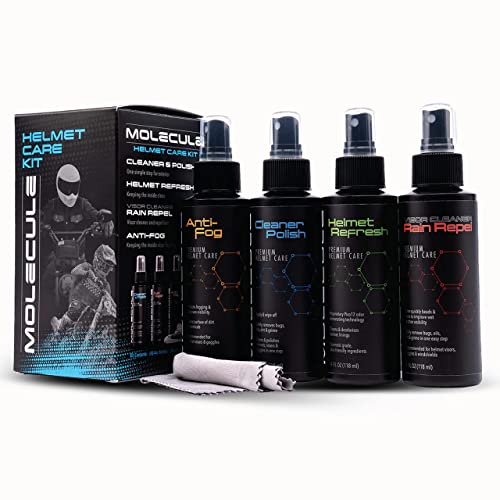 |
Best Overall | Format: 4-piece kit (Anti-Fog, Cleaner Polish, Refresh, Rain Repel), 4 ounces total (stated on listing) | Job Coverage: Visor, shell, and interior lining, all 3 jobs stated on the listing | Best For: One purchase that touches the visor, the shell, and the liner | VIEW LATEST PRICE | Read Our Analysis |
| Molecule Matte Helmet Care Kit |  |
Best for Matte Finishes | Format: 4-piece kit + 3 microfiber towels, 16 oz bottle (stated on listing) | Job Coverage: Visor, matte shell, and interior lining, all 3 jobs stated on the listing | Best For: Matte-finish shells and visors in one system | VIEW LATEST PRICE | Read Our Analysis |
| Muc-Off Motorcycle Care Duo Kit | 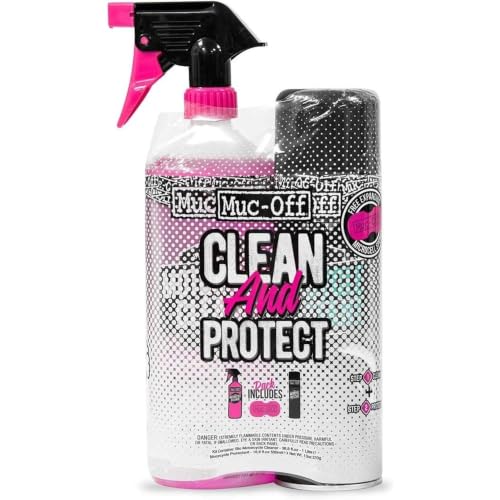 |
Best Shell & Exterior Duo | Format: 2-piece kit, Motorcycle Cleaner + Protectant spray (stated on listing) | Job Coverage: Shell and exterior only, stated on listing; not visor- or interior-specific | Best For: A whole bike-and-shell wash-and-protect routine, not just the helmet | VIEW LATEST PRICE | Read Our Analysis |
| Muc-Off Nano-Tech Motorcycle Cleaner (1L) |  |
Best Budget Single Bottle | Format: Single bottle, 1 liter (stated on listing) | Job Coverage: Shell and exterior only, general motorcycle cleaner; not visor- or interior-specific | Best For: One cheap bottle for the shell instead of a multi-piece kit | VIEW LATEST PRICE | Read Our Analysis |
| ProGold Helmet Cleaner and Deodorizer |  |
Best for Interior Liner & Odor | Format: Single 8-ounce spray bottle (stated on listing) | Job Coverage: Interior lining and odor only, stated in the product name; not visor- or shell-specific | Best For: Sweat-salt smell in the liner and cheek pads | VIEW LATEST PRICE | Read Our Analysis |
| Motorcycle Visor Lens Goggle Cleaning Kit |  |
Best Dedicated Visor Kit | Format: 30 mL spray + 2 microfiber cloths, 40x40cm and 24x24cm (stated on listing) | Job Coverage: Visor only, stated on listing; not shell- or interior-specific | Best For: A ride-pack visor kit with a clean cloth already built in | VIEW LATEST PRICE | Read Our Analysis |
| Khaki Tom Motorcycle Helmet and Visor Cleaner |  |
Best Budget Visor Cleaner | Format: Single 2-ounce spray + 1 microfiber towel, rated for 200+ sprays (stated on listing) | Job Coverage: Visor only, stated on listing; not shell- or interior-specific | Best For: The cheapest single bottle that explicitly rules out ammonia | VIEW LATEST PRICE | Read Our Analysis |
| oplace Motorcycle Helmet Dryer |  |
Best Helmet Dryer | Format: Electric dryer and rack with UV light and negative ion generator (stated on listing) | Job Coverage: Interior drying and odor only, stated on listing; does not clean the visor or shell | Best For: Actually drying a soaked liner overnight, not just spraying it | VIEW LATEST PRICE | Read Our Analysis |
More Details on Our Top Picks
Molecule Helmet Care Kit
The Molecule Helmet Care Kit is the closest thing on this list to a one-box answer, because its own feature list claims all three jobs: it "cleans and polishes helmets, visors" for the shell and visor, and separately "cleans & deodorizes helmet linings" for the interior. That is a rarer claim to find stated outright rather than implied by the word "kit."
The four-piece format (Anti-Fog, Cleaner Polish, Refresh, and Rain Repel) splits the jobs into dedicated bottles rather than one do-everything spray, which matters because a formula gentle enough for polycarbonate is not automatically the right one for a foam liner. Cleaner Polish handles the visor and shell, and Refresh is aimed at the lining specifically.
The listing does not make a matte-safe claim, so if your shell has a matte or satin finish, treat this as the gloss-shell kit and look at the Molecule Matte version below instead. It also does not print an ammonia-free or pH claim, so riders who want that reassurance in writing should check the dedicated visor picks further down.
For a rider with one glossy helmet who wants a single purchase that at least attempts all three jobs, the Molecule Helmet Care Kit is the sensible starting point.
- Format:4-piece kit (Anti-Fog, Cleaner Polish, Refresh, Rain Repel), 4 ounces total (stated on listing)
- Job Coverage:Visor, shell, and interior lining, all 3 jobs stated on the listing
- Matte Safe:Not specified by manufacturer
- Ammonia:Not specified by manufacturer
- Includes:4 separate products in one kit (stated on listing)
- Formula Notes:Cleaner Polish removes "oils, dirt & grime from visor in one easy step" (stated on listing)
- Best For:One purchase that touches the visor, the shell, and the liner
Molecule Matte Helmet Care Kit
The Molecule Matte Helmet Care Kit is the one product on this list whose listing explicitly says it will not gloss up a matte shell, describing its Matte Detailer as designed to "keep exterior of helmets clean and maintain a low luster finish." That distinction matters more than it sounds: a standard polish or wax-based detailer can leave a shiny patch on a matte finish that no amount of buffing removes.
Like the standard Molecule kit, it splits into four jobs: the Matte Detailer for the shell, Anti-Fog for the inside of the shield, Rain Repel for the visor exterior, and a Refresh spray for the interior that the listing says contains benzalkonium chloride (BKC), a sanitizing ingredient, to keep "padding, foam and helmet lining clear of odors."
It ships with three microfiber towels, a genuinely useful inclusion given how much of a "visor scratch" complaint traces back to wiping grit around with whatever rag was on the garage floor, rather than the cleaner itself. More on that below.
If your helmet's shell is matte, satin, or anything other than glossy, this is the pick that will not undo that finish while it cleans everything else.
- Format:4-piece kit + 3 microfiber towels, 16 oz bottle (stated on listing)
- Job Coverage:Visor, matte shell, and interior lining, all 3 jobs stated on the listing
- Matte Safe:Yes, Matte Detailer is built to "maintain a low luster finish" (stated on listing)
- Ammonia:Not specified by manufacturer
- Includes:3 bundled microfiber towels (stated on listing)
- Formula Notes:Refresh spray contains benzalkonium chloride (BKC), described as a sanitizing ingredient (stated on listing)
- Best For:Matte-finish shells and visors in one system
Muc-Off Motorcycle Care Duo Kit
The Muc-Off Motorcycle Care Duo is built for the bike, not specifically the helmet, and its listing is upfront about that: it is a cleaner-plus-protectant pairing meant for "basic motorbike care," not a visor or liner product. We include it because plenty of riders want one shell-and-exterior routine that covers the helmet alongside the tank and fairings, and the nano-tech formula is built for exactly that kind of general grime.
The Nano Tech Motorcycle Cleaner is described as breaking "down dirt and grime on a molecular level," and the companion Protectant spray goes on after washing to "reduce dirt adhesion" before the next ride, per the listing. Neither bottle claims a visor-safe or interior-liner-safe use case, so keep this one on shell and exterior duty.
There is no matte-safe claim on the listing either, so matte-shell owners should default to a dedicated matte product rather than assuming a general "suitable for all types of bike" cleaner is finish-neutral.
For a rider who already treats their bike and their helmet as one wash-day routine, the Duo Kit is a sensible two-bottle add rather than a helmet-specific purchase.
- Format:2-piece kit, Motorcycle Cleaner + Protectant spray (stated on listing)
- Job Coverage:Shell and exterior only, stated on listing; not visor- or interior-specific
- Matte Safe:Not specified by manufacturer
- Ammonia:Not specified by manufacturer
- Includes:Nano Tech Motorcycle Cleaner + Motorcycle Protectant (stated on listing)
- Formula Notes:Nano Tech formula, biodegradable (stated on listing)
- Best For:A whole bike-and-shell wash-and-protect routine, not just the helmet
Muc-Off Nano-Tech Motorcycle Cleaner (1L)
If a four-bottle kit is more ceremony than you want, the Muc-Off Nano-Tech 1-liter bottle is the single-product answer: one spray, described on the listing as a "fast-action, biodegradable" cleaner built around the same nano-tech grime-breakdown chemistry as the Duo Kit above, just without the protectant half.
At a full liter, it is also the largest-volume bottle on this list by a wide margin, so per-clean cost stays low even though it is not a helmet-specific product. It is a general motorcycle cleaner, and the listing does not make a visor-safe or interior-liner claim.
There is no matte-safe or ammonia-free statement on the listing, so treat it, like the Duo Kit, as a shell-and-exterior product rather than something to spray directly on a foam liner or trust blind on a matte finish.
For riders who want the fewest bottles in the garage and do not mind that this one skips the visor and interior jobs entirely, it is the straightforward budget shell cleaner in this group.
- Format:Single bottle, 1 liter (stated on listing)
- Job Coverage:Shell and exterior only, general motorcycle cleaner; not visor- or interior-specific
- Matte Safe:Not specified by manufacturer
- Ammonia:Not specified by manufacturer
- Includes:One bottle, no accessories
- Formula Notes:Nano Tech formula, described as "fast-action, biodegradable" (stated on listing)
- Best For:One cheap bottle for the shell instead of a multi-piece kit
ProGold Helmet Cleaner and Deodorizer
The ProGold Helmet Cleaner and Deodorizer names its job in the product title and does not try to be anything else: an 8-ounce spray aimed at the interior lining and the sweat-salt smell that builds up there, not the visor or the shell.
The listing itself is sparse on feature detail beyond the product name and basic package dimensions, so we are not able to cite specific claims about ammonia content, pH, or matte compatibility here, and we would rather say that plainly than imply a spec the manufacturer has not published.
That thin listing is also why this sits here as a single-job pick rather than an overall winner: it is the interior specialist for riders whose real complaint is smell, not haze or shine, and it is a lighter purchase than a full multi-bottle kit for that one job.
If the only thing wrong with your helmet is that it smells like the inside of a gym locker after every ride, this is the narrowest, cheapest fix on this list.
- Format:Single 8-ounce spray bottle (stated on listing)
- Job Coverage:Interior lining and odor only, stated in the product name; not visor- or shell-specific
- Matte Safe:Not specified by manufacturer
- Ammonia:Not specified by manufacturer
- Includes:One 8 oz spray bottle
- Formula Notes:Not specified by manufacturer beyond "cleaner and deodorizer" (stated in product name)
- Best For:Sweat-salt smell in the liner and cheek pads
Motorcycle Visor Lens Goggle Cleaning Kit
This visor-and-lens kit is built around one job and says so on the listing: a 30 mL spray plus two microfiber cloths sized for quick cleaning "in your ride pack," described as removing "dust, mud, insects from your helmet and goggles leaving a streak free finish."
The listing also states the formula is "PH neutral... as recommended by helmet manufacturers," the kind of claim that matters most on the one surface where the wrong chemistry does permanent, visible damage. It ships with two different microfiber cloths, a 40x40cm general one and a tighter-weave 24x24cm one, which covers the actual scratch risk (a dirty or gritty cloth) better than most single-cloth kits.
It does not claim an interior-liner or matte-shell use case, and the brand on the listing is generic rather than a name brand, so treat it as a pocket-size visor specialist rather than a whole-helmet solution.
For a rider who wants a small, dedicated visor kit to keep in a tank bag rather than a full at-home system, this is the compact, purpose-built pick.
- Format:30 mL spray + 2 microfiber cloths, 40x40cm and 24x24cm (stated on listing)
- Job Coverage:Visor only, stated on listing; not shell- or interior-specific
- Matte Safe:Not specified by manufacturer
- Ammonia:Not specified by manufacturer
- Includes:2 microfiber cloths, one general-purpose and one tight-weave (stated on listing)
- Formula Notes:PH neutral, biodegradable, "as recommended by helmet manufacturers" (stated on listing)
- Best For:A ride-pack visor kit with a clean cloth already built in
Khaki Tom Motorcycle Helmet and Visor Cleaner
The Khaki Tom cleaner is a single 2-ounce spray rated on the listing for "over 200 sprays," paired with one microfiber towel, and it is the only product in this list whose listing states an ammonia-free formula outright: "Alcohol-Free - Ammonia-Free - and Phosphate-Free."
That is a meaningfully different claim from most of the kits above, which simply do not mention ammonia either way. Given that ammonia-based glass cleaner is one of the specific chemicals documented to cloud and crack polycarbonate over repeated use (sourced below), a listing that states its absence outright is worth something.
The listing also says it works on "Windscreens, Action Cameras, Fairings, Mirrors and Headlights," so it is positioned as a general clear-plastic cleaner that happens to include a visor use case, not a helmet-only specialist, and it makes no claim about the interior lining or matte shells.
For the rider who wants the cheapest single bottle that explicitly rules out ammonia, this is the pick.
- Format:Single 2-ounce spray + 1 microfiber towel, rated for 200+ sprays (stated on listing)
- Job Coverage:Visor only, stated on listing; not shell- or interior-specific
- Matte Safe:Not specified by manufacturer
- Ammonia:Ammonia-free (stated on listing)
- Includes:1 microfiber towel
- Formula Notes:Alcohol-free and phosphate-free (stated on listing)
- Best For:The cheapest single bottle that explicitly rules out ammonia
oplace Motorcycle Helmet Dryer
None of the sprays above solve the problem of a liner that is still wet the next morning, which is what the oplace Helmet Dryer is built for: a turbo-airflow rack that the listing says holds its warm setting to 50C-55C (122F-131F) specifically "to avoid damaging the helmet's interior lining," with a separate cool-air mode for more delicate gear.
It also folds in an odor step: the listing describes an integrated UV light and negative ion generator plus a bundled "hat deodorizer" accessory meant to sanitize and "eliminate unpleasant odors" rather than just move air around a damp liner.
This is a device, not a cleaner, so it does nothing for a hazy visor or a dirty shell, and the listing states FCC certification rather than any helmet-specific safety standard. It is also the priciest single item on this list by a wide margin, which only makes sense if a genuinely wet liner, commuters, wet-climate riders, anyone who rides in real rain, is your actual problem.
For the specific complaint "my helmet never dries out between rides," none of the spray-and-wipe products above do what this one does.
- Format:Electric dryer and rack with UV light and negative ion generator (stated on listing)
- Job Coverage:Interior drying and odor only, stated on listing; does not clean the visor or shell
- Matte Safe:Not applicable
- Ammonia:Not applicable
- Includes:Bundled hat/helmet deodorizer accessory (stated on listing)
- Formula Notes:Warm mode 50-55C / 122-131F plus a separate cool-air mode (stated on listing)
- Best For:Actually drying a soaked liner overnight, not just spraying it
What Are the Three Jobs a Helmet Cleaning Kit Actually Has to Do?
A full helmet cleaning routine covers three separate surfaces with three different failure modes if you get the chemistry wrong: the visor or shield, the interior lining and cheek pads, and the shell and vents (with matte finishes as their own sub-case). Most single products only do one or two of those jobs well, which is why the comparison table below lists Job Coverage as its own column instead of assuming "helmet cleaner" means all three.
What Does the Visor and Shield Job Actually Need?
The visor needs a formula that will not cloud, craze, or strip an anti-fog or anti-scratch coating, because polycarbonate is chemically sensitive to exactly the products people reach for by habit (see the chemistry section below). A dedicated visor spray such as the Khaki Tom cleaner or the visor-and-lens kit above, or the visor step inside a multi-job kit like the Molecule sets, is built around that constraint. A general automotive glass cleaner is not.
What Does the Interior Liner and Cheek Pad Job Actually Need?
The interior lining needs an approach built around sweat salts, not grime, since the problem inside a helmet is body chemistry soaked into foam and fabric rather than road dirt on a hard surface. That is a deodorizing and sanitizing job more than a scrubbing one, which is exactly what the ProGold Helmet Cleaner and Deodorizer and the Refresh step in each Molecule kit are formulated for. A liner that is chronically damp or compressed from sweat buildup can also change how the helmet sits on your head and create new pressure points that were not there when it was new; if fresh hot spots show up after a ride, our guide on why your helmet hurts your head walks through the usual causes.
What Does the Shell and Vents Job Actually Need, Especially on Matte Finishes?
The shell and vents need a wash that matches the finish, and a glossy shell and a matte shell are not interchangeable here. A standard polish or wax-based detailer is built to add shine, and used on a matte or satin finish it can leave a permanent glossy patch that will not buff back out. The Molecule Matte Helmet Care Kit is the only product on this list whose listing states a matte-safe claim outright ("maintain a low luster finish"); everything else in this list without that claim should be treated as gloss-shell-safe only until you confirm otherwise on the current listing.
Why Not Just Use Whatever Cleaner Is Already in the Garage?
Purpose-made helmet cleaners exist because the two materials that make up most of a helmet, polycarbonate for the visor and shell, and EPS foam for the liner, are both chemically vulnerable to products designed for glass, metal, and grease. Household glass cleaner, brake cleaner, and automotive degreasers were never formulated with either material in mind, and the damage they cause is not always visible immediately.
Does Ammonia-Based Glass Cleaner Damage a Polycarbonate Visor?
Yes. Reporting on standard ammonia-based Windex specifically found that the ammonia in the classic formula can cloud and crack a motorcycle visor and strip anti-fog or anti-reflective coatings faster with repeated use. Industry chemical-resistance references for polycarbonate independently list ammonia and amine solutions as chemicals the material is not recommended for contact with. That is two separate sources landing on the same conclusion: ammonia and polycarbonate do not mix well over repeated exposure.
Do Solvents and Degreasers Damage a Polycarbonate Shell or Visor?
Yes, and the mechanism is well documented outside the helmet world entirely. Plastics-industry chemical-resistance guidance for polycarbonate lists ketone and aromatic hydrocarbon solvents, such as acetone, benzene, and related degreaser ingredients, as substances that can make the material swell, discolor, or crack under stress, sometimes at very low stress levels. Brake cleaner, lacquer thinner, and many household degreasers draw on exactly that chemical family, which is why they belong nowhere near a polycarbonate shell or visor regardless of how effective they are at cutting grease on metal.
Can Petroleum-Based Cleaners Damage the EPS Foam Inside a Helmet?
Yes, and here the damage can be dramatic rather than subtle. EPS foam is a form of expanded polystyrene, and petroleum-based solvents such as gasoline are hydrocarbon solvents that dissolve polystyrene through a straightforward "like dissolves like" mechanism, breaking down the weak intermolecular forces that hold the foam's polymer chains together and collapsing the trapped-air structure that makes EPS work as an impact liner in the first place. That is the same basic chemistry, at a smaller and slower scale, in any solvent-heavy degreaser that finds its way onto or into a foam liner, which is exactly why none of the interior products on this list are solvent-based sprays.
Is It the Cleaner or the Cloth That Scratches a Visor?
Usually the cloth, not the cleaner. Helmet-care guidance from retailers echoes a consistent point: a lot of visor scratches come from rubbing grit and dirt around with a dirty, dry, or rough cloth, not from any chemical reaction with the cleaning spray itself. That is why several of the kits above bundle a dedicated microfiber towel rather than assuming you already own a clean one, and it is also why a quick rinse before wiping, and a clean cloth every time, matters more than which bottle you bought. If scratches are already there, our guide to removing scratches from a helmet visor covers what can and cannot be buffed out.
Do You Need a Full Kit, or Just Three Separate Bottles?
Either works, and a "cleaning kit" is usually just the three jobs above bundled into shared packaging rather than a single formula that does everything. Buying the three pieces separately, a visor spray, an interior deodorizer like the ProGold, and a shell cleaner like the Muc-Off Nano-Tech, covers the same ground and lets you skip whatever job you genuinely do not need, such as a rider with a glossy shell skipping the matte detailer entirely, or a rider who stores the helmet properly between rides skipping the dryer. Our guide on when to replace a motorcycle helmet covers helmet storage and cleaning as part of the full lifespan picture, which is worth reading alongside this page if you are trying to get the most life out of the helmet you already own.
What We Did and Did Not Test
Our research desk did not run these cleaners on a shelf of helmets side by side. What we did: pulled every product claim in this article directly from each listing's own title and feature text via the Amazon Creators API, and where a listing did not state a claim (matte-safe, ammonia-free, pH, or otherwise), we said so rather than assuming it. The general chemistry claims about ammonia, solvents, and polycarbonate and EPS foam are sourced separately from plastics-industry chemical-resistance references and independent reporting on ammonia-based glass cleaner and helmet plastics, not from any single manufacturer's marketing copy, and we read that material directly rather than repeating what another gear site said about it. Prices, star ratings, and review counts change too often to print reliably here, so none appear in this article; check current figures on the retailer's page before buying.
Helmet Cleaning Kit Comparison
| Kit | Format | Job Coverage | Matte Safe | Ammonia | Best For |
|---|---|---|---|---|---|
| Molecule Helmet Care Kit | 4-piece kit (Anti-Fog, Cleaner Polish, Refresh, Rain Repel), 4 ounces total (stated on listing) | Visor, shell, and interior lining, all 3 jobs stated on the listing | Not specified by manufacturer | Not specified by manufacturer | One purchase that touches the visor, the shell, and the liner |
| Molecule Matte Helmet Care Kit | 4-piece kit + 3 microfiber towels, 16 oz bottle (stated on listing) | Visor, matte shell, and interior lining, all 3 jobs stated on the listing | Yes, Matte Detailer is built to "maintain a low luster finish" (stated on listing) | Not specified by manufacturer | Matte-finish shells and visors in one system |
| Muc-Off Motorcycle Care Duo Kit | 2-piece kit, Motorcycle Cleaner + Protectant spray (stated on listing) | Shell and exterior only, stated on listing; not visor- or interior-specific | Not specified by manufacturer | Not specified by manufacturer | A whole bike-and-shell wash-and-protect routine, not just the helmet |
| Muc-Off Nano-Tech Motorcycle Cleaner (1L) | Single bottle, 1 liter (stated on listing) | Shell and exterior only, general motorcycle cleaner; not visor- or interior-specific | Not specified by manufacturer | Not specified by manufacturer | One cheap bottle for the shell instead of a multi-piece kit |
| ProGold Helmet Cleaner and Deodorizer | Single 8-ounce spray bottle (stated on listing) | Interior lining and odor only, stated in the product name; not visor- or shell-specific | Not specified by manufacturer | Not specified by manufacturer | Sweat-salt smell in the liner and cheek pads |
| Motorcycle Visor Lens Goggle Cleaning Kit | 30 mL spray + 2 microfiber cloths, 40x40cm and 24x24cm (stated on listing) | Visor only, stated on listing; not shell- or interior-specific | Not specified by manufacturer | Not specified by manufacturer | A ride-pack visor kit with a clean cloth already built in |
| Khaki Tom Motorcycle Helmet and Visor Cleaner | Single 2-ounce spray + 1 microfiber towel, rated for 200+ sprays (stated on listing) | Visor only, stated on listing; not shell- or interior-specific | Not specified by manufacturer | Ammonia-free (stated on listing) | The cheapest single bottle that explicitly rules out ammonia |
| oplace Motorcycle Helmet Dryer | Electric dryer and rack with UV light and negative ion generator (stated on listing) | Interior drying and odor only, stated on listing; does not clean the visor or shell | Not applicable | Not applicable | Actually drying a soaked liner overnight, not just spraying it |
Frequently Asked Questions
What should you never use to clean a motorcycle helmet visor?
Skip ammonia-based glass cleaner, brake cleaner, acetone, gasoline, and other solvents on a polycarbonate visor. Ammonia is documented to cloud and crack polycarbonate and strip anti-fog or anti-reflective coatings with repeated use, and ketone or aromatic solvents like acetone are known to make polycarbonate swell, discolor, or crack under stress. Stick with a product that states it is visor-safe, such as a dedicated visor cleaner or one of the multi-job kits above.
Is Windex safe on a motorcycle helmet visor?
Standard ammonia-based Windex is not a safe long-term choice for a polycarbonate visor. Reporting on the product notes the ammonia in the classic formula can cloud the shield and crack it with repeated use, and strip anti-fog or anti-reflective coatings faster than a helmet-specific cleaner would. An ammonia-free glass cleaner is a smaller risk, but a purpose-made visor cleaner such as the Khaki Tom spray or the dedicated visor kit above avoids the question entirely.
What actually scratches a motorcycle visor, the cleaner or the cloth?
Most of the time it is the cloth, not the cleaner. Helmet-care guidance from retailers points out that a lot of visor scratches come from rubbing grit and dirt around with a dirty or rough cloth, not from any chemical reaction with the cleaning spray itself. That is why several of the kits above bundle a dedicated microfiber towel rather than assuming you already own a clean one; if scratches already happened, our guide to removing scratches from a helmet visor covers what can be buffed out.
Do you need a matte-specific cleaner for a matte helmet shell?
Yes, if the shell is not glossy. A standard polish or wax-based detailer can leave a shiny patch on a matte or satin finish that will not buff back out, since it is designed to add gloss rather than preserve a low-luster look. The Molecule Matte Helmet Care Kit states its Matte Detailer is built to "maintain a low luster finish," the specific claim a matte-shell product needs to make.
Can you use brake cleaner or a household degreaser on a helmet?
No. Household degreasers and automotive solvents like brake cleaner are formulated for metal and grease, not polycarbonate or EPS foam. Petroleum-based solvents are documented to dissolve polystyrene-family foams (the same chemistry as EPS) by breaking down the polymer's structure, and similar aggressive solvents are known to craze or crack polycarbonate. Neither type of damage is reversible once it happens.
Do you need to buy a full cleaning kit, or can you buy the pieces separately?
A "helmet cleaning kit" is usually just three small bottles, a visor cleaner, an interior or liner spray, and a shell wash, bundled together with shared packaging. Buying the three jobs separately, such as a dedicated visor spray, a liner deodorizer like the ProGold, and a general shell cleaner like the Muc-Off Nano-Tech, covers the same ground and lets you skip whichever job you do not actually need.
DOT vs ECE vs Snell vs MIPS, how to pick the right lid in 60 seconds, and when to replace it. One page, no fluff.
