

Affiliate disclosure As an Amazon Associate we earn from qualifying purchases, at no extra cost to you.
Most motorcycle helmets leave the comms question as homework. You pick the helmet, then you go figure out where to mount a Sena or Cardo on the outside of it, route the cables, and hope the speakers fit your ear canal geometry. A built-in bluetooth motorcycle helmet skips all of that by baking the intercom hardware directly into the liner, so the controls are in the right place, the audio is tuned for the shell, and there are no stick-on clamps to rattle loose on the freeway.
For this guide our research desk worked through the major integrated-comms helmets available on Amazon, focusing on three questions: is the bluetooth system actually built in (not a clip-on kit), does the helmet carry a real safety certification, and how does the comms hardware stack up as a daily-use tool for music, phone, and rider-to-rider communication? We landed on eight helmets, from Sena's flagship mesh-plus-bluetooth full-face down to the budget DOT flip-ups that introduced a lot of riders to the category. If you are still deciding whether a helmet intercom is right for your riding style, our piece on why riders use helmet intercoms on and off road lays out the full case before you commit.
A quick note on the big distinction in this space: there are helmets with integrated bluetooth intercoms (the hardware is built into the liner and cannot be removed) and there are helmets with speaker pockets designed to accept an aftermarket unit like a Sena 50S. The eight helmets below all belong to the first group. If you already own a Cardo or Sena puck and just want a compatible shell, see our modular helmet guide for the add-on-ready options.
Key Takeaways
- The Sena Outrush 2 is the benchmark integrated-comms modular: Mesh Intercom 3.0 plus bluetooth, WAVE cross-brand compatibility, and DOT/P/J dual homologation. It is the one to beat in 2026.
- Mesh intercom and point-to-point bluetooth are different technologies. Mesh (Sena Outrush 2, Sena Stryker, Sena Cavalry 2) creates a self-healing group network with no pairing daisy-chain. Bluetooth intercom (ILM, FreedConn) requires rider-to-rider pairing and has a hard range limit.
- DOT (FMVSS 218) is self-certification. The Sena Outrush 2 adds P/J dual homologation so it passes the flip-up modular standard with chin bar up and down. The ScorpionEXO Covert FX is the only pick here also certified to ECE 22.06, the independently tested European standard.
- Budget integrated-comms helmets (ILM 953, FreedConn BM2-S) use Bluetooth 3.0 and top out at roughly 500m rider-to-rider range. The premium Sena units run Bluetooth 5.0 and Mesh for virtually unlimited group range over cellular (WAVE feature).
- Battery life varies widely: 8 hours on budget picks (ILM 953, FreedConn BM2-S) up to 14 hours on the ILM 159BT and the Sena Cavalry 2. Factor in your typical riding day before committing.
| Sena Outrush 2 |  |
Best Overall Integrated Comms | Type: Modular (flip-up) | Comms: Mesh Intercom 3.0 + Bluetooth 5.x; WAVE cross-brand intercom | Best for: Touring and group rides where you want mesh group comms and phone connectivity in one shell | VIEW LATEST PRICE | Read Our Analysis |
| Sena Stryker |  |
Best Full-Face Integrated Comms | Type: Full-face | Comms: Mesh Intercom + Bluetooth; SOUND by Harman Kardon | Best for: Full-face riders who want premium audio and the LED taillight safety feature | VIEW LATEST PRICE | Read Our Analysis |
| Sena Outrush R |  |
Best Value Sena Modular | Type: Modular (flip-up) | Comms: 4-Way Bluetooth 5.0 Intercom; 2-Way HD Intercom | Best for: Sena-ecosystem group riders who want a Sena modular at a step below the Outrush 2 | VIEW LATEST PRICE | Read Our Analysis |
| Sena Cavalry 2 |  |
Best Half Helmet Integrated Comms | Type: Half helmet | Comms: Mesh Intercom + Bluetooth 5.2; Hands-Free Profile (HFP) | Best for: Cruiser and touring riders who prefer a half helmet but want integrated mesh comms | VIEW LATEST PRICE | Read Our Analysis |
| ILM 159BT |  |
Best Budget Upgraded BT | Type: Modular (flip-up) | Comms: Bluetooth 5.0; up to 2-3 rider intercom; Pinlock30-ready outer visor | Best for: Solo riders who want the longest battery life in a budget integrated-comms helmet | VIEW LATEST PRICE | Read Our Analysis |
| ILM 953 | 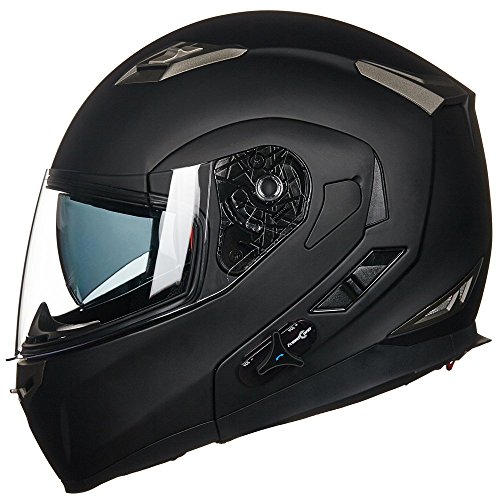 |
Best Entry-Level Integrated BT | Type: Modular (flip-up) | Comms: Bluetooth 3.0; 1680 ft (512m) 2-rider intercom | Best for: First integrated-comms helmet on the tightest budget | VIEW LATEST PRICE | Read Our Analysis |
| FreedConn BM2-S (2024) | 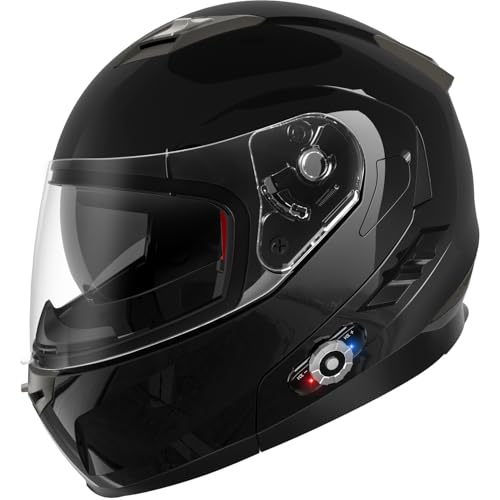 |
Best FreedConn Upgraded Model | Type: Modular (flip-up) | Comms: Bluetooth 5.0; 1680 ft (512m) intercom for 2-3 riders | Best for: FreedConn ecosystem riders upgrading from BT 3.0 to BT 5.0 | VIEW LATEST PRICE | Read Our Analysis |
| FreedConn BM2-S Classic | 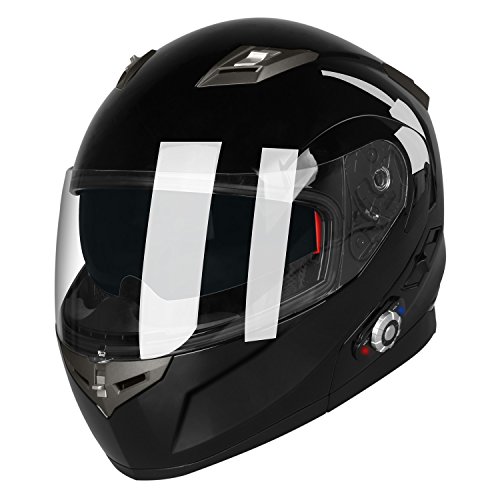 |
Lowest-Cost DOT Integrated BT | Type: Modular (flip-up) | Comms: Bluetooth 3.0; 1640 ft (500m) intercom for 2-3 riders | Best for: Lowest-cost entry point into integrated-comms modular helmets | VIEW LATEST PRICE | Read Our Analysis |
More Details on Our Top Picks
-
Sena Outrush 2
The Outrush 2 is the helmet that makes the strongest case for ditching the aftermarket puck altogether. Sena baked in Mesh Intercom 3.0 alongside standard bluetooth, which means you get the self-healing group network that mesh riders have been raving about, without needing a separate clip-on unit. The WAVE Intercom feature extends that further: it lets the helmet talk to any brand's headset over the cellular network, which is a genuine first for an integrated-comms helmet at this tier.
The modular design carries P/J dual homologation, meaning it meets DOT FMVSS 218 with the chin bar in both positions. That is not guaranteed on every flip-up, and it matters if you plan to ride with the chin bar raised in traffic. The retractable sun visor and Intelligent Power Management (which kills the unit after you park and forget it) are the kind of details you notice after a month of daily use rather than in a spec sheet comparison.
Sena's 2nd Generation HD speakers are genuinely good for helmet audio. The acoustic dampening padding is designed around them, so you are not just cramming generic drivers into liner cutouts. At highway speed the noise cancellation holds up better than the older Outrush R, which owners consistently note was the weak spot on the previous generation.
The main thing to know going in: the Outrush 2 is a Sena ecosystem helmet. If your riding partner runs Cardo, the WAVE feature covers the gap, but it requires cellular coverage on both ends. For a group entirely on Sena hardware it is seamless. It is also one of the pricier picks in this list, but it is the only integrated-comms modular here with both mesh and WAVE capability.
- Type:Modular (flip-up)
- Comms:Mesh Intercom 3.0 + Bluetooth 5.x; WAVE cross-brand intercom
- Certification:DOT FMVSS 218; P/J dual homologation
- Battery:Intelligent Power Management; auto-off when stationary
- Audio:2nd Gen HD speakers
- Best for:Touring and group rides where you want mesh group comms and phone connectivity in one shell
-
Sena Stryker
The Stryker is Sena's full-face answer to the Outrush 2's modular, and it makes a different trade: you keep the chin bar down at all times and gain a SOUND by Harman Kardon audio setup and an integrated LED taillight. The Harman Kardon partnership is not just a badge. The premium padding is acoustically dampened specifically for those speakers, and owners who care about music quality on long rides consistently note the difference.
The integrated mesh and bluetooth system mirrors the Outrush 2's connectivity architecture. You get group mesh comms, bluetooth phone and GPS audio, and the retractable sun visor so you are not fumbling a separate face shield insert in changing light. The magnetic Pogo charging port is a cleaner solution than micro-USB flaps on budget helmets that always seem to fail in year two.
The LED taillight is a polarising feature. Some riders find it genuinely useful for daytime visibility in heavy traffic; others think it looks like a toy. It runs off the helmet's battery, so it is integrated rather than a separate gadget. If you commute in traffic daily and want every visibility edge, it earns its place. If you are a weekend canyon rider, it matters less. Riders who document their rides should also look at our best helmets for motovlogging roundup, which focuses on quiet shells and chin-mount camera compatibility alongside integrated audio.
DOT only here, no ECE 22.06, which is worth flagging if you also ride in Europe. The full-face form is the right choice for sport and commuter riders who are not buying the modular for a specific reason. For anyone who regularly wants open-face airflow, the Outrush 2 makes more sense. Riders who want to mount an action camera should see our best helmet camera guide for mount types and camera picks that work alongside a full-face shell.
- Type:Full-face
- Comms:Mesh Intercom + Bluetooth; SOUND by Harman Kardon
- Certification:DOT FMVSS 218
- Battery:Magnetic Pogo charging port
- Visibility:LED taillight; retractable sun visor
- Best for:Full-face riders who want premium audio and the LED taillight safety feature
-
Sena Outrush R
The Outrush R is the previous-generation Sena modular, and it remains a legitimate pick if you do not need mesh or WAVE. It runs 4-way Bluetooth intercom with 2-way HD mode and Bluetooth 5.0, which puts it several steps above the budget ILM and FreedConn options in audio quality and range. The QR-code Smart Intercom Pairing via the Sena Utility App makes group setup fast compared to button-sequence pairing on older units.
The retractable sun visor and DOT certification carry over from the Outrush 2's architecture. The three-button left-side control layout is familiar to anyone who has used a Sena puck on a previous helmet, so the learning curve is minimal. Build quality is solidly mid-premium: better than the budget Chinese flip-ups, not quite the material feel of the flagship Stryker.
Where owners are consistent in criticism: wind noise at highway speeds is higher than the Outrush 2, and the speaker audio quality is noticeably behind the Harman Kardon-equipped Stryker. If your primary use is voice calls and GPS audio rather than music listening, neither issue is a dealbreaker. If long-ride music is important, the Stryker or Outrush 2 audio hardware is worth the premium.
As the step-down Sena modular it undercuts the Outrush 2 meaningfully while keeping the brand's reliability and app ecosystem. For riders who want the Sena name and group intercom but are not doing the mesh-network group rides where the Outrush 2's upgrade is most apparent, the Outrush R is the practical choice.
- Type:Modular (flip-up)
- Comms:4-Way Bluetooth 5.0 Intercom; 2-Way HD Intercom
- Certification:DOT FMVSS 218
- Battery:Standard; three-button left-side control
- Pairing:Smart Intercom Pairing via QR code + Sena Utility App
- Best for:Sena-ecosystem group riders who want a Sena modular at a step below the Outrush 2
-
Sena Cavalry 2
The Cavalry 2 makes an unusual case: it combines the open-air feel of a half helmet with the same mesh-plus-bluetooth connectivity architecture as the Outrush 2. The composite fiberglass shell is a construction step above the ABS budget helmets, and DOT FMVSS 218 certification applies. The EPS padding integrates the microphone and speakers without the visible puck that external clip-on units create.
Mesh Intercom with Bluetooth 5.2 means the group connectivity story here is identical to the Outrush 2: self-healing mesh network for rider groups, standard bluetooth for phone and GPS. The Hands-Free Profile (HFP) is the specific bluetooth spec that handles phone calls cleanly, so it is the right pick for riders who take a lot of calls.
The half-helmet form is the right form factor for a specific type of rider. Cruiser and touring riders, particularly those who never wanted a full-face, are the audience here. Wind noise at highway speeds will always be higher than a full-face or modular by geometry alone, and microphone pickup is harder in an open environment. The Cavalry 2 addresses it with EPS-integrated mic placement, but it is not a neutral noise environment.
The aerodynamic removable visor and D-ring retention system are standard-appropriate details. This is not a sport-riding helmet and is not positioned as one. For the rider who was never going to wear a full-face and wanted integrated mesh comms in a half shell, the Cavalry 2 is the only mainstream option currently worth recommending.
- Type:Half helmet
- Comms:Mesh Intercom + Bluetooth 5.2; Hands-Free Profile (HFP)
- Shell:Composite fiberglass
- Certification:DOT FMVSS 218
- Closure:D-ring nylon strap
- Best for:Cruiser and touring riders who prefer a half helmet but want integrated mesh comms
-
ILM 159BT
ILM's 159BT is the upgrade over the older 953 in two meaningful ways: Bluetooth 5.0 instead of 3.0, and a claimed 14-hour talk time that outpaces everything else in the budget tier. The Pinlock30-ready outer visor is an unusual spec at this price and useful for cold-weather commuters who deal with fogging.
The intercom range for 2-3 riders stays in the ILM ecosystem, which is the constraint that applies to every budget integrated-comms helmet in this list. ILM helmets talk to other ILM helmets via their proprietary intercom system. Bluetooth phone pairing with any device works fine. If all your regular riding partners are also ILM helmet owners, the group comms work as advertised. If they run Sena or Cardo, you are calling their phone number, not the mesh network.
DOT FMVSS 218 applies, ABS shell and multi-vent design are standard for the price tier. The flip-up chin bar locks in both positions and the inner sun visor deploys on a lever. Build quality is a step above the FreedConn in finish feel but not by a wide margin. The sweat-absorbing liner uses upgraded fabric versus the 953 and removes easily for washing.
The 14-hour battery claim is the standout spec here, and it is the reason to choose the 159BT over the 953 if you are buying for solo commuting with music and phone audio rather than multi-rider intercom. For group riding, the Sena options pull ahead on interoperability.
- Type:Modular (flip-up)
- Comms:Bluetooth 5.0; up to 2-3 rider intercom; Pinlock30-ready outer visor
- Certification:DOT FMVSS 218
- Battery:14 hours talk time
- Visor:Dual visor (Pinlock30-ready outer + inner sun visor)
- Best for:Solo riders who want the longest battery life in a budget integrated-comms helmet
-
ILM 953
The ILM 953 is the helmet that introduced a lot of riders to built-in bluetooth, and it has been on Amazon long enough to have a real review trail behind it. The case for it is simple: DOT-certified flip-up with Bluetooth 3.0 intercom, FM radio, MP3 and GPS audio, all included rather than bolted on after the fact. For a rider coming from zero intercom experience, the learning curve is minimal.
Bluetooth 3.0 means the range and audio quality ceiling is lower than the newer 5.0 units. The 1680-foot (roughly 512m) intercom range is real-world adequate for riding in close formation but will drop out if the group spreads across a long straight. DSP echo cancellation and noise suppression technology help considerably at highway speed, and owners consistently rate call clarity as acceptable rather than exceptional.
The 8-hour battery is the other constraint to know up front. It covers most day rides comfortably, but a 600-mile touring day requires a charge mid-route. The battery also has a quirk common to this price tier: deep sleep mode activates if the unit sits unused for extended periods, requiring a 30-minute wake-up charge. ILM documents this in the manual but it surprises first-time users.
It runs one size smaller than standard due to the integrated bluetooth module, so order up from your normal helmet size. The microfiber liner is washable. For a rider who wants integrated comms without spending Sena money and primarily rides solo or with one regular partner, the 953 still does what it says at a price that is hard to dispute.
- Type:Modular (flip-up)
- Comms:Bluetooth 3.0; 1680 ft (512m) 2-rider intercom
- Certification:DOT FMVSS 218
- Battery:8 hours talk time; 110 hours standby
- Audio:DSP echo cancellation + noise suppression
- Best for:First integrated-comms helmet on the tightest budget
-
FreedConn BM2-S (2024)
FreedConn updated the BM2-S to Bluetooth 5.0 in 2023, which is the version to buy if you are in this price range. The bluetooth upgrade matters for connection stability and pairing speed, even though the intercom range ceiling stays similar to the Bluetooth 3.0 version at 1680 feet for two riders. The 300-hour standby time is a genuine step up from the older spec.
The helmet uses a same-shell approach with interchangeable padding in different thicknesses to handle sizing rather than separate size-specific shells. FreedConn recommends ordering one size larger than normal, a recurring note across integrated-comms flip-ups where the bluetooth module eats some headroom. The outer shell is ABS, dual visor deploys on a lever, and three-way ventilation is standard for the tier.
Intercom compatibility is tighter than Sena's ecosystem: BM2-S helmets talk to other BM2-S and BM12 FreedConn helmets. The older Bluetooth 3.0 and newer Bluetooth 5.0 versions can pair, with the newer version initiating the connection. Cross-brand intercom to Sena or Cardo is not directly supported. This is the same constraint as ILM, and it is worth knowing before buying into the ecosystem.
The 8-10 hour battery covers most use cases, and the 300-hour standby means a helmet sitting in a garage for two weeks does not require a wake-up charge the way the ILM 953 sometimes does. Build quality and audio are roughly even with the ILM 159BT. The choice between them often comes down to which ecosystem your current riding partners use.
- Type:Modular (flip-up)
- Comms:Bluetooth 5.0; 1680 ft (512m) intercom for 2-3 riders
- Certification:DOT FMVSS 218
- Battery:8-10 hours talk time; 300 hours standby
- Visor:Dual visor; 3-way ventilation
- Best for:FreedConn ecosystem riders upgrading from BT 3.0 to BT 5.0
-
FreedConn BM2-S Classic
The original BM2-S Classic is the lower-cost entry point in the FreedConn lineup, running Bluetooth 3.0 with a single multi-function button control. The one-button interface is the defining feature here: answer/reject calls, play/pause music, activate Siri, and switch between intercom and phone audio all from a single button. It is a simplified control scheme compared to the three-button Sena layout, and most owners find it faster to learn.
DOT FMVSS 218 applies. The flip-up chin bar, dual visor, and washable liner are consistent with the rest of the budget integrated-comms category. The upgrade package includes riding gloves in the same size as the helmet, which is either a pleasant bonus or a strange combo depending on your view.
Bluetooth 3.0 and 110-hour standby are the technical limits to know. The 500m intercom range for 2-3 riders (FreedConn ecosystem only) is the same ceiling as the ILM 953. Call quality with DSP echo cancellation is adequate at city and secondary-road speeds; sustained highway riding above 80 mph introduces more wind noise than the newer 5.0 units handle.
The honest recommendation here is the same as for the ILM 953: if the 2024 BM2-S or ILM 159BT is within reach, buy those instead. The Bluetooth 5.0 connection stability and battery improvements are meaningful. But if budget is the hard constraint and you want a DOT-certified integrated-comms flip-up, the BM2-S Classic is a proven product that does what it claims.
- Type:Modular (flip-up)
- Comms:Bluetooth 3.0; 1640 ft (500m) intercom for 2-3 riders
- Certification:DOT FMVSS 218
- Battery:8 hours intercom; 110 hours standby
- Controls:1 multi-function button; Siri voice command
- Best for:Lowest-cost entry point into integrated-comms modular helmets
How to Choose a Bluetooth Motorcycle Helmet
The category splits two ways before you get to any other spec: do you want a helmet with a built-in comms system, or a communications-ready shell designed to accept an aftermarket unit? The eight helmets above are all built-in. Here is what matters when choosing between them.
Integrated Comms vs Add-On Intercom: Know What You Are Buying
A helmet with a built-in bluetooth intercom (the Sena Outrush 2, ILM 953, FreedConn BM2-S) has the speakers, microphone, and control unit permanently housed in the liner. Nothing mounts on the outside. A communications-ready helmet (ScorpionEXO Covert FX, most Shoei or Arai shells) has speaker pockets cut into the liner for you to drop a Sena 50S or Cardo Packtalk into later. The add-on approach costs more in total but lets you upgrade the intercom without changing the helmet. The built-in approach is cheaper upfront, simpler day-to-day, and limits your intercom to whatever is baked in. Most riders in this category pick built-in for the simplicity. See our guide to helmet communication systems if you want the full breakdown of aftermarket add-on options alongside the integrated picks. If your bike already has a stereo or if you are on a touring-oriented Harley, a standalone Harley-Davidson Bluetooth motorcycle headset that mounts to any helmet is worth comparing before you commit to an integrated lid.
Bluetooth vs Mesh Intercom: Two Very Different Technologies
Standard bluetooth intercom (ILM 953, FreedConn BM2-S) works like a long-range walkie-talkie: you pair Helmet A to Helmet B, and they talk within a range of roughly 500-1680 feet depending on the unit. Add a third helmet, you daisy-chain through Helmet B. Lose the connection and you re-pair manually. Mesh intercom (Sena Outrush 2, Sena Stryker, Sena Cavalry 2) is a self-organizing network: all helmets in range discover each other automatically, the signal routes around any single dropped node, and there is no pairing sequence. For group rides above four riders, mesh is the meaningful upgrade. For solo riders or consistent two-up riding, standard bluetooth intercom is fully adequate and significantly cheaper.
Intercom Range and Cross-Brand Compatibility
The range numbers on integrated-comms helmets ("up to 1680 feet") assume clear line of sight with no obstacles. Real-world group riding in terrain cuts those figures substantially. More importantly, most budget integrated helmets are brand-locked: ILM helmets talk to ILM helmets, FreedConn to FreedConn. Sena units add WAVE Intercom (over cellular) and mesh, which effectively extends compatibility to any brand. If your regular riding group uses a mix of helmet brands, the Sena picks are the practical choice. If everyone is buying new helmets together, the budget brands work fine within their own ecosystem. For a full comparison of modular helmet designs and their intercom mounting options, see that guide.
Battery Life and Audio Quality
Budget integrated-comms helmets (ILM 953, FreedConn BM2-S Classic) typically offer 8-hour talk time and 110-hour standby. That covers most day rides with margin. The ILM 159BT extends to 14 hours. Sena's units do not always publish exact battery figures but add Intelligent Power Management that auto-shuts the system when the helmet is stationary. On audio quality, Bluetooth 3.0 units are adequate for calls and GPS audio but noticeably compressed for music. Bluetooth 5.0 units (ILM 159BT, FreedConn BM2-S 2024) are better. The Sena Stryker's Harman Kardon setup is the clear leader in this list for music listeners. Battery deep-sleep mode is a recurring quirk on Bluetooth 3.0 helmets left unused for weeks: they require a 30-minute wake-up charge before pairing. If your helmet sits in a garage between seasonal rides, factor that in.
Certification: What DOT Actually Means vs ECE 22.06
Every helmet in this list carries DOT FMVSS 218. That matters, but it is worth knowing that DOT is self-certification: the manufacturer tests their own helmets and declares compliance. Nobody from the government verifies it. ECE 22.06 (the current European standard) requires independent laboratory testing across a wider impact test matrix including rotational impact scenarios. The Sena Outrush 2 adds P/J dual homologation, which tests the flip-up modular in both chin-bar-up and chin-bar-down positions. If you travel internationally or simply want the stricter tested standard, check our helmet replacement guide for how ECE and DOT certification age over time and what to look for.
Bluetooth Motorcycle Helmet Comparison
| Helmet | Type | Comms | Certification | Best For |
|---|---|---|---|---|
| Sena Outrush 2 | Modular (flip-up) | Mesh Intercom 3.0 + Bluetooth 5.x; WAVE cross-brand intercom | DOT FMVSS 218; P/J dual homologation | Touring and group rides where you want mesh group comms and phone connectivity in one shell |
| Sena Stryker | Full-face | Mesh Intercom + Bluetooth; SOUND by Harman Kardon | DOT FMVSS 218 | Full-face riders who want premium audio and the LED taillight safety feature |
| Sena Outrush R | Modular (flip-up) | 4-Way Bluetooth 5.0 Intercom; 2-Way HD Intercom | DOT FMVSS 218 | Sena-ecosystem group riders who want a Sena modular at a step below the Outrush 2 |
| Sena Cavalry 2 | Half helmet | Mesh Intercom + Bluetooth 5.2; Hands-Free Profile (HFP) | DOT FMVSS 218 | Cruiser and touring riders who prefer a half helmet but want integrated mesh comms |
| ILM 159BT | Modular (flip-up) | Bluetooth 5.0; up to 2-3 rider intercom; Pinlock30-ready outer visor | DOT FMVSS 218 | Solo riders who want the longest battery life in a budget integrated-comms helmet |
| ILM 953 | Modular (flip-up) | Bluetooth 3.0; 1680 ft (512m) 2-rider intercom | DOT FMVSS 218 | First integrated-comms helmet on the tightest budget |
| FreedConn BM2-S (2024) | Modular (flip-up) | Bluetooth 5.0; 1680 ft (512m) intercom for 2-3 riders | DOT FMVSS 218 | FreedConn ecosystem riders upgrading from BT 3.0 to BT 5.0 |
| FreedConn BM2-S Classic | Modular (flip-up) | Bluetooth 3.0; 1640 ft (500m) intercom for 2-3 riders | DOT FMVSS 218 | Lowest-cost entry point into integrated-comms modular helmets |
DOT vs ECE vs Snell vs MIPS, how to pick the right lid in 60 seconds, and when to replace it. One page, no fluff.
If you would rather keep the helmet you own and add comms to it, see our picks for the best motorcycle Bluetooth intercoms.
The Premium Route: Pair a Quiet Helmet With a Mesh Intercom
Every helmet on this list has its Bluetooth built in, which keeps the price down and the setup simple. Integrated modules do have a ceiling, though: they top out at mid-tier range and audio, and when the electronics date, the whole helmet dates with them. Riders who want the longest range, the best sound, and group talk that holds together take a different route. They buy a quiet, well-built helmet and add a standalone mesh intercom.
A dedicated mesh unit such as the Cardo Packtalk Edge or the Sena 50S out-ranges and out-connects any built-in module, and it moves to your next helmet instead of being retired with the old one. The one catch is that mesh only links riders on the same brand's network, so a group has to agree on Cardo or on Sena rather than mixing the two.
For the full breakdown of mesh and Bluetooth units by rider count, see our best motorcycle Bluetooth intercom guide. A quieter shell also makes any intercom easier to hear at speed, so for the helmet half of the pairing start with our quietest motorcycle helmet picks.
Frequently Asked Questions
What is the difference between a built-in bluetooth helmet and one that is bluetooth-ready?
A built-in bluetooth helmet (like the Sena Outrush 2 or ILM 953) has the speakers, microphone and control unit permanently integrated into the liner. A bluetooth-ready helmet has speaker pockets designed to accept an aftermarket intercom unit such as a Sena 50S or Cardo Packtalk Bold. Built-in is simpler and cheaper upfront. Add-on lets you upgrade the comms hardware without replacing the helmet.
Can I use a Sena bluetooth helmet to talk to a rider wearing a FreedConn or ILM helmet?
Not via the helmet intercom channel. Budget integrated-comms helmets (ILM, FreedConn) use proprietary bluetooth intercom that only pairs within the same brand's ecosystem. Sena helmets can communicate with other brands via the WAVE Intercom feature (which routes the call over the cellular network rather than direct radio), but that requires cellular coverage on both ends and the Sena Utility App. If cross-brand group riding is important, the Sena Outrush 2's WAVE capability is the cleanest current solution.
Is mesh intercom worth the premium over bluetooth intercom?
For groups of three or more riders, almost certainly yes. Mesh intercom (Sena's system on the Outrush 2, Stryker, and Cavalry 2) creates a self-organizing network where all riders in range are in one channel, with no pairing sequence and no daisy-chain to lose. Standard bluetooth intercom requires pairing Helmet A to Helmet B to Helmet C sequentially, and a mid-ride dropout means re-pairing manually while parked. For solo or consistent two-rider use, standard bluetooth intercom is fully adequate at a much lower price.
Does DOT certification cover the chin bar on a modular helmet?
Standard DOT FMVSS 218 testing is done with the chin bar closed. Some modular helmets carry additional P/J dual homologation (as the Sena Outrush 2 does), which tests the helmet with the chin bar in both positions. If you regularly ride with the chin bar raised, P/J dual homologation is the spec to look for. Helmets without it are only certified in full-face mode, regardless of what the marketing copy implies.
How often should I replace a bluetooth motorcycle helmet?
The same rules apply as any other motorcycle helmet: replace immediately after any impact, even if the shell looks undamaged, because EPS foam compresses once and does not recover. Absent a crash, most manufacturers and the Snell Foundation recommend replacement every five years as foam, liner materials and retention systems age. The integrated electronics do not change that timeline. See our full guide on when to replace a motorcycle helmet for the full breakdown of wear indicators and certification aging.
